
Crosslist from WooCommerce to Poshmark — FLUF’s WordPress Plugin for Multi-Marketplace Selling
The WordPress plugin that lists your WooCommerce store on Poshmark and syncs inventory in both directions



TL;DR: The FLUF Connect plugin for WooCommerce pushes your WordPress catalogue onto Poshmark with one click. Photos, titles, descriptions, prices, sizes, brands, colours and condition transfer; stock stays synced in both directions; Poshmark sales land back inside wp-admin. The fit is strongest for WooCommerce stores selling women’s contemporary fashion, designer handbags, shoes, accessories or activewear into the US and Canada — the only two regions Poshmark serves after closing its Australia, India and UK marketplaces in November 2023.
If your WooCommerce store sells women’s contemporary clothing, designer resale, shoes, handbags or activewear into North America, Poshmark is one of the highest-engagement places on the internet to put that inventory in front of new buyers. Poshmark reports more than 80 million registered users, an average daily session of roughly 27 minutes inside the app, and a buyer base concentrated in the United States and Canada that skews about 80% female across the Millennial and Gen X brackets. That is a very different audience profile from the one searching your WordPress storefront on Google, and the overlap between the two — if any — is exactly what makes adding Poshmark to a WooCommerce store worth the effort.
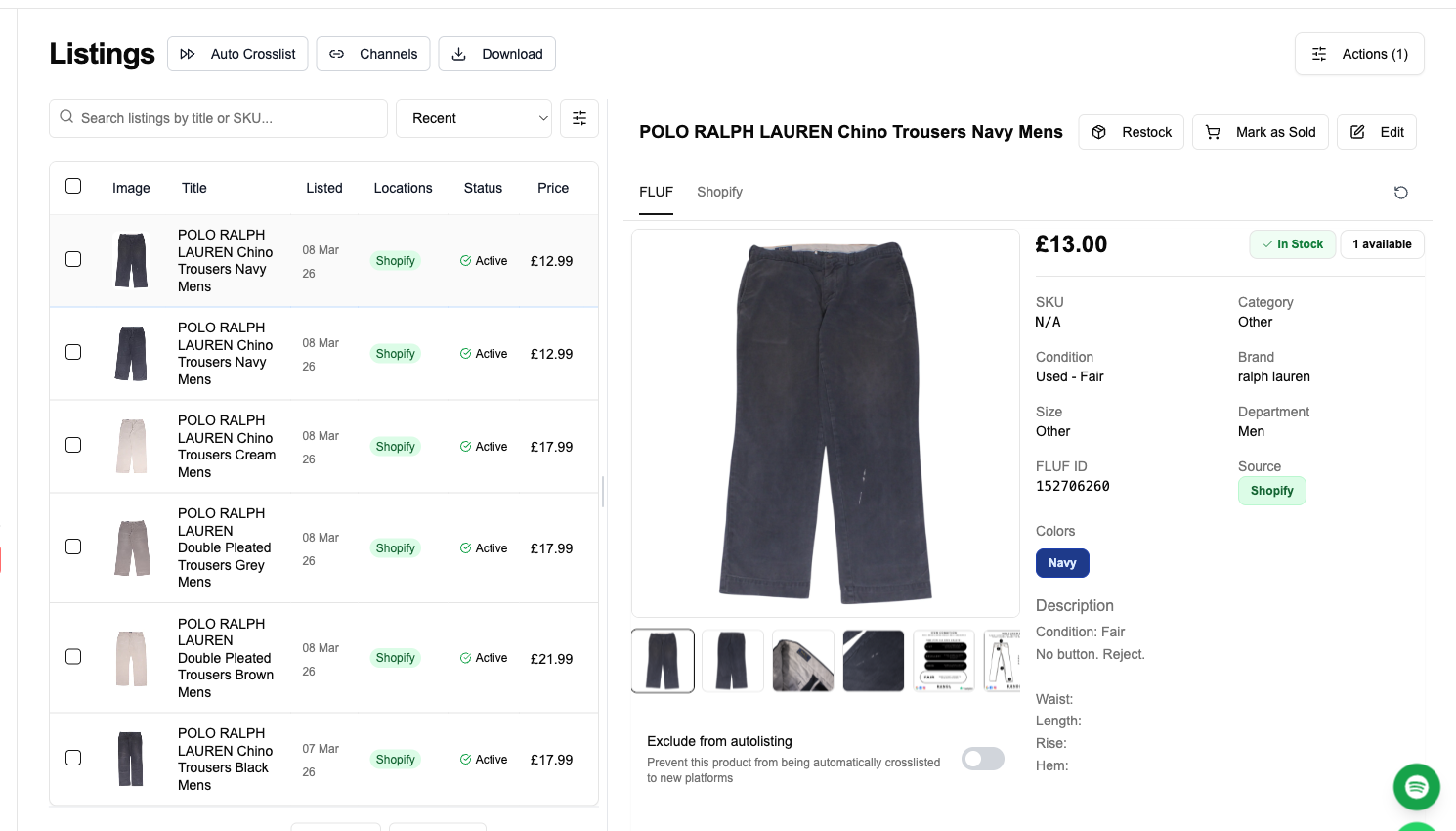
Doing this manually is the catch. Poshmark was built mobile-first as a social network for fashion, not as a back-office tool. Every listing is meant to be uploaded one at a time from the iOS or Android app: a cover shot cropped to square, up to 15 supporting photos, an 80-character title, a category selected from a three-level taxonomy, brand resolved against Poshmark’s brand directory, colour limited to two options, condition picked from five codes, size chosen from a category-specific size set. For a WooCommerce store with even a few hundred SKUs, retyping all of that into the Poshmark app is a week of work. The FLUF Connect plugin removes the friction entirely — select products in wp-admin, click crosslist, watch them appear in your Poshmark closet.
Why WooCommerce Store Owners Should Consider Poshmark
WooCommerce gives you a branded direct-to-consumer channel. Poshmark gives you access to a fundamentally different buyer base whose purchasing decisions are made entirely inside one app. The two stack cleanly without changing your operational setup, because WordPress remains the canonical store and Poshmark becomes an additional discovery surface.
Your WordPress store keeps the brand and the margin
WooCommerce gives you complete control: your domain, your theme, your customer email list, your full margin on every direct sale. Repeat buyers come back to you, not to a platform’s recommendation feed. The trade-off is that direct traffic does not appear by itself — you spend on SEO, content, social or paid ads to bring new buyers in.
Poshmark brings buyers WordPress will never reach
The typical Poshmark buyer is a woman in the United States or Canada in her late twenties or thirties who opens the app multiple times a day, follows hundreds of closets, and discovers items through the social feed and themed Posh Parties rather than through web search. That buyer almost certainly will not find a Shopify-style WooCommerce store via Google. Poshmark’s selling fee is a flat $2.95 on sales under $15 and 20% on sales of $15 or more, including payment processing, which is the highest take rate of any major resale platform — but the engagement makes the per-sale economics defensible for the right inventory.
The two together compound
Many WooCommerce sellers report that Poshmark buyers later find their WordPress site via the closet bio or a thank-you-card insert and convert to direct customers at a higher average order value once the brand relationship exists. Poshmark functions as a paid acquisition channel for a specific demographic that retains badly when you keep selling on Poshmark and beautifully when you migrate them to your WordPress store. Treating one as a funnel into the other is the standard playbook.
Where Poshmark Fits and Where It Does Not
Poshmark is not a generic marketplace and it has hard geographic limits. Both of those facts matter when deciding whether to wire your WooCommerce catalogue into it.
On geography: in November 2023 Poshmark closed its Australia, India and United Kingdom marketplaces to refocus on the US and Canada, following its January 2023 $1.6 billion acquisition by Naver Corp. If your WooCommerce buyers live primarily in the UK, France, Italy or Germany, Poshmark cannot reach them — Vinted, Depop and Vestiaire Collective are the right destinations for those audiences instead. If your shipping origin and buyer base are in the US or Canada, Poshmark remains one of the most engaged resale platforms in the world.
On inventory fit: Poshmark’s category leaderboards are dominated by women’s contemporary clothing (J.Crew, Madewell, Anthropologie, Free People, Reformation), designer and contemporary handbags (Coach, Kate Spade, Tory Burch, Marc Jacobs), branded shoes, Lululemon and athleisure, jewellery, and sealed beauty products. Mass-produced commodity goods, food, electronics, books, vintage homewares and men’s unbranded clothing tend to underperform on Poshmark — eBay, Facebook Marketplace and Whatnot are typically better destinations for those.
The natural Poshmark price corridor sits roughly between $15 and $200 per item. Below $15 the flat $2.95 fee eats a punishing share of revenue (a $10 sale nets only $7.05); above $500 any item except electronics, home, pets and toys automatically routes through Poshmark’s free Posh Authenticate authentication programme, adding one to two business days to delivery. Pricing your WooCommerce inventory into that corridor before crosslisting is the simplest single lever for Poshmark sell-through.
How the FLUF Connect Plugin Syncs WooCommerce and Poshmark
The FLUF Connect plugin is the canonical WordPress plugin for crosslisting WooCommerce to Poshmark and other resale marketplaces. Setup is roughly ten minutes.
Step 1: Install the FLUF Connect plugin in wp-admin
From your WordPress dashboard go to Plugins → Add New → search “FLUF Connect” → Install → Activate. The plugin auto-generates a WooCommerce REST API key, registers itself, and prompts you to connect a marketplace. No code, no FTP, no developer involvement. The plugin lives inside your WordPress install so it respects your existing user roles, security plugins, caching layer and hosting setup.
Step 2: Connect your Poshmark closet
Click “Connect Poshmark” in the FLUF Connect dashboard. Because Poshmark does not expose a public seller API, the connection runs through FLUF Connect’s bundled Chrome extension. The extension authenticates against your existing logged-in Poshmark session in Chrome, Edge or Brave — it never asks for your Poshmark password and never accesses any closet other than yours. You pick the right Poshmark domain at connect time (poshmark.com for the US, poshmark.ca for Canada) and the dashboard remembers it. Connection typically takes under a minute.
Step 3: Select what to crosslist
Your WooCommerce products appear in the FLUF dashboard with their Poshmark status — already in your closet, queued, or WordPress-only. Filter by category, brand, size, tag, condition or stock level. Variable products with sizes or colours expand into per-variation rows so each size or colour can be its own Poshmark listing if you want — Poshmark treats listings as single items by default rather than as parent products with variations, which matches how their buyer search works.
Step 4: Push to Poshmark with photos and attributes mapped
FLUF takes each WooCommerce product’s title, description, gallery, price, condition, brand, colour and size and creates a corresponding Poshmark listing. The plugin truncates titles to Poshmark’s 80-character limit and uses your WooCommerce product description (HTML stripped). Photos from your WooCommerce gallery become the cover shot plus supporting pictures — Poshmark accepts up to 16 images per listing. Brand, colour and condition map to Poshmark’s structured attribute fields; the plugin resolves your stored brand against Poshmark’s brand directory before pushing so the brand actually attaches to the listing rather than being silently dropped.
Step 5: Inventory stays synchronised in both directions
When stock changes in WooCommerce — a sale on your WordPress store, a manual stock adjustment, a supplier feed update — the corresponding Poshmark listing’s availability updates automatically. When something sells on Poshmark, the WooCommerce stock_quantity decreases to match. Two-way sync is the single feature that makes running the same catalogue across multiple marketplaces practical without overselling.
Step 6: Poshmark sales appear in your WooCommerce admin
Every Poshmark sale flows back into the standard WooCommerce orders screen, so you fulfil from your existing workflow — your shipping plugin, accounting integration or warehouse system. The buyer pays the flat $6.49 USPS Ground Advantage shipping label that Poshmark introduced on 12 September 2025, and you print that prepaid label from the Poshmark app or web interface. Mark the WooCommerce order shipped and the lifecycle event closes cleanly inside WordPress.
Ready to put your WooCommerce store on Poshmark?
FLUF Connect vs Listing on Poshmark by Hand
Manual Poshmark listing was designed for closet cleaners with a wardrobe of personal items. It does not scale to a WooCommerce catalogue.
| Task | Manual | With FLUF Connect |
|---|---|---|
| Creating Poshmark listings | Upload each item one at a time from the iOS or Android app. Crop cover shot square by hand, type 80-character title, write description, pick category and feature, set brand, colour, size and condition individually. | Select WooCommerce products in the dashboard and click crosslist. Photos, attributes, taxonomy mapping handled automatically. |
| Variations (sizes, colours) | Create one Poshmark listing per size and colour combination, each with the same per-listing setup repeated. | Variable products expand into per-variation listings automatically with stock tracked at the variant level. |
| Keeping inventory accurate | Manually mark Poshmark items sold whenever they sell on WordPress. Mark WordPress out-of-stock when sold on Poshmark. | Two-way sync. Stock in either system updates the other within minutes. |
| Processing Poshmark sales | Manage Poshmark orders in the Poshmark app. Manually re-create the order inside WooCommerce for accounting and fulfilment. | Poshmark sales flow into WooCommerce admin. Fulfil from your existing dashboard. |
| Price changes | Update on both platforms separately every time you reprice; also re-trigger Offer to Likers manually for any price drop >10%. | Update in WooCommerce; FLUF pushes the new price to Poshmark. |
| Refreshing listings for visibility | Manually relist stale items in the Poshmark app every 30–90 days to keep them showing in search. | Auto-relisting on a configurable schedule. Included in every plan, not a paid add-on. |
| Brand resolution | Type the brand name and hope Poshmark recognises it; misspellings get silently dropped from the listing. | Brands resolve against Poshmark’s full 29,000+ brand directory before push, so the brand actually attaches. |
For a WooCommerce store with even a hundred items, manual Poshmark management is a part-time job. With FLUF Connect it becomes a few minutes of dashboard oversight per week — leaving you free to do the things automation cannot do, like sharing your closet and showing up at Posh Parties.
What Makes FLUF Connect the Right WordPress Plugin for Poshmark
A handful of services claim to integrate WooCommerce with Poshmark. FLUF Connect’s approach differs in four ways that matter.
Built around Poshmark’s actual session model
Poshmark has no public seller API. Every crosslisting tool that supports Poshmark interacts with it through the browser, using the seller’s own logged-in session. FLUF Connect’s bundled Chrome extension does this cleanly: it scrapes the same CSRF token and cookies the live Poshmark UI uses, executes listing creation and edits as ordered HTTP steps inside your session, and reports results back to the FLUF dashboard. The extension never stores your password and never touches a closet that is not yours. This is more robust than the screen-scraping approach some competitors use and survives Poshmark’s regular UI changes.
Brand directory resolution before push
Poshmark silently drops unknown brands from the payload when you create a listing. If you type “Anthro” instead of “Anthropologie”, Poshmark accepts the listing but strips the brand field — and that listing disappears from brand-filtered search, where most Poshmark buyers actually find inventory. FLUF Connect maintains a synced copy of Poshmark’s 29,000+ brand directory and resolves your WooCommerce brand attribute against it before push. If a brand cannot be resolved it is omitted gracefully and surfaced as a warning, never sent as broken free text.
Smart relisting tuned for Poshmark’s recency-weighted algorithm
Poshmark’s search and feed weight recency heavily. Delisting and relisting stale items lifts them back to the top of search; manually doing this for hundreds of listings is what consumes Poshmark sellers’ evenings. FLUF Connect’s auto-relisting handles the delist-and-relist cycle on a configurable schedule across Poshmark, Depop and Vinted in one pass. Included in every plan, not a paid add-on.
Centralised order management inside WordPress
Every Poshmark sale appears in your WooCommerce admin. Your existing shipping plugin, accounting integration and warehouse system all continue to work because they listen to standard WooCommerce order hooks rather than any FLUF-specific event.
One plugin for many marketplaces
FLUF Connect also supports Depop, Vinted, eBay, Etsy, Shopify, Facebook Marketplace, Whatnot, Vestiaire Collective and several others from the same WordPress install. Most North American fashion-focused WooCommerce stores end up running Poshmark alongside three or four other channels; doing that through one plugin avoids credential sprawl and gives you a single source of truth for inventory.
What Data Transfers from WooCommerce to Poshmark
| Data Field | WooCommerce Source | Poshmark Destination |
|---|---|---|
| Title | WooCommerce product name (truncated to 80 characters) | Poshmark listing title |
| Description | WooCommerce description (HTML stripped to plain text, up to 1,500 characters) | Poshmark listing description |
| Cover photo | WooCommerce featured image (square-cropped) | Poshmark cover_shot |
| Supporting photos | Product gallery images (up to 15 additional) | Poshmark pictures array |
| Price | sale_price ?: regular_price (in USD or CAD by closet domain) | Poshmark listing price |
| Original price | regular_price when a sale_price exists | Poshmark original_price field |
| Variations | WooCommerce variable product children | One Poshmark listing per variation |
| Brand | Brand product attribute or taxonomy (resolved against Poshmark brand directory) | Poshmark Brand field |
| Size | pa_size attribute (mapped to Poshmark’s category-specific size sets) | Poshmark inventory size |
| Colour | pa_colours attribute (mapped to Poshmark’s 15 canonical colours, up to 2) | Poshmark colors array |
| Condition | Product attribute (New With Tags, New Without Tags, Pre-owned, etc.) | Poshmark condition code (nwt / uln / ug / uf / ret) |
| Category | WooCommerce category | Poshmark department + category + category_feature (3-level taxonomy) |
Photos and the Poshmark Visual Standard
Poshmark is a visual marketplace. The cover shot — the first photo on the listing — is the only image that appears in feed and search results, and Poshmark’s buyer base has come to expect a specific style: clean backgrounds, daylight or daylight-balanced lighting, square framing, with the brand or logo visible whenever the item is from a recognisable label. WooCommerce product gallery photos are usually wider than square, which is why FLUF Connect crops to 1:1 before pushing rather than letterboxing or stretching.
The cropping is centre-anchored by default, which works for most well-composed product photos. If your WooCommerce photos have important detail at the edges — a tag, a label, a hem detail — you can set a per-product crop anchor in the FLUF dashboard. For stores that maintain dedicated Poshmark-style square photos in a separate WooCommerce gallery, those can be designated as Poshmark-preferred and FLUF uses them in preference to the main gallery.
Poshmark allows up to 16 photos per listing — the highest limit of any major resale platform. The first photo becomes the cover shot, the rest become the swipeable photo carousel. Most top closets use 6–10 photos: cover shot, brand tag, size tag, full-front, full-back, detail shot, flaw shot (if any) and one on-body or styled shot. FLUF Connect uses your WooCommerce gallery in order, so curating that gallery on the WooCommerce side gives you the result you want on Poshmark without per-listing tweaking.
WordPress Admin Tips for Multi-Channel Poshmark Sellers
WP-CLI for catalogue audits
wp post meta get <product_id> pushed_poshmark_id tells you whether a specific WooCommerce product is currently on Poshmark. wp post list --post_type=product --post_status=publish --meta_key=pushed_poshmark_id --format=csv exports every product that has been pushed. Useful when auditing a large initial push or investigating why a specific item is not showing up in your Poshmark closet.
WooCommerce hooks for custom Poshmark behaviour
Hook woocommerce_product_set_stock to fire a Slack notification when a Poshmark bestseller hits low stock. Hook woocommerce_order_status_completed to trigger downstream actions when a Poshmark sale is fulfilled. FLUF Connect uses standard WooCommerce hooks, so any code that listens to product or order events continues to work without modification.
WPML and bilingual North American stores
Poshmark serves the US in English and Canada in English and French. If your WordPress store runs WPML for English/French bilingual content, FLUF Connect uses your primary language for the Poshmark push and respects per-language pricing in USD or CAD where you have configured it for your poshmark.com versus poshmark.ca closet.
Self-Hosted WordPress: Why Poshmark Sellers Should Care
Poshmark can change its fees, algorithm or seller policies at any time, and historically has — the 12 September 2025 shipping switch from USPS Priority to USPS Ground Advantage is a recent example. A WordPress store running in parallel is an insurance policy. Every Poshmark buyer you can convert into a direct WooCommerce customer is a customer Poshmark cannot take away. Many established Poshmark sellers explicitly use WooCommerce as their long-term canonical inventory and customer database, with Poshmark as the high-engagement acquisition surface.
Data ownership matters here too. Your WordPress install owns the canonical product, order and customer records on hosting you control. Poshmark buyer personal data stays on Poshmark per their privacy policy, but order references and SKU sales history accumulate inside your wp_posts and wp_postmeta tables. If a Poshmark closet is ever suspended or restricted, the WooCommerce-side records persist intact.
Pricing for Poshmark Crosslisting: Where Fees Actually Land
Poshmark listings themselves do not cost anything to create — there is no per-listing fee, no monthly platform subscription and no separate payment processing fee. The cost is the single Poshmark commission charged only when an item sells: a flat $2.95 on sales under $15 or 20% on sales of $15 or more, with payment processing already included. That makes Poshmark a cost-efficient channel to test for any WooCommerce store with the right inventory; you only pay when you make money.
Worked examples to make the fee curve concrete: a $25 dress nets $20.00, a $45 handbag nets $36.00, a $120 pair of boots nets $96.00, a $600 designer bag nets $480.00 after Posh Authenticate verification. The structural quirk is the discontinuity at the $15 threshold — a $14 listing pays $2.95 (21% take), a $15 listing pays $3.00 (20% take). Pricing strategy 101 on Poshmark is to round below-threshold items up to $15 wherever the inventory plausibly supports it. CLOSO has good worked data on this break point.
Poshmark also offers four reduced-fee mechanics that automated tooling cannot fully replicate. Offer to Likers (private 10%+ discount with subsidised shipping) and Closet Clear Out (10% price drop triggers automatic discounted-shipping offers to all likers) are the two highest-converting features on the platform; both require seller initiation per item. Bundle discounts (10–15% off two or more items in a single order) and Posh Parties (themed live-listing events four times a day) drive substantial GMV but are manual workflows. FLUF Connect automates the listing creation and inventory layer; the community-engagement layer remains a seller’s own decision per closet.
Which WooCommerce and Poshmark Setups Are Supported?
The FLUF Connect plugin requires WordPress 6.0 or newer and WooCommerce 7.0 or newer (PHP 7.4+). On the Poshmark side, the bundled Chrome extension is supported on Chrome, Edge and Brave on macOS, Windows and Linux desktop. Poshmark closets on poshmark.com (US, USD) and poshmark.ca (Canada, CAD) are both supported, with the right currency and shipping rates resolved automatically by the closet domain. Closets on poshmark.co.uk and poshmark.com.au are not addressable in 2026 because Poshmark closed those markets in November 2023.
Honest Limits: What Crosslisting Cannot Do on Poshmark
Crosslisting solves the listing and inventory problem. It does not solve the community problem. Poshmark’s algorithm rewards in-platform engagement — sharing your closet 2–4 times per day, sharing other sellers’ closets to build follow-back relationships, showing up at Posh Parties when the theme matches your inventory, hosting Posh Shows for higher-velocity inventory. None of that can be automated without violating Poshmark’s terms of service, and FLUF Connect intentionally does not try.
The practical implication for WooCommerce store owners is that Poshmark works best as a place where the operational workload (creating listings, syncing inventory, handling fulfilment) lives on FLUF Connect, leaving you free to spend the saved time on the community side that automation cannot touch. Sellers who crosslist to Poshmark but never share, never engage and never appear in Posh Parties typically get one to two sales a month per hundred listings; sellers who automate the operational side and put the saved time into community typically get five to ten times that. Crosslisting is necessary but not sufficient — that is the honest framing.
FLUF Connect Pricing
FLUF Connect uses transparent, simple pricing. Every plan includes the WordPress plugin, all channels — Poshmark, Depop, Vinted, eBay, Etsy, Shopify, Facebook Marketplace and others — and every automation feature. The only difference between plans is the active product cap. The cheapest paid tier is Growth at £19/month for 500 active products. Plans start at £19/month (Growth — 500 products). There is no free plan.
| Plan | Price | Active Products | Channels & Features |
|---|---|---|---|
| Growth | £19/month | 500 | All channels, all features |
| Seller | £99/month | 5,000 | All channels, all features |
| Super Seller | £299/month | Unlimited | All channels, all features |
Poshmark’s own commission (20% on sales of $15 or more, flat $2.95 below) applies separately and is deducted from the buyer payment by Poshmark before payout. Automation features — auto-relisting, smart pricing, inventory sync, bundle handling, centralised orders — are included in every plan, not a paid add-on.
Related Guides
- All channels FLUF Connect supports — overview hub including WooCommerce and Poshmark
- WooCommerce crosslisting — the full hub for crosslisting your WooCommerce store to every channel
- Crosslist from WooCommerce to Vinted — reach Vinted’s 100M+ European buyers from your WordPress store
- How to sell on Poshmark — the 2026 guide — full Poshmark seller fundamentals
- Crosslist from Shopify to Poshmark — the same workflow for Shopify store owners
- Crosslist Poshmark to Depop — for sellers expanding to the Gen Z audience
- Inventory Sync — how two-way sync prevents overselling across every channel
- FLUF Connect pricing — plans start at £19/month, all channels included
- Crosslist from WooCommerce to Whatnot — take your catalogue to live shopping auctions
- Crosslist Poshmark to WooCommerce
Sources & Verification
- Poshmark user demographics and scale: expandedramblings.com Poshmark statistics
- Poshmark fee structure: Voolist 2026 Poshmark fees guide, Vendoo Poshmark fees overview
- Naver acquisition: PR Newswire — Naver completes acquisition of Poshmark
- International market closures: TechCrunch — Poshmark shutting down in Australia, India, UK
- Shipping change to USPS Ground Advantage: Poshmark Blog — lower shipping starting September 12th
- Posh Authenticate programme: Poshmark Help — Posh Authenticate
- WooCommerce REST API reference: WooCommerce REST API docs
More Crosslisting Guides
- How to Sell on WooCommerce
- Crosslist WooCommerce to Etsy (handmade & vintage)
- Crosslist WooCommerce to Depop
Also from a store platform: Crosslist from BigCommerce to Poshmark.
Frequently Asked Questions
Poshmark is fashion-focused — women's contemporary clothing, designer handbags, shoes, accessories, jewellery, activewear and sealed beauty all sell strongly. WooCommerce stores selling those categories into US or Canadian buyers tend to do well. Mass-produced commodity goods, electronics, books, food, vintage homewares and men's unbranded clothing generally do not match Poshmark's buyer demographic — eBay, Facebook Marketplace or Whatnot are usually better destinations for those. FLUF Connect lets you crosslist selectively so you push only the WooCommerce SKUs that fit the platform.
No. The plugin installs from wp-admin: Plugins → Add New → search FLUF Connect → Install → Activate. The plugin auto-generates a WooCommerce REST API key and prompts you to connect Poshmark. The Poshmark connection requires the bundled Chrome extension (Chrome, Edge or Brave) because Poshmark does not expose a public seller API. Setup typically takes ten minutes from a vanilla WordPress install.
No. Listing creation, inventory sync and order ingestion all happen on FLUF infrastructure. Your wp-admin only handles the lightweight handshake and incoming webhooks. The initial catalogue push touches the WooCommerce database briefly but is paginated to stay polite to your hosting. Most WordPress stores report no measurable page-speed impact after installing the plugin.
No. In November 2023 Poshmark closed its Australia, India and United Kingdom marketplaces to refocus on the United States and Canada following its January 2023 acquisition by Naver Corp. If your WooCommerce buyer base is primarily in the UK or Europe, Poshmark cannot reach them — Vinted, Depop and Vestiaire Collective are the right destinations for those audiences. FLUF Connect supports all of those channels from the same WordPress install.
Poshmark treats listings as single items by default rather than as a parent with variations. FLUF Connect respects this — your WooCommerce variable product with five sizes can become five separate Poshmark listings, each with its own price and stock count. This matches how Poshmark buyers search (they filter by size in the category taxonomy) and gives each variant its own surface in the feed. Alternatively you can flatten variations to a single Poshmark listing if you prefer, configured per product.
Three things happen automatically. The Poshmark sale flows into your WooCommerce admin as a standard order so you can fulfil from your existing dashboard. The WooCommerce stock_quantity for the sold variation decreases to match. Poshmark generates the prepaid USPS Ground Advantage label (currently $6.49 flat, paid by the buyer); you print it from the Poshmark app or web interface, ship within 24–48 hours, and mark the order shipped in WooCommerce. Listings on other channels you have crosslisted to (Depop, Vinted, eBay, etc.) are pulled automatically to prevent overselling.
Poshmark's search and feed reward recent activity — relisted items lift back to the top. FLUF Connect's auto-relisting automatically delists and relists stale inventory on a configurable schedule (typically every 30–60 days) across Poshmark, Depop and Vinted in one pass. Note that auto-relisting addresses the listing-freshness signal, not the social-sharing signal — sharing your closet and engaging with Posh Parties is a manual community workflow that platform terms of service deliberately do not allow tools to automate. Auto-relisting is included in every FLUF Connect plan, not a paid add-on.
Poshmark allows up to 16 photos per listing — the highest of any major resale platform. FLUF Connect crops your WooCommerce product gallery photos to square format (centre-anchored by default; per-product anchors available) and uses the first image as the Poshmark cover shot. The cover shot is the only image visible in feed and search, so curating your WooCommerce featured image to a clean square crop with the brand visible is the highest-leverage single change you can make for Poshmark sell-through.
Yes. Filter the FLUF dashboard by category, brand, tag, size, condition or stock level and choose what to crosslist. Most WooCommerce store owners push only their Poshmark-eligible inventory (women's fashion, accessories, designer items priced $15–$200) and keep the rest WordPress-only. You can add or remove products from Poshmark at any time without affecting the WooCommerce product or stock count.
FLUF Connect plans start at £19/month (Growth — 500 active products), with Seller at £99/month for 5,000 products and Super Seller at £299/month for unlimited. There is no free plan. Every plan includes the WordPress plugin, all channels, auto-relisting, inventory sync and centralised orders. Poshmark's own selling fee (flat $2.95 on sales under $15, 20% on sales of $15 or more, with payment processing included) applies separately and is deducted by Poshmark before payout. The buyer pays the $6.49 flat shipping label at checkout.