
Crosslist from Shopify to Poshmark — Automatically
Put your Shopify catalogue in front of Poshmark's 80 million shoppers. Variants become single-item listings and inventory stays in sync, so you never oversell.



Key Takeaways
- Shopify is your own branded store, not a marketplace — millions of live stores and roughly $292bn of GMV in 2024 — but it brings no built-in audience; traffic is your job.
- Poshmark supplies the audience Shopify does not: about 80 million registered users with a social, fashion-led feed and a 20% commission on $15+ sales.
- FLUF Connect crosslists your Shopify products to Poshmark in seconds, mapping product type and tags to Poshmark’s Department → Category → Subcategory tree and listing brand-new stock as New With Tags.
- Shopify products with variants and quantity are turned into Poshmark’s single-item listings, and inventory sync decrements your Shopify stock when a Poshmark sale fires — so you never oversell.
- As of early 2026 Poshmark retired its Boutique listing type and converts new product to New With Tags in a standard closet — so DTC and boutique stock sells through a normal Poshmark closet.
- The cheapest plan is Starter at £9/month, with no cap on how much you list. There is no free plan, but every new account gets a 7-day trial for £1; every plan includes the Shopify, Poshmark bridge, sync, bulk tools, Seller and above add relisting, and Seller and above add offers.
Why Crosslist from Shopify to Poshmark?
The single biggest reason is audience. Shopify is brilliant at running your own branded storefront, but it is a platform, not a marketplace — it sends you no shoppers. Every visitor to a Shopify store arrives because you paid for an ad, ranked in search, or built the following yourself. Poshmark is the opposite: it has around 80 million registered users already browsing a social fashion feed, and listing there puts your products in front of them at no upfront cost.
Shopify is enormous as infrastructure — millions of live stores and about $292bn of GMV in 2024 — but that scale is spread across independent stores each fighting for their own traffic. Crosslisting a fashion, beauty or home catalogue to Poshmark is one of the cheapest ways to add a demand channel: you pay nothing to list, and 20% only when an item actually sells.
| Dimension | Shopify | Poshmark |
|---|---|---|
| What it is | Your own store platform | A marketplace with a built-in audience |
| Built-in shoppers | None — you drive traffic | ~80M registered users |
| Cost model | Monthly plan + card processing | Free to list, 20% on $15+ sales |
| Discovery | Your ads, SEO, social | Social feed, sharing, Posh Parties |
| Listing model | Products with variants, quantity | Single item, quantity 1 |
| Photos per listing | Many | Up to 16 |
For a DTC brand, boutique or resale shop, Poshmark is added demand for the same inventory — and because it is social, well-shared listings keep working long after a one-off ad spend would have stopped. It is the rare growth lever that costs nothing to switch on: you reuse the product data, descriptions and photographs already sitting in your Shopify admin, and the only marginal cost is Poshmark’s commission on the extra sales it generates. For most stores that is a far better risk profile than pouring more budget into ad auctions that keep getting more expensive.
Variants, Quantity and Poshmark’s Single-Item Model
The one structural thing to understand before crosslisting is that Shopify and Poshmark model products differently. A Shopify product can carry many variants — size and colour combinations — each with its own stock level. Poshmark is a single-item marketplace: one listing is one item, quantity one.
FLUF Connect bridges that gap. A Shopify product with several variants becomes the right set of single-item Poshmark listings, and inventory sync keeps the counts honest — when a Poshmark listing sells, FLUF decrements the matching Shopify variant so you do not oversell across channels. For high-stock SKUs you choose a quantity strategy; for one-off or low-stock fashion and home pieces, the mapping is clean.
There is also good news on listing type. Poshmark retired its separate Boutique listing tier in early 2026 and now converts brand-new product into standard New-With-Tags listings. So you no longer need to qualify for a special boutique section — new Shopify stock simply lists as New With Tags in your normal Poshmark closet.
How to Crosslist from Shopify to Poshmark with FLUF Connect
Setup takes about 10 minutes, then each product crosslists in roughly 30 seconds.
- Create a FLUF Connect account. Sign up at FLUF Connect and choose Starter (£9/month), with no cap on how much you list.
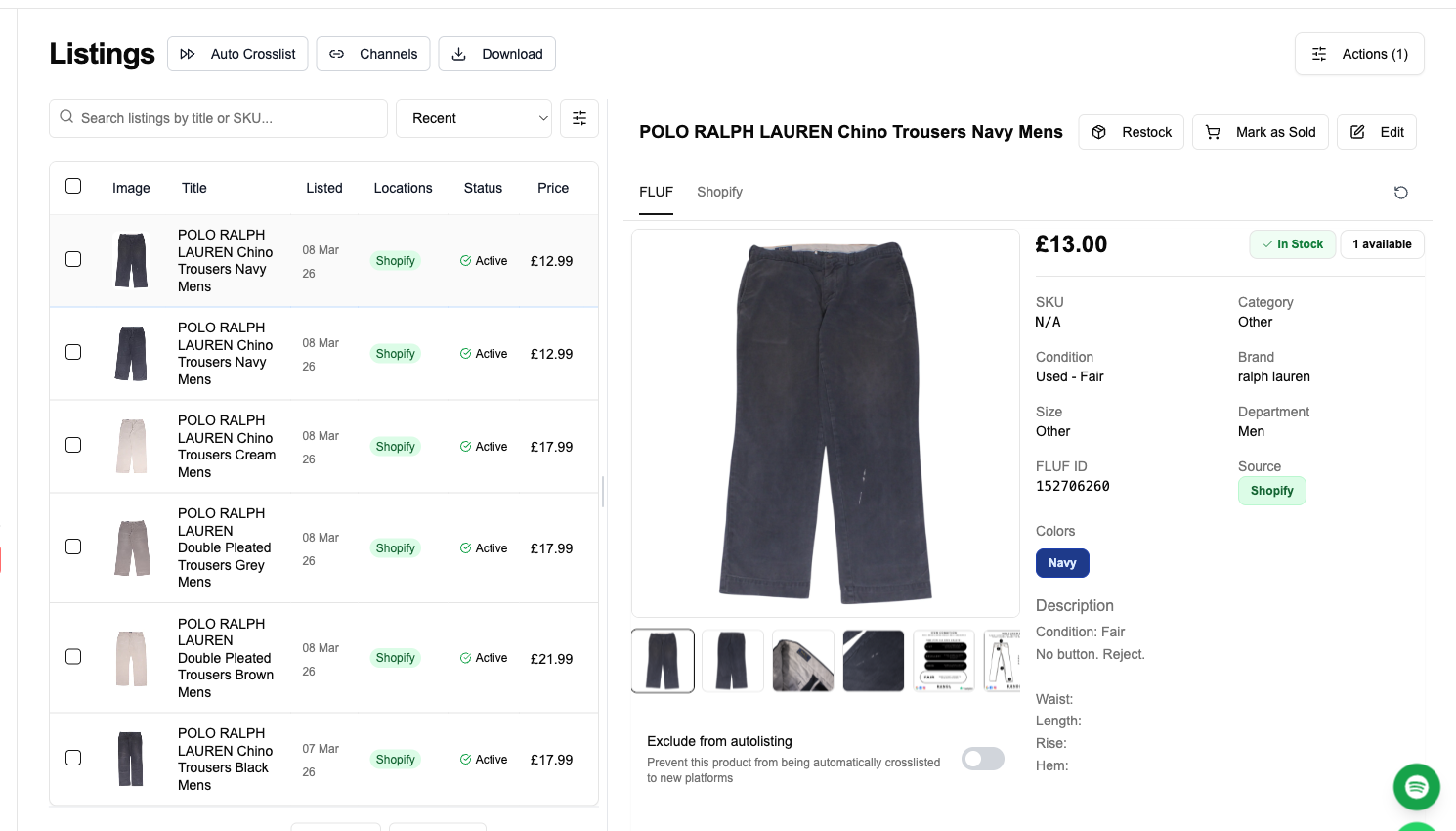
- Connect Shopify. Shopify connects through its official app authorisation, and FLUF imports your products — titles, descriptions, images, variants, price and stock — into one dashboard.
- Install the extension and connect Poshmark. Poshmark has no public seller API, so FLUF drives it through a browser extension inside your own logged-in session.
- Map products to Poshmark categories. FLUF maps your Shopify product types and tags to Poshmark departments and sets new stock to New With Tags.
- Handle variants. Choose how variants become single-item Poshmark listings.
- Crosslist. Confirm and publish into your Poshmark closet; inventory then stays in sync.
What Transfers When You Crosslist from Shopify to Poshmark?
Shopify’s product fields are flexible; Poshmark’s are fixed and fashion-shaped. FLUF maps the overlap and sets sensible defaults for the Poshmark-only fields.
Field mapping — Shopify to Poshmark
| Shopify field | Poshmark field | Transfer | Notes |
|---|---|---|---|
| Title | Title | ✅ Automatic | Trimmed for Poshmark’s brand-led format. |
| Body (description) | Description | ✅ Automatic | HTML is converted to plain text. |
| Images | Photos | ⚡ Mapped | Poshmark caps at 16, so the first 16 transfer. |
| Price | Price | ⚡ Smart mapped | Converted to USD where needed; add a markup for the 20% commission. |
| Vendor | Brand | ⚡ Mapped | Shopify vendor maps to Poshmark’s brand picker. |
| Variants (size/colour) | Separate listings | ⚡ Mapped | Each variant becomes a single-item Poshmark listing. |
| Inventory quantity | Quantity | ⚡ Mapped | Synced so a Poshmark sale decrements Shopify stock. |
| Product type / tags | Department / Category | ⚡ Smart mapped | Mapped to the nearest Poshmark subcategory. |
| — | Condition | ⚠ Default | Shopify has no condition field; new stock defaults to New With Tags. |
| — | Original (retail) price | ⚠ Manual / default | Poshmark-only field; set a default. |
Legend: ✅ Automatic · ⚡ Smart-mapped · ⚠ Poshmark-only, needs a default.
Category mapping examples
| Shopify product type | Poshmark path | Note |
|---|---|---|
| Apparel → T-Shirts | Women or Men → Tops | Department from variant/tag |
| Accessories → Handbags | Women → Bags | Direct match |
| Home → Décor | Home → Home Décor | Maps where Poshmark has a home category |
The two fields to watch are condition (Shopify has none, so FLUF defaults new stock to New With Tags) and variants (each becomes its own Poshmark listing, which is why a clear variant strategy matters at high volume).
Inventory Sync Between Shopify and Poshmark — What Stays in Sync?
This is the part that makes Shopify-to-Poshmark safe at any stock level.
| Event | What happens | Timing |
|---|---|---|
| Item sells on Poshmark | Matching Shopify variant stock decremented | Within minutes |
| Shopify variant sells out | Poshmark listing removed | Within minutes |
| Price changed in FLUF | Updated on both channels | Minutes |
| Product unpublished in FLUF | Delisted from Poshmark | Minutes |
When a Poshmark sale fires, FLUF Connect decrements the matching Shopify variant and pulls the listing when stock hits zero — so the same unit is never sold on two channels.
Poshmark sync depends on the extension being connected. Updates on this pair are not instantaneous, so check availability after a sale.
Crosslisting from Shopify to Poshmark: Before and After
Without FLUF Connect (manual)
- Export or open each Shopify product and download its images.
- Decide how to split variants into separate Poshmark listings.
- Start a Poshmark listing and re-type a trimmed title.
- Convert the HTML description to plain text.
- Upload up to 16 photos one at a time.
- Pick department, category and subcategory, and set brand and condition.
- Set a US price that absorbs the 20% fee.
- Publish, then manually adjust Shopify stock whenever a Poshmark order comes in.
With FLUF Connect
- Select Shopify products in your dashboard.
- Click crosslist to Poshmark.
- Confirm the variant and category mapping.
- Done — stock decrements automatically across both.
Manual: roughly 12-20 hours, plus ongoing stock reconciliation. With FLUF Connect: under an hour, with inventory kept in sync automatically.
Automation Features for Shopify and Poshmark Sellers
FLUF Connect automates the demand-side work Poshmark rewards.
Auto-relisting and sharing
Poshmark surfaces fresher, well-shared listings higher. FLUF can refresh your Poshmark listings on a schedule so your Shopify products keep climbing the feed.
Offer management
Poshmark’s “Offer to Likers” converts interested browsers into buyers. FLUF runs offer rules across the listings that have drawn likes.
Auto-crosslist rules and bulk operations
Auto-push new Shopify products to Poshmark, bulk-adjust prices, and run find-and-replace across descriptions.
| Feature | Shopify | Poshmark |
|---|---|---|
| Crosslisting | ✅ | ✅ |
| Inventory sync | ✅ | ✅ |
| Order sync | ✅ | Scheduled |
| Auto-relisting | ❌ (always live) | ✅ |
| Offer management | ❌ | ✅ |
| Bulk operations | ✅ | ✅ |
The Real Problem Shopify Has That Poshmark Solves
Every Shopify merchant eventually runs into the same wall: the store works, but nobody comes. Shopify gives you a fast, flexible, fully branded shopfront — and then leaves customer acquisition entirely to you. You buy Meta and Google ads, you grow an email list, you chase influencers, and the moment you stop spending, the traffic stops with it. That is the structural cost of running your own storefront rather than selling on a marketplace.
Poshmark inverts that. It already has a community of shoppers opening the app every day to browse fashion, beauty and home, and it surfaces inventory socially — followers see your shares, Posh Parties feature your categories, and other users re-share listings they like. Crosslisting a slice of your Shopify catalogue to Poshmark is therefore one of the cheapest demand experiments a brand can run: you pay nothing to list, you only give up 20% when something actually sells, and a well-shared listing keeps generating views long after a paid ad would have gone dark. For a boutique or DTC brand whose ad costs keep climbing, that built-in audience is the whole point.
Choosing a Variant and Quantity Strategy
Because Poshmark is single-item and Shopify is variant-and-quantity, the decision that matters most is how you map a stocked product onto a one-item marketplace. There are two sensible patterns, and FLUF Connect supports both.
- One listing per variant. Best for fashion and apparel, where buyers shop by a specific size and colour. A dress in four sizes becomes four Poshmark listings, each mapped to the right size, and inventory sync decrements the matching Shopify variant when one sells. This mirrors how a closet naturally works on Poshmark.
- One representative listing. Best for accessories or homeware with little variation, where a single Poshmark listing represents the product and FLUF keeps it live while Shopify stock remains, pulling it when the count reaches zero.
The risk a manual workflow creates here is overselling: a Poshmark sale that nobody reflects in Shopify, or a Shopify sale that leaves a dead Poshmark listing live. FLUF’s inventory sync closes that gap automatically, decrementing the right variant and delisting at zero, so you can safely list stocked products on a marketplace that was never designed for stock counts.
Orders, Fulfilment and Shopify as the Hub
Most Shopify merchants want their store to stay the operational centre, and crosslisting should not change that. FLUF can mirror a Poshmark sale back so your Shopify records and stock stay accurate, keeping Shopify as the single source of truth for what you have and what you have sold. Poshmark handles its own prepaid shipping label on each sale, so fulfilment on the Poshmark side is straightforward for a US or Canadian merchant — pack the item, attach the label Poshmark provides, and post it. The honest constraint is the same as for every Poshmark seller: that prepaid label is US-origin only, and Poshmark gates sellers by US or Canadian address and IP, so an international Shopify brand needs a US fulfilment route before Poshmark sales make sense. For a US-based brand, the flow is clean: list from Shopify, sell on Poshmark, ship with Poshmark’s label, and let FLUF keep your Shopify inventory honest.
There is one mindset shift worth naming for store owners. On Shopify you control every pixel — branding, layout, upsells, the checkout — and Poshmark gives you none of that; your listing lives inside Poshmark’s standard closet format and its social feed. That feels like a loss of control, but it is the trade that buys you the audience. The brands that do best treat Poshmark as a discovery and clearance channel that runs alongside their store rather than a replacement for it: new-season and full-price storytelling stays on Shopify, while Poshmark carries the pieces that benefit from a large, ready-made audience and social sharing. Because FLUF keeps inventory in sync across both, you can run that split confidently, knowing a sale in either place updates the other and nothing is sold twice.
Finally, think about which products to send to Poshmark first, because not everything in a Shopify catalogue belongs there. Poshmark’s audience responds to fashion, accessories, beauty and home, and to individual, photogenic pieces rather than deep-stocked basics. A boutique’s seasonal dresses, limited runs, sample-sale stock and end-of-line items are ideal candidates: each is a discrete listing that benefits from social discovery, and clearing them on Poshmark frees working capital without discounting them on your own storefront. Bulk-import those collections, set a default New-With-Tags condition and a price uplift to cover the 20% commission, and let auto-crosslist rules push future products that match the same product types. That turns Poshmark from a manual chore into a standing demand channel that runs quietly alongside the store you already operate, earning incremental sales from inventory that would otherwise sit waiting for paid traffic to find it.
How Much Does It Cost to Crosslist from Shopify to Poshmark?
| Plan | Monthly | Crosslisted products |
|---|---|---|
| Starter | £9/month | Unlimited |
| Pro | £29/month | Unlimited |
| Priority | Custom pricing — tell us what you need | Unlimited |
there is no free plan, but every new account gets a 7-day trial for £1; the cheapest option is Starter at £9/month, with no cap on how much you list. Every plan covers all supported channels, so your Shopify catalogue can also reach Depop, Vinted, eBay, Etsy and more at no extra cost. See the full pricing page.
Sources & Verification
- Capital One Shopping — Shopify statistics (live stores, GMV)
- Shopify — platform vs marketplace (no built-in audience)
- Poshmark user statistics
- Poshmark blog — 2026 seller updates (Boutique retired, New-With-Tags conversion)
- Poshmark Support — What can I sell on Poshmark
Start crosslisting from Shopify to Poshmark
Related guides
- Crosslist from Poshmark to Shopify
- Crosslist from Shopify to Depop
- Crosslist from Shopify to eBay
- Sell on Shopify — full guide
- Sell on Poshmark — full guide
- All crosslisting guides
Also from a store platform: Crosslist from BigCommerce to Poshmark.
Frequently Asked Questions
FLUF Connect plans start at £9/month on Starter, with Pro at £29/month and custom Priority plans above that; every plan is unlimited on listings and marketplaces, and the tiers differ only by how often we check your channels for sales. There is no free plan. Every plan includes crosslisting, inventory sync, auto-relisting, offers and bulk operations across all supported channels, so automation is never a paid add-on. Poshmark itself is free to list on and charges 20% only when an item sells.
Yes. Poshmark retired its separate Boutique listing tier in early 2026 and now lists brand-new product as New With Tags in a standard closet, so DTC and boutique stock from Shopify sells through your normal Poshmark closet without needing to qualify for a special section.
Poshmark is a single-item marketplace, so a Shopify product with size or colour variants becomes the matching set of single-item Poshmark listings. FLUF helps you choose how variants are split and keeps the counts in sync.
Yes. When a Poshmark sale fires, FLUF decrements the matching Shopify variant, and when Shopify stock hits zero the Poshmark listing is removed within minutes — so the same unit is never sold on two channels.
No. Shopify has a full official API, but Poshmark does not publish a seller API, so FLUF Connect drives Poshmark through a browser-extension bridge inside your own logged-in session. Shopify connects through its official app authorisation.
Shopify has no condition field because its products are usually new, so FLUF defaults crosslisted stock to Poshmark's New-With-Tags condition. You can adjust this per listing for any pre-owned or sample stock.
Poshmark's prepaid label is US-only and Poshmark gates sellers by US or Canadian address and IP, so a non-US merchant needs a US fulfilment route to make Poshmark orders economical. US and Canadian merchants can crosslist directly.
Yes. Every FLUF Connect plan includes all supported channels, so the same Shopify catalogue can also go to Depop, Vinted, eBay, Etsy and more from one dashboard at no extra cost.
Sign up for free
Join the community
You're in.
Open your dashboard