Crosslist from Poshmark to Shopify — Automatically
Build a brand store from your Poshmark closet — without abandoning Poshmark sales. Variants, metafields and sync handled automatically.



- Poshmark: Naver-owned US and Canada marketplace; flat $2.95 fee on sales under $15, 20% on $15+[1]. Discovery is built in — buyers come to you.
- Shopify: ~5.5M paying merchants in 2026[2]; not a marketplace — your own store, your own domain, your own brand. Basic plan from $39/month plus payment processing[3].
- Different shape entirely — Poshmark gives you demand; Shopify gives you ownership. Crosslisting from Poshmark to Shopify is for sellers ready to start building a brand independent of any single marketplace’s algorithm — without abandoning Poshmark sales while you grow.
- Fields that transfer automatically: title (no Shopify character limit), description (full HTML allowed), all 16 photos (Shopify is unlimited), price, brand (becomes Shopify vendor), condition (lives in a product metafield), size and colour (become Shopify variants).
- Inventory sync: native and bidirectional — Shopify is FLUF Connect’s order-truth hub. When an item sells on Poshmark it is delisted from Shopify within minutes, and Poshmark/eBay/Vinted/etc. orders all flow into Shopify for unified fulfilment.
- Cost: from £19/month (Growth, 500 products). There is no free plan. Every plan includes crosslisting, sync, relisting, offers and bulk operations across all supported channels.
Crosslisting from Poshmark to Shopify is for Poshmark sellers ready to own their relationship with buyers. The typical fit profile: 200+ active Poshmark listings, a consistent style or category that buyers can recognise as a brand, and ambition to grow beyond what Poshmark’s algorithm alone delivers. Vintage curators, designer resellers, archive-clothing curators, niche-category specialists, anyone with repeat buyers asking “do you have an Instagram?” — these sellers are the right audience.
This pair is not a fit if you are looking for instant sales without any marketing effort. Shopify is your own store — there is no built-in buyer base. Poshmark gives you discovery for free in exchange for 20% commission; Shopify gives you ownership for the cost of a monthly subscription and the responsibility of driving your own traffic (Instagram, TikTok, email, ads). FLUF Connect handles the listings; the brand-building you still do yourself. If your priority is more sales this week, our Poshmark to eBay guide is a better entry point. If you are ready to build something durable, this is the right pair.
Why Sell on Both Poshmark and Shopify?
The case for running both is straightforward once you separate the marketplace dynamic from the brand-store dynamic. Poshmark gives you a captive US+Canada audience of ~80M registered users who land on your closet through brand+size search, Posh Parties and Posh Shows — without you doing any marketing[1]. The cost is a flat 20% commission on sales of $15+, the lack of any direct buyer relationship (Poshmark intermediates all messaging), and the fact that everything you build belongs to Poshmark. Close your account or get suspended and the audience evaporates.
Shopify is the opposite. ~5.5M merchants worldwide run their own stores on the platform[2]; the Basic plan is $39/month with Shopify Payments at 2.9% + $0.30 per US card transaction[3]. You pay a monthly fee instead of a per-sale commission, you collect buyer emails, you can run discount campaigns, you control the customer experience, and the audience you build is yours. The trade is responsibility for driving traffic — Shopify has no built-in discovery.
Crosslisting from Poshmark to Shopify lets you keep Poshmark’s free demand while building a brand store in parallel. Every Poshmark buyer who lands on your closet, likes a few items, and asks “do you ship internationally?” or “do you have more like this?” is a candidate to move to your Shopify store — where you control pricing, bundling, returns and follow-up. The Shopify store also becomes a home for items Poshmark restricts (homeware beyond Poshmark Home’s narrow remit, accessories outside the Poshmark catalogue, custom listings), and a destination you can point to from Instagram and TikTok.
| Poshmark | Shopify | |
|---|---|---|
| Type | Marketplace (built-in buyers) | Standalone store (your own brand and domain) |
| Audience | ~80M registered, US+CA only | Whoever you bring — global |
| Discovery | Search, Posh Parties, Posh Shows, share-back social graph | Your marketing — Instagram, TikTok, email, SEO, ads |
| Cost structure | Per-sale commission: $2.95 flat under $15 / 20% on $15+ | $39/mo Basic + payment processing (Shopify Payments 2.9% + 30¢ US) |
| Buyer relationship | Intermediated by Poshmark | Direct — emails, segments, follow-up |
| Listing constraints | 16 photos, 80-char title, 3 style tags | Effectively unlimited photos, no title limit, full HTML descriptions, rich variants |
| Inventory architecture | Single-item or multi-item, no variants | Multi-variant native (size + colour + style) |
The sellers who get the most out of this pair use Poshmark for volume and discovery, and Shopify for repeat customers, bundled product, restock alerts and email-driven launches. Neither replaces the other.
How to Crosslist from Poshmark to Shopify with FLUF Connect
1. Sign Up to FLUF Connect
Create your account at fluf.io/connect. Growth is £19/month for 500 products with every automation feature included. There is no free plan; the entry tier is the full Poshmark + Shopify feature set.
2. Connect Your Poshmark Account
Install the FLUF Connect browser extension, sign in to Poshmark, and pick your TLD — com for US, ca for Canada. The extension handles authentication so FLUF Connect never sees your Poshmark password. No credentials are stored on FLUF Connect’s servers.
3. Connect Your Shopify Store
If you do not already have a Shopify store, create one at shopify.com — Basic at $39/month or $29/month annual[3]. Then connect it to FLUF Connect using Shopify’s official OAuth — install the FLUF Connect Shopify app from your admin, authorise the requested scopes, and the connection completes. FLUF Connect now becomes the bridge between your Shopify store and every marketplace you list on.
4. Import Your Poshmark Closet
FLUF Connect indexes every active Poshmark listing — title, description, all 16 photos, price, category, brand, condition, size, colour. Inventory imports run in the background; a 500-listing closet typically finishes within an hour.
5. Review Field Mapping
FLUF Connect previews how each item appears on Shopify. Title transfers untouched (Shopify has no character limit). Description carries across with full HTML support — bold, lists, links. All 16 photos transfer (Shopify is unlimited per product). Brand becomes Shopify’s vendor field. Condition is written to a product metafield so it appears in your product page template. Size and colour become Shopify variants, structured properly for your theme.
6. Crosslist — Individually or in Bulk
Tick items, click Crosslist to Shopify. A single product is created in your Shopify catalogue in around 20 seconds; 100 products takes about five minutes. You can also enable auto-crosslisting — any new Poshmark listing matching your rules (e.g. “everything in the Vintage category”) flows automatically into Shopify as a new product.
7. Inventory Syncs Bidirectionally — Shopify is the Order-Truth Hub
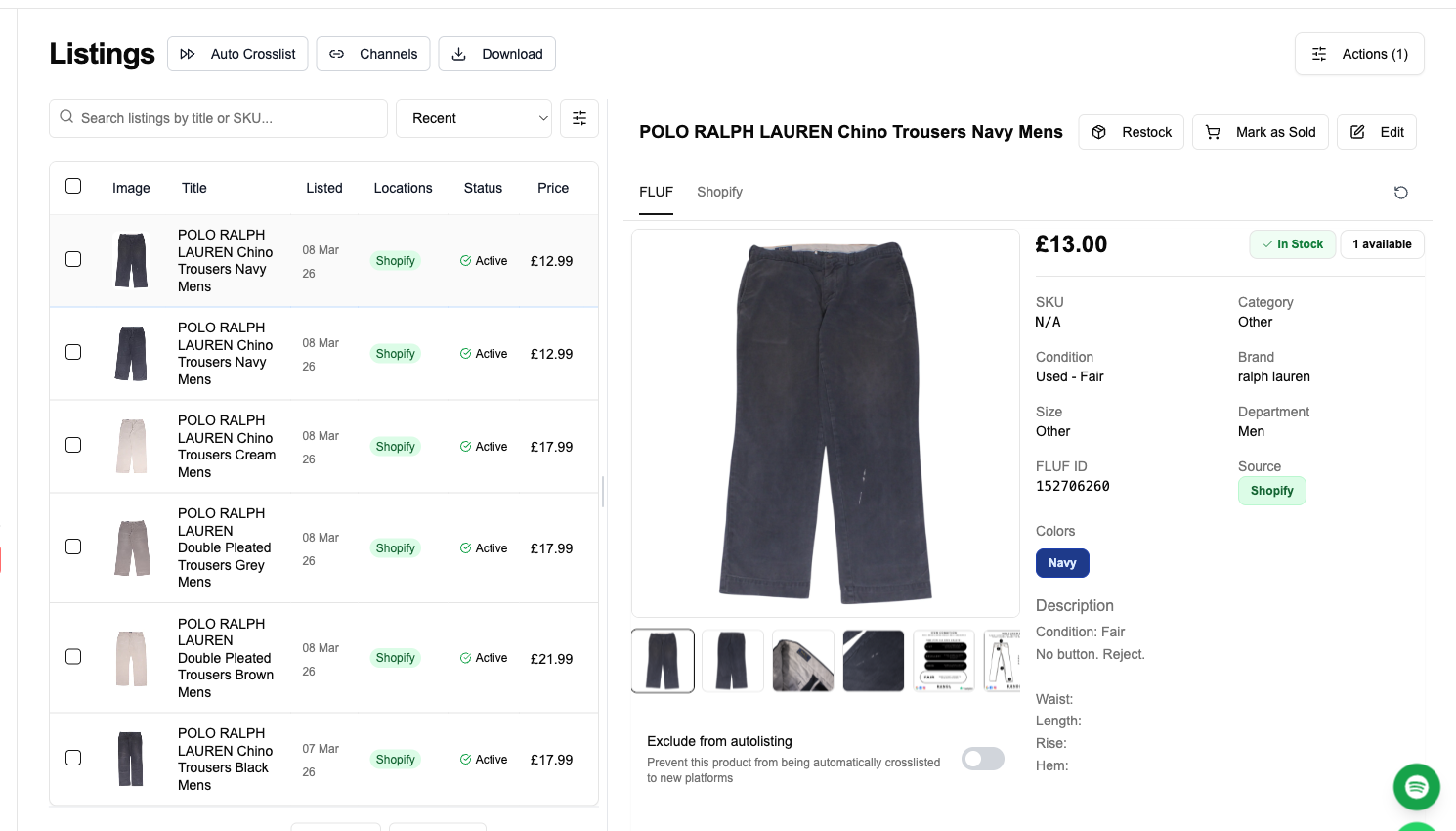
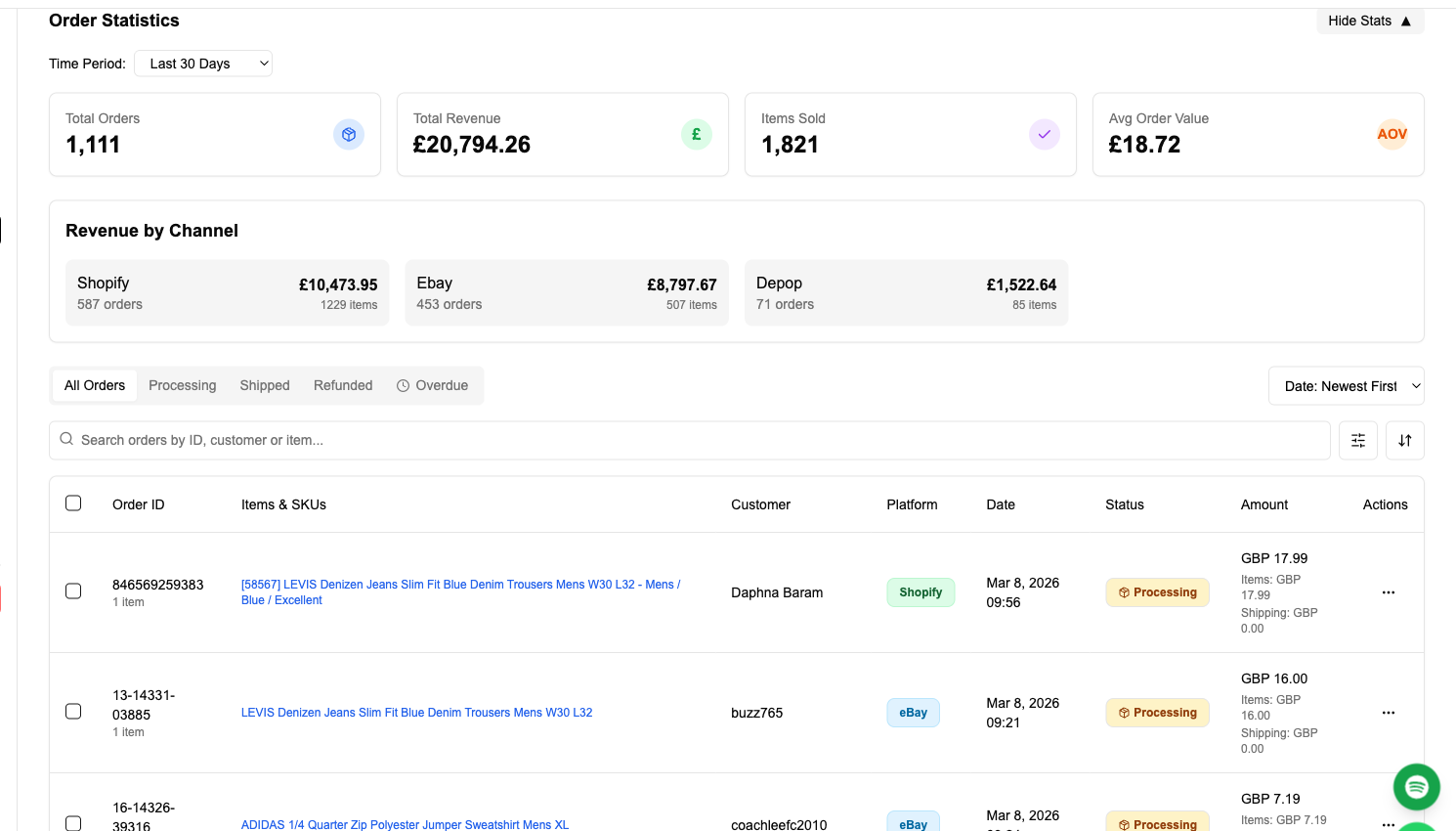
This is the part of the pair that is different from any other Poshmark crosslist. Shopify is FLUF Connect’s order-truth hub. When an item sells on Poshmark it is delisted from Shopify (and any other connected channels) within minutes. When an item sells on Shopify, the same happens in reverse. Every marketplace order — Poshmark, eBay, Depop, Vinted, Etsy, Facebook Marketplace, Whatnot — also flows into Shopify as a real order, so you ship from one screen with one fulfilment workflow.
What Transfers When You Crosslist from Poshmark to Shopify
| Poshmark Field | Shopify Field | Transfer Status | Notes |
|---|---|---|---|
| Title (up to 80 chars) | Title (unlimited) | ✅ Automatic | Transfers untouched; Shopify has no character limit |
| Description | Description (full HTML) | ✅ Automatic | HTML formatting preserved; richer than Poshmark’s plain-text description |
| Photos (up to 16) | Product images (unlimited) | ✅ All transfer | Every Poshmark photo carries across; order preserved |
| Cover photo | Featured image | ✅ Automatic | Poshmark cover_shot becomes Shopify featured image |
| Price (USD) | Price (store currency) | ✅ Automatic | Currency follows your Shopify store; conversion at current rate where needed |
| Original price (MSRP) | Compare at price | ✅ Automatic | Used to display “Save $X” strike-through on your storefront |
| Brand | Vendor | ✅ Automatic | Shopify’s vendor field maps cleanly from Poshmark brand |
| Department + Category + Feature | Product type + Tags + Collection | ⚡ Smart mapped | Poshmark’s 3-level tree is mapped into Shopify product type + auto-collection tags |
| Size | Variant: Size | ⚡ Mapped | Becomes a Shopify variant option; multi-item Poshmark listings produce one variant per size |
| Colour (Poshmark’s 15-colour palette) | Variant: Colour | ⚡ Mapped | Two-colour Poshmark items become two-option Shopify variants |
| Condition (NWT, NWOT, EUC, VGUC, GUC) | Metafield: condition | ⚡ Mapped | Lives in a custom metafield; your theme can display it on the product page |
| Style tags (up to 3) | Tags | ⚡ Mapped | Style vocabulary becomes Shopify tags for collections and filters |
| Inventory mode (single / multi-item) | SKU + stock level | ✅ Both supported | Single-item maps to qty 1; multi-item produces variants with per-size stock |
| — | SEO title + SEO description | ⚠️ Defaults from title/description | Auto-populated; editable per product |
| — | Product weight + dimensions | ⚠️ Defaults from category | Pulled from your category defaults; required for shipping calculation |
Legend: ✅ Automatic. ⚡ Mapped. ⚠️ Defaults you set once. ❌ Not available.
The Variant Win
Multi-item Poshmark listings — say a t-shirt you have in five sizes — are awkward on Poshmark (you list them as a single multi-item listing with size_quantities). On Shopify the same product becomes one cleanly-variant SKU with per-size stock, ready for restock alerts, bundle pricing, and gift cards. Crosslisting unlocks the Shopify-native shape of the product you may already be reluctantly squeezing into Poshmark’s single-product UI.
Category Mapping Examples
| Poshmark Path | Shopify Product Type | Auto-applied Tags / Collection |
|---|---|---|
| Women > Dresses > Mini | Dress | Tags: women, dresses, mini; Collection: Women’s Dresses |
| Women > Pants > Leggings | Activewear Bottom | Tags: women, leggings, activewear; Collection: Activewear |
| Men > Shoes > Sneakers | Shoe | Tags: men, shoes, sneakers; Collection: Men’s Footwear |
| Women > Bags > Crossbody Bags | Bag | Tags: women, bags, crossbody; Collection: Women’s Bags |
Inventory Sync — Shopify as the Order-Truth Hub
| Event | What Happens | Timing |
|---|---|---|
| Item sells on Poshmark | Shopify product stock decremented (or delisted if last unit) | Within minutes |
| Item sells on Shopify | Poshmark listing taken down | Within minutes |
| Item sells on any other connected channel (eBay/Depop/Vinted/etc.) | Shopify stock decremented; order replicated into Shopify as a real order | Within minutes |
| Stock manually edited on Shopify | All connected channels updated | Within minutes |
| Price edited on Shopify | Connected channels NOT auto-updated (each channel has its own pricing strategy) | — |
| New product created on Shopify (manually or via app) | Auto-crosslist rules can be set to push to Poshmark + other channels | — |
| Item refunded on any channel | Stock restored on Shopify and any connected channels | Within hours |
Every Poshmark order, every eBay order, every Vinted order — they all land in Shopify as a real order. Tracking, shipping labels, fulfilment, returns and customer notifications all run from Shopify’s one order screen. The accountant gets one CSV at the end of the month; the warehouse runs one pick list. The same architecture that powers crosslisting also collapses fulfilment.
Crosslisting from Poshmark to Shopify: Before and After FLUF Connect
Without FLUF Connect (Manual)
- Open Poshmark listing.
- Save the title, description, all 16 photos.
- Open Shopify admin; create a new product.
- Upload photos one at a time; reorder.
- Paste title and description; reformat in HTML.
- Pick product type and create or attach collections.
- Set vendor (brand).
- Create variants for size — one variant per size with its own SKU and stock level.
- Set SEO title and meta description for the product page.
- Set weight and dimensions for shipping calculation.
- Add condition information manually (Shopify has no native condition field — needs a metafield or description note).
- Publish.
- Open a spreadsheet; record the Shopify product ID against the Poshmark listing ID.
- When an item sells on either side: manually edit stock on the other.
Time per item: 15–25 minutes. Time per 500-item closet: 100+ hours.
With FLUF Connect
- Select items in the FLUF Connect dashboard.
- Click “Crosslist to Shopify”.
- Review (everything pre-mapped, variants auto-created).
- Confirm.
- Done — all future orders auto-sync into Shopify as well.
Time per item: about 30 seconds. Time per 500-item closet: about 4 hours one-off, then zero ongoing.
Automation Features for Poshmark and Shopify Sellers
Auto-Crosslisting Rules
The natural workflow for Poshmark + Shopify sellers is to make Poshmark the source-of-truth for new inventory (because it is fastest to list there) and have FLUF Connect auto-create the matching Shopify product. Set a rule once: “any new Poshmark listing in the Designer category creates a matching Shopify product in the Designer collection”. Then every new Poshmark item appears on your store without you touching anything.
Bulk Operations Across Both
Run find-and-replace across Shopify product descriptions and Poshmark closet descriptions at once — update shipping copy, swap a discontinued brand mention, or add a seasonal note. Drop prices by a percentage across a Shopify collection and the matching Poshmark items in one operation. See bulk operations.
Smart Pricing
Different channels often want different price points — Poshmark buyers expect “Make an offer”, Shopify direct-store buyers do not. FLUF Connect’s Smart Pricing rules can apply a Shopify uplift versus Poshmark, or a Poshmark discount window, while keeping inventory unified.
Offer Management on Poshmark
Send-offer-to-likers on Poshmark runs automatically — a 10% discount to anyone who has liked a listing for 48 hours, for example. Shopify-side promotions (discount codes, store-wide sales) are handled in Shopify natively. FLUF Offer Management handles the Poshmark side.
Order Centralisation
This is the highest-value automation in the Poshmark + Shopify pair. Every channel order ends up in Shopify as a real order — same line items, same buyer details, same tracking. One ship-from address; one CSV for the accountant; one returns workflow. See FLUF Inventory Sync.
Feature Support Per Channel
| Feature | Poshmark | Shopify |
|---|---|---|
| Crosslisting | ✅ | ✅ |
| Auto-relisting | ⚠️ Posh Sharing | N/A — Shopify has no algorithmic feed |
| Offer management | ✅ | Native Shopify discount codes |
| Inventory sync | ✅ | ✅ (native, bidirectional) |
| Order sync | Roadmap → Shopify | ✅ (truth hub) |
| Bulk operations | ✅ | ✅ |
| Variants (size + colour) | ⚠️ Multi-item only, no real variants | ✅ Native multi-option variants |
How Much Does It Cost to Crosslist from Poshmark to Shopify?
| Plan | Price | Products | Includes |
|---|---|---|---|
| Growth | £19/month | 500 | All automation features, all supported channels |
| Seller | £99/month | 5,000 | All automation features, all supported channels |
| Super Seller | £299/month | Unlimited | Priority sync, all features |
There is no free plan. £19/month for FLUF Connect, $39/month for Shopify Basic — a total under $65/month to run your own brand store alongside your Poshmark closet. Compared to the cost of doing this manually (15+ minutes per Poshmark listing to recreate in Shopify, plus a daily reconciliation routine to prevent overselling), the pricing pays for itself on the first day you crosslist a non-trivial closet.
Why FLUF Connect rather than a Shopify-only multi-channel app like Channable or Codisto? Those apps cover Shopify → eBay/Amazon/Google Shopping but do not support Poshmark. FLUF Connect was built around the marketplace-first reseller, with Poshmark, Depop, Vinted, Vestiaire Collective and Whatnot first-class. The same dashboard manages all of them.
Related Guides
- Crosslist from Poshmark to eBay — broadest single audience
- Crosslist from Poshmark to Depop — for Y2K and Gen Z items
- Crosslist from Poshmark to Etsy — vintage 20+ year items only
- Crosslist from Poshmark to Vestiaire Collective — designer / luxury
- How to Sell on Poshmark
- How to Sell on Shopify
- Crosslisting Hub
- FLUF Inventory Sync — Shopify as truth hub
- Crosslist Poshmark to WooCommerce
Sources & Verification
- Poshmark seller fees and US/CA-only operations: Poshmark fees 2026, TechCrunch — Poshmark UK/AU/IN closure.
- Shopify merchant count: DemandSage — Shopify statistics 2026.
- Shopify pricing: Shopify official pricing.
Frequently Asked Questions
FLUF Connect's Growth plan is £19/month for 500 products with every automation feature included. There is no free plan. Shopify Basic is $39/month (or $29/month annual) plus payment processing (2.9% + 30¢ US on Shopify Payments). Total under $65/month to run an owned brand store alongside your Poshmark closet.
Yes — and Shopify is FLUF Connect's order-truth hub. When an item sells on Poshmark, FLUF Connect decrements the Shopify product stock or delists it within minutes. When Shopify wins the sale, the Poshmark listing comes down. Every other marketplace order (eBay, Depop, Vinted, Etsy, Vestiaire Collective) also lands in Shopify as a real order for unified fulfilment.
Yes — Shopify supports unlimited product images, so all 16 Poshmark photos transfer with their order preserved and the cover shot becomes the Shopify featured image.
Multi-item Poshmark listings — for example a t-shirt in five sizes — become a single Shopify product with one variant per size, each with its own SKU and stock level. This is the natural Shopify shape and unlocks restock alerts, bundle pricing and gift cards that Poshmark cannot offer.
Yes — the Poshmark brand becomes the Shopify vendor field, which is queryable, filterable and works with most Shopify themes' brand pages.
Shopify has no native condition field, so FLUF Connect writes the Poshmark condition (NWT, NWOT, EUC, VGUC, GUC) to a Shopify product metafield. Your theme can display it on the product page; you can also filter or search by it in the admin.
Yes. FLUF Connect supports 17+ channels. Once your Poshmark products are in Shopify, you can crosslist outward from Shopify to eBay, Depop, Vinted, Etsy, Vestiaire Collective, Whatnot, Facebook Marketplace and more — making Shopify the catalogue hub for every channel.
Yes — Shopify is your own store, not a marketplace. There are no built-in buyers; you bring them via Instagram, TikTok, email, SEO or paid ads. Crosslisting from Poshmark to Shopify lets you keep Poshmark's free demand while building the brand store you own. The pair fits sellers ready to invest in marketing; sellers wanting immediate sales without marketing effort should use the Poshmark to eBay route first.
About 30 seconds per item with FLUF Connect; about 15–25 minutes per item manually. A 500-listing closet takes a single afternoon with FLUF Connect; manually it would take 100+ hours.
Those apps cover Shopify outbound to eBay/Amazon/Google Shopping but do not support Poshmark, Depop, Vinted or Vestiaire Collective. FLUF Connect was built around the marketplace-first reseller, with Poshmark, Depop, Vinted, Vestiaire Collective and Whatnot all first-class channels. The same dashboard manages all of them, and the £19/month entry covers more channels than any Shopify-app competitor's equivalent tier.