Crosslist from Bidzzy to eBay — Same Fee Model, Very Different Reach
Bidzzy charges sellers nothing and puts a protection fee on the buyer — which is exactly what eBay does for UK private sellers. So this route is about reach, not cost: eBay has 136 million active buyers, and Bidzzy is newer and growing.



- Bidzzy is not an auction site, despite the name. It is fixed-price with offers — its help centre covers accepted offers and minimum offers, and has no bidding at all.
- It is new and growing. Its iOS app launched on 24 June 2026.
- Its fee model is the same one eBay uses for UK private sellers — no subscription, no listing fee, no commission, with the buyer paying a protection fee. Bidzzy’s is typically 3%–7.5% plus a small fixed fee, capped at £16.99. eBay’s is £0.10 + 7% to £20, then 4% and 2%.
- So this is about reach, not cost. eBay reported 136 million active buyers in the year to 30 June 2026. Bidzzy is newer and smaller.
- Crosslisting means keeping both, not choosing. The free Bidzzy listing costs you nothing to leave up.
- If you sell clothing, size and condition are the thing to get right. From August 2026 eBay may hide apparel and footwear listings with unclear or missing size or condition details.
- You will need an eBay business account. eBay states that only business sellers are eligible to use third-party tools and APIs — which is what a crosslisting tool is.
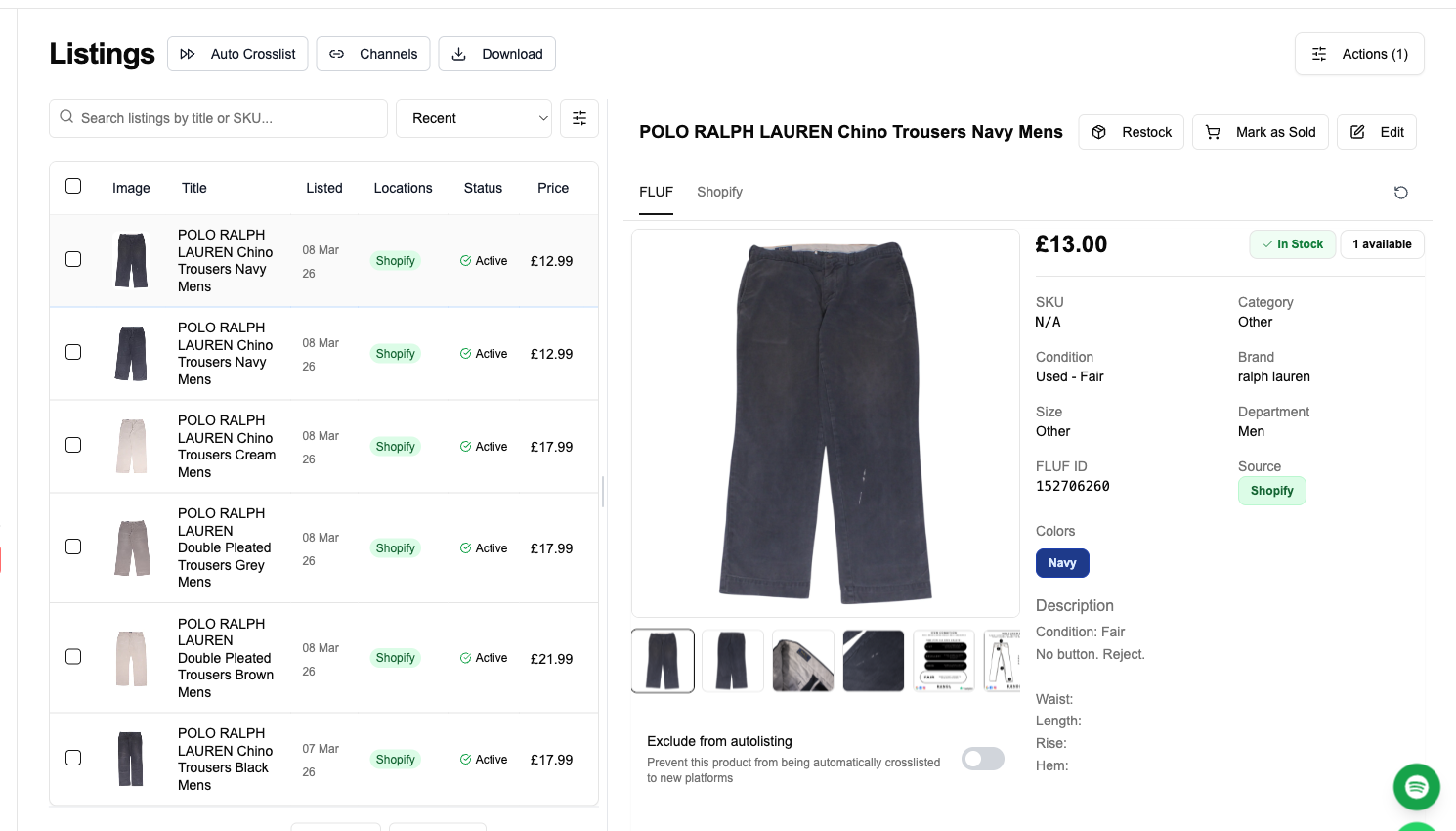
- Cost: FLUF Connect crosslists to 70+ marketplaces from one dashboard. 7 days for £1, then from £9/month. There is no free plan.
What Bidzzy actually is
Two corrections before anything else, because both are easy to get wrong.
The site is bidzzy.co.uk. bidzzy.com is not Bidzzy’s site.
It is not an auction site. Despite the name, its help centre covers accepted offers and minimum offers, with no bidding. It is a fixed-price marketplace with offers, structurally much closer to Vinted or Depop than to a traditional auction.
Beyond that: the iOS app arrived on 24 June 2026. Its homepage describes it as a place to “buy and sell fashion, tech and more across the UK”, and elsewhere as “The Preloved Marketplace” and “a UK marketplace built for real people”.
Its catalogue filters — Unisex, Category, Size, Brand, Condition, Colour, Price, Material, Style — are built around apparel, alongside its wider “tech and more” range. Buyers can be anywhere in the UK, including Northern Ireland, the Highlands and Islands, the Isle of Man and the Channel Islands, with a remote-area surcharge for some. Sellers must be on the UK mainland.
Its “why Bidzzy” page names no competitor; it describes itself as new and building alongside its sellers and buyers.
The two platforms charge in the same shape
This is the finding that reframes the route, and it runs against the usual story about marketplace fees.
Bidzzy, verbatim from its own site: “No subscription. No listing fees. No commission taken from your sale price” — and buyers cover shipping and a buyer protection fee (typically 3%–7.5% of the item price plus a small fixed fee, capped at £16.99; the buyer sees the exact fee before paying). Its business-seller guide adds: “You receive the item price. Bidzzy collects the delivery charge and Buyer Protection fee and pays the carrier separately.” Payouts run through Stripe, which must verify every seller receiving them; business-seller funds are normally released after the 14-day cancellation window.
eBay UK, for private sellers, works identically in structure. The seller pays £0 in selling fees; the buyer pays a Buyer Protection fee added on top of the displayed price: £0.10 flat per item, plus 7% of the price up to £20, 4% of the portion from £20 to £300, and 2% of the portion to £4,000, with nothing above that. Vehicles, Classified Ads and Property are excluded. Private sellers get 300 free listings a month, or 400 with a Shop, and 35p after.
| A £40 item | Bidzzy | eBay UK, private seller |
|---|---|---|
| Seller pays | £0.00 | £0.00 |
| Buyer protection fee | Set by Bidzzy; the buyer sees it before paying | £2.30 (£0.10 + 7% of £20 + 4% of £20) |
| Listing cost | Free, no stated limit | Free within 300 a month |
Both charge sellers nothing and put the protection fee on the buyer, so the reason to crosslist is not seller cost.
Business sellers are a different story, and if you are moving stock at volume this is the schedule that applies to you. eBay UK charges a category final value fee — 11.9% on Clothes, Shoes & Accessories, 9.9% on Books, Cameras and Computers, 12.5% on Business, Office & Industrial — plus a per-order fee of 30p up to £10 or 40p above, plus a 0.35% regulatory operating fee, or 0.42% including VAT. Shops cost £27, £77 or £437 a month. The upper per-order band rose from 30p to 40p on 12 February 2026.
Against that, Bidzzy takes nothing from a business seller either. Its zero-commission model is genuinely, materially cheaper than eBay business rates. The constraint is entirely on the other side of the ledger.
The size difference
Bidzzy is new and growing. eBay is far larger, and Bidzzy does not publish the figures that would let you compare them directly.
| Bidzzy | eBay | |
|---|---|---|
| Buyers | Not published | 136 million active buyers, year to 30 June 2026 |
| GMV | Not published | $22.4bn in the quarter to 30 June 2026, up 15% |
Bidzzy does not publish user, listing or GMV figures.
The conclusion for any newer marketplace: crosslisting is additive. The Bidzzy listing is free to create and free to leave up, so it costs you nothing but the minutes to make it, and it might sell. eBay is where the buyers are today. You do not have to decide which platform deserves your loyalty; you have to remember to pull one listing when the other sells.
What eBay needs that Bidzzy does not
A listing that publishes cleanly to a newer marketplace will not necessarily publish to eBay. Four differences matter.
Titles are short and load-bearing. eBay gives you 80 characters and tells sellers to use as many as they can, including brand, model or type, colour, style and even the model number, avoiding special characters and irrelevant words. Bidzzy’s filter-driven catalogue means its structured fields do more of the work; on eBay the title is the primary search surface.
Item specifics can block the listing entirely. When you list, eBay prompts for required information such as size, colour, brand and style, and a listing missing required item specifics cannot be published. Which ones are required varies by category, so this is not a fixed checklist you can prepare once.
Apparel is being actively enforced, and this is the one to watch. eBay told UK sellers in August 2026 that it is standardising fashion sizes and that they should update their fashion listings that month to keep selling smoothly. For anyone moving apparel off a platform whose size data is a filter field rather than a validated attribute, this is the most likely cause of a listing that goes live and then quietly stops performing.
GPSR applies to European buyers only, and the exclusion matters. Business sellers listing to EU or Northern Ireland buyers must supply manufacturer name and contact, an EU-based Responsible Person where the manufacturer sits outside the EU, model and type details, and safety warnings in the local language. But eBay is explicit that the regulation “does not apply to sales to UK buyers, with the exception of Northern Ireland”, so a purely domestic ebay.co.uk seller is unaffected. If Bidzzy is your whole business today, that is a compliance question you have never had to answer — and you only have to answer it if you sell into Europe.
One Bidzzy-side rule worth carrying across in the other direction: it prohibits stock and AI-generated images for both individual and business sellers. eBay’s picture policy is similar in spirit, prohibiting borders, added text, watermarks and stock photos on used items, so photographs that satisfy Bidzzy will generally satisfy eBay.
The business-account question
Both platforms define a business seller, and their definitions agree closely enough that if you are one on Bidzzy you are one on eBay.
Bidzzy’s triggers: “You buy items with the intention of reselling them at a profit”, “You make or craft items to sell”, “You sell regularly and it forms part of your income.” eBay’s: a seller must register as a business “if, for example, they sell items they have bought to resell, they make items in order to sell them, or if they buy items for their business”.
There is one consequence specific to crosslisting, and it is easy to miss. eBay states that “only business sellers are eligible to benefit from the use of third-party tools and APIs”. A crosslisting tool is exactly that. So the decision to automate is also, on eBay, a decision to be a business seller — which brings a returns policy, a 14-day right of withdrawal, 30-day faulty returns, full business details, a VAT number if registered, and no restocking fees or buyer-paid return postage. It also moves you off the private-seller fee schedule and onto the category rates above.
That is not a reason to avoid crosslisting. It is a reason to do the arithmetic on the business schedule rather than the private one before you start, because the fee comparison earlier in this page changes completely depending on which side of that line you sit.
Field mapping: Bidzzy listing to eBay listing
| Bidzzy field | eBay field | Transfer | Notes |
|---|---|---|---|
| Title | Title (80 characters) | ⚡ Rewritten | eBay wants brand, model, colour and style packed in; Bidzzy leans on filters instead |
| Description | Description | ✅ Automatic | Free text on both |
| Brand | Brand item specific | ⚡ Mapped | Often a required aspect on eBay |
| Size | Size item specific | ⚠️ Validate | The field eBay is standardising through 2026 — get it structured, not descriptive |
| Condition | Condition | ⚡ Mapped | Structured on both; eBay uses defined values rather than free text |
| Colour, Material, Style | Item specifics | ⚡ Mapped | Bidzzy’s filter schema maps unusually cleanly here |
| Photos | Photos | ✅ Automatic | Both prohibit stock imagery. Bidzzy requires at least three original photos |
| Price | Buy It Now price | ✅ Automatic | Both are fixed-price with offers, so the format matches directly |
| Offers | Best Offer | ⚡ Mapped | The closest structural equivalent between the two platforms |
| Shipping | Postage options | ⚡ Rebuilt | Bidzzy arranges the courier and collects the charge; on eBay you choose and price the service |
Because both platforms are fixed-price with offers and both use a structured apparel schema, this is one of the cleaner mappings on any crosslisting route. The work is concentrated in two places: writing a proper eBay title, and making sure size is a validated value rather than something typed into a description.
What FLUF Connect syncs, and what it does not
What works. eBay is among the most fully supported channels in FLUF Connect — crosslisting, relisting, offer management, order sync and sold-detection all work. So a sale on eBay is detected and can drop the item from your other channels automatically.
What is still manual. Bidzzy supports crosslisting, order sync and sold-detection, but not relisting or offer management. Offers are handled in the Bidzzy app. For one-of-one secondhand items, check that a sale on either side has cleared the other before you ship.
Two things make that easier here than on most routes. Both platforms are fixed-price, so there is no auction you cannot withdraw from — the item can be pulled from either side at any moment. And Bidzzy holds business-seller funds until after the 14-day cancellation window, which gives you a longer look at an order before it is settled.
Sources and verification
- Bidzzy “Why Bidzzy” — “No subscription. No listing fees. No commission taken from your sale price”, and the buyer protection fee (typically 3%–7.5% plus a small fixed fee, capped at £16.99).
- Bidzzy business seller guide — the seller receiving the item price, Stripe verification of every seller receiving payouts, fund release after the 14-day cancellation window, the business-seller triggers, and the ban on stock and AI-generated images.
- Bidzzy help centre — accepted offers and minimum offers, with no bidding language; and buyer coverage across the UK, with sellers on the mainland.
- Bidzzy on the App Store — version 1.0 released 24 June 2026.
- eBay UK Buyer Protection — £0 private-seller selling fees, the £0.10 plus 7%, 4% and 2% fee bands, and the Vehicles, Classified Ads and Property exclusions.
- eBay UK rate change of 12 February 2026 — the per-order fee rising from 30p to 40p above £10, and the category rate changes; plus the business-seller fee schedule and shop tiers at £27, £77 and £437.
- eBay UK business seller policy — when registration is required, the obligations that follow, and that only business sellers may use third-party tools and APIs.
- eBay UK listing guidance — the 80-character title advice and the prompt for required item specifics; and the August 2026 seller update on standardising fashion sizes.
- eBay UK on GPSR — effective 13 December 2024 for new and second-hand goods sold to EU and Northern Ireland buyers, and the explicit exclusion of non-Northern-Ireland UK buyers.
- eBay Q2 2026 results — 136 million active buyers, $22.4bn GMV and $3.1bn revenue.
What we could not verify, and therefore left out. Bidzzy’s photo limit per listing, its listing duration or expiry rules, its full category tree, its courier partners, its withdrawal timing for individual sellers, and any user, listing or GMV figures — it publishes no volume data at all. Its social following, since its site links only one profile. Whether Bidzzy formally describes itself as non-auction, which it does not state either way. And any eBay fee or policy change dated 1 September 2026 affecting UK sellers — we looked and found none, and would rather say so than invent one. The real nearby change is that from 1 July 2026 eBay introduced an additional 7% on final value fees for UK accounts rated Below Standard for four or more consecutive months.
Related guides
- Sell on Bidzzy — the complete seller guide
- Sell on eBay — the complete seller guide
- Crosslist from eBay to Gumtree
- Crosslist from eBay to Vinted
- Crosslist from eBay to Depop
- All crosslisting routes
- Crosslist from Bidzzy to Shopify
- Crosslist from Bidzzy to Facebook Marketplace
- Crosslist from Causee to eBay — the same move from another young UK marketplace
- Crosslist from Bidzzy to Grailed
- Crosslist from Cardmarket to eBay
- Bidzzy vs eBay
- Crosslist from eBay to Bidzzy
Frequently Asked Questions
No. Bidzzy is a fixed-price marketplace with offers and no bidding. Its help centre covers accepted offers and minimum offers, so the format maps directly onto eBay Buy It Now with Best Offer.
bidzzy.co.uk. bidzzy.com is not Bidzzy's site.
Nothing. Its own wording is "No subscription. No listing fees. No commission taken from your sale price", with buyers covering shipping and a buyer protection fee of typically 3%–7.5% of the item price plus a small fixed fee, capped at £16.99; the buyer sees the exact fee before paying. Its business-seller guide adds that you receive the item price while Bidzzy collects the delivery charge and protection fee and pays the carrier separately. Payouts run through Stripe, which must verify every seller receiving them, and business-seller funds are normally released after the 14-day cancellation window.
For a business seller, yes and clearly: Bidzzy takes no commission, while eBay's business rates are 11.9% on clothing plus a per-order fee and a 0.35% regulatory fee. For a private seller both charge nothing; the difference is the buyer-side protection fee, which on Bidzzy varies with price and is shown to the buyer before paying.
Reach. eBay reported 136 million active buyers in the year to 30 June 2026 and $22.4bn of GMV in that quarter alone. Bidzzy is newer and smaller and publishes no user or sales figures. Crosslisting is additive: the free Bidzzy listing costs nothing to leave up while eBay finds you buyers today.
Yes, and for a reason people miss. eBay states plainly that "only business sellers are eligible to benefit from the use of third-party tools and APIs" — which is exactly what a crosslisting tool is. So deciding to automate is also deciding to be a business seller on eBay, which brings a returns policy, a 14-day right of withdrawal, 30-day faulty returns, full business details and a VAT number if registered, and moves you off the free private-seller schedule onto the category fee rates. Do the arithmetic on the business schedule before you start.
Most likely size data. eBay told UK sellers in August 2026 that it is standardising fashion sizes and that they should update their fashion listings that month to keep selling smoothly. A listing with unclear or missing size or condition details is not rejected outright — it can simply stop being surfaced, which is much harder to diagnose. If you are moving apparel off a platform where size is a filter field rather than a validated attribute, structure it properly on the eBay side rather than describing it in prose.
No. eBay is explicit that the General Product Safety Regulation "does not apply to sales to UK buyers, with the exception of Northern Ireland", so listings on ebay.co.uk offered to non-Northern-Ireland UK buyers are unaffected. It applies from 13 December 2024 to new and second-hand goods sold to EU and Northern Ireland buyers, where a business seller must supply manufacturer name and contact, an EU-based Responsible Person where the manufacturer sits outside the EU, model and type details, and safety warnings in the local language.
Not one we could find for UK sellers, and we would rather say so than invent one. The real nearby change is that from 1 July 2026 eBay introduced seller-performance-related fees on selected marketplaces including the UK — an additional 7% on final value fees where an account has been rated Below Standard for four or more consecutive months. Separately, on 12 February 2026 the UK per-order fee for orders above £10 rose from 30p to 40p, and several category rates changed.
Yes, in both directions. A Bidzzy sale withdraws the matching eBay listing automatically, and an eBay sale withdraws the Bidzzy listing. Offers are handled in the Bidzzy app, and relisting is not available for Bidzzy.
Sign up for free
Join the community
You're in.
Open your dashboard