
Crosslist from WooCommerce to Shopify — Sync Your WordPress Store With FLUF’s WordPress Plugin
Run both? Keep one catalogue in your WordPress store and mirror it into Shopify automatically from wp-admin.



TL;DR: The FLUF Connect plugin for WooCommerce syncs your WordPress catalogue into Shopify from wp-admin. Titles, descriptions, photos, prices, variants and stock transfer to Shopify’s product catalogue automatically. This is for the growing number of merchants who run both — a self-hosted WordPress store for ownership and SEO, plus a Shopify storefront for POS, checkout conversion or a separate brand — and want one catalogue feeding both without maintaining two product databases by hand.
WooCommerce and Shopify are usually framed as rivals — and they are the two biggest names in e-commerce software. WooCommerce, the WordPress e-commerce plugin, powers around 6.18 million live selling sites and roughly 38.7% of all e-commerce websites by count (WooCommerce market share). Shopify hosts about 2.92 million live stores and processed an estimated $378 billion in GMV in 2025 (Shopify statistics 2025). But plenty of sellers run both — and for them the real problem is keeping one catalogue in sync across two platforms. The FLUF Connect plugin for WooCommerce solves exactly that.
This page is deliberately not a “which is better” argument. If you have already decided to run a WordPress store and a Shopify storefront side by side — and many serious sellers do — the question that actually costs you time is operational: how do you avoid maintaining the same products, prices and stock in two separate systems? Re-typing a catalogue into Shopify, then keeping it current by hand as WooCommerce changes, is the kind of duplicated effort that quietly eats hours every week. FLUF makes WooCommerce the single source and lets Shopify mirror it.
The underlying difference between the two platforms is ownership versus convenience. WooCommerce is open-source and self-hosted on WordPress: you own the store outright, pay no platform subscription, and control your data — but you manage hosting, security and updates yourself. Shopify is hosted SaaS: a fixed monthly fee buys fully managed infrastructure, a fast checkout and a deep app ecosystem (WooCommerce vs Shopify comparison). Running both lets you keep the WordPress store you own while tapping what Shopify does well — and a catalogue sync is what makes that practical instead of painful.
Why a WooCommerce Store Owner Would Also Run Shopify
Shopify POS for selling in person
Shopify POS unifies in-person and online sales, inventory and customers in one system. WooCommerce has no official point-of-sale and relies on third-party add-ons, so a WordPress store owner who also sells at markets, pop-ups or a physical shop often adds a Shopify store specifically for POS while keeping WooCommerce as the web home base. With the catalogue synced, the same products are sellable on the shop floor and online without separate entry.
Higher checkout conversion for paid traffic
Shopify reports its checkout converts on average around 17% higher than a comparable WooCommerce checkout (Shopify comparison). For some product lines, mirroring the catalogue to a Shopify storefront and pointing paid traffic (Meta, Google Shopping, TikTok) at Shopify’s optimised checkout can lift conversion enough to justify the subscription — while your WordPress store continues to win the organic, content-driven traffic it is better suited to.
A second brand or a managed sales channel
Shopify’s app ecosystem (around 8,000 apps versus WooCommerce’s roughly 900 extensions) and native sales channels make it a low-maintenance home for a sub-brand, a wholesale storefront, or a market you do not want running on your main WordPress install. Keeping the product data unified means launching that second storefront is a sync, not a rebuild.
Resilience against single-platform risk
Running on two independent platforms is also insurance. A hosting incident on your WordPress site, or a plugin conflict during an update, does not take down a separately hosted Shopify storefront — and vice versa. For a business that depends on always being able to take an order, having the same catalogue live in two places is a quiet form of redundancy.
How the FLUF Connect Plugin Syncs WooCommerce to Shopify
Install the FLUF Connect plugin in WordPress and use your WooCommerce catalogue as the source for products you publish to Shopify.
Step 1: Install the FLUF Connect plugin in wp-admin
From WordPress, go to Plugins → Add New, search “FLUF Connect”, then install and activate it. Follow the setup prompts. No FTP access or coding is required.
Step 2: Connect your Shopify store
Click “Connect Shopify” and follow Shopify’s authorisation prompts. No browser extension is required. Review your products and variants before publishing.
Step 3: Sync the catalogue
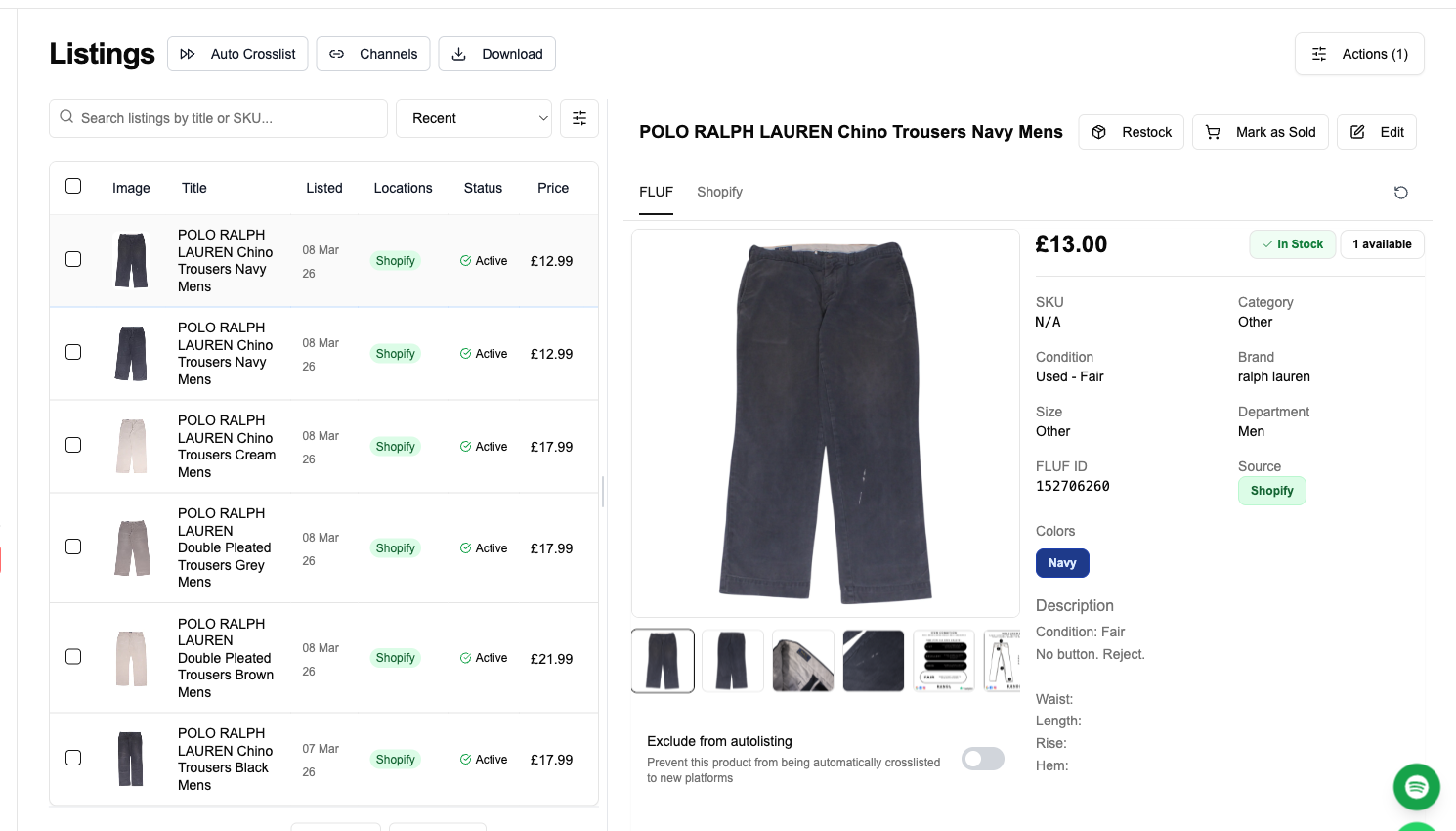
Choose which WooCommerce products to mirror. FLUF maps each product’s title, description, photos, price, variants and stock into a Shopify product, including variant-level prices and SKUs. From then on, your WordPress store stays the single place you maintain product data, and Shopify reflects it. You can sync your whole catalogue or just a curated subset — useful if your Shopify storefront carries only a focused product line.
Keep one catalogue in WordPress; mirror it into Shopify automatically.
Shopify Costs: What a WooCommerce Seller Pays
Shopify has no per-listing fee, but it does charge a monthly subscription plus payment fees — the opposite cost shape to WooCommerce:
| Plan | Monthly (billed annually) | Card rate (Shopify Payments) |
|---|---|---|
| Basic | $39 ($29) | 2.9% + 30¢ |
| Grow | $105 ($79) | 2.7% + 30¢ |
| Advanced | $399 ($299) | 2.5% + 30¢ |
Figures from Shopify’s pricing page. There is an important catch for sellers who already have a payment processor they prefer: if you use a third-party gateway instead of Shopify Payments, Shopify adds a transaction surcharge of 2% / 1% / 0.6% by plan, on top of the gateway’s own card fee. That surcharge disappears entirely if you use Shopify Payments. This is the structural trade-off versus WooCommerce, where there is no platform subscription and no transaction surcharge of any kind — you simply pay your own gateway and manage the stack yourself.
FLUF Connect itself has no free plan — plans start at £9/month (Starter) — and catalogue sync is included in every plan, and automation from Seller upwards rather than charged as a paid add-on. So the running cost of a dual setup is your Shopify subscription plus your FLUF plan, in exchange for never maintaining the catalogue twice.
What Transfers from WooCommerce to Shopify
| Field | WooCommerce source | In Shopify |
|---|---|---|
| Title | Product name | Product title |
| Description | Long description, else short description | Product description (HTML body) |
| Photos | Product gallery | Product media (images) |
| Price | Sale price, else regular price | Variant price |
| Variants | Variable product → child variations | Product variants (price, SKU, stock each) |
| Stock | stock_quantity |
Inventory level (per location) |
| Category | First WooCommerce category | Collection / product type |
Of all the destinations a WooCommerce store can crosslist to, Shopify is the cleanest mapping, because the two platforms model products almost identically. A WooCommerce variable product becomes a Shopify product with multiple variants, each carrying its own price, SKU, barcode and inventory (Shopify ProductVariant docs). Shopify also supports multi-location inventory, so synced stock lands against the location you choose — useful when your Shopify POS and online stock should draw from the same pool. There are no marketplace-style required “item specifics” to satisfy, so far fewer products get rejected than when crosslisting to a marketplace like eBay.
Apps and Features You Will Not Have to Duplicate
One worry sellers have about running a second platform is rebuilding all their integrations. With a mirror setup, you do not. Your WooCommerce store keeps its own plugins — email marketing, reviews, SEO, accounting connectors — and the Shopify storefront uses Shopify apps for whatever it needs on that side. The product catalogue is the only thing that has to stay in sync, and that is exactly what FLUF handles. You are not migrating your operations to Shopify; you are extending your catalogue onto it. The result is that each platform plays to its strengths — WordPress for content and ownership, Shopify for its checkout and app-driven storefront features — without you maintaining two copies of your product data.
This separation also keeps your data ownership intact. Customer records, order history and the email list on your WooCommerce store remain yours on infrastructure you control, while the Shopify side accumulates its own customer base for that channel. For a business that values owning its audience, mirroring rather than migrating is the model that preserves what WooCommerce gives you.
Keeping Prices and Promotions Aligned Across Both Stores
Running the same catalogue on two storefronts raises an obvious question: how do you keep prices consistent? Because FLUF treats WooCommerce as the source of truth, a price change on your WordPress store propagates outward to Shopify on the next sync, so the two do not silently diverge. If you intentionally run different pricing on each — for example, absorbing Shopify’s subscription cost with slightly higher prices on that storefront, or running a Shopify-only promotion — you can, but the default behaviour keeps them aligned so a markdown you make once is reflected everywhere. This removes one of the most common and embarrassing multi-store errors: a customer finding the same item cheaper on your other storefront because a price update only landed in one place.
The same logic applies to new products. Add a product once in WooCommerce and it appears on Shopify on the next sync, rather than being launched on one storefront and forgotten on the other. For a small team, having a single place where products are created and edited is worth as much as the time saved on the initial sync.
Inventory Sync: WooCommerce as Your Source of Truth
FLUF keeps your WordPress store as the master record. When stock changes in WooCommerce — a direct sale on your WordPress site, or a manual edit — FLUF syncs the new level outward to Shopify on its next check, so the two storefronts never drift apart. Maintaining product data in one place rather than two is the entire point of a dual setup done well: no more editing the same description twice, no more discovering a price that updated on only one platform, and no more reconciling stock counts at the end of the month.
Because WooCommerce is the canonical source, your workflow stays in the WordPress admin you already know. You add and edit products where you always have; Shopify becomes a mirror you rarely need to touch directly. For teams, that also means fewer places where a mistake can creep in.
How WooCommerce Categories Map to Shopify Collections
WooCommerce organises products into categories; Shopify uses collections and a product-type field. When FLUF syncs a product, it carries your first WooCommerce category across as the Shopify product type, and you can group synced products into Shopify collections — either manually or with Shopify’s automated collection rules based on product type, tag or price. This means the merchandising structure you built in WooCommerce does not have to be rebuilt by hand in Shopify; it carries enough structure for Shopify’s collection logic to take over. For stores with a deep category tree, this saves hours of re-organising and keeps the two storefronts’ navigation broadly consistent.
Migrating vs Mirroring: Keep WooCommerce as the Canonical Store
There is an important distinction between migrating to Shopify and mirroring into it. A migration is a one-time move that leaves WordPress behind; mirroring keeps your WooCommerce store as the permanent system of record and uses Shopify as an additional surface. FLUF is built for mirroring. That matters because mirroring preserves everything WooCommerce gives you — ownership, the WordPress content and SEO engine, no platform commission — while still letting you operate a Shopify storefront. You are not betting the business on one platform; you are running the owned store and the hosted store in parallel, with one source of truth feeding both.
Shopify POS: One Catalogue, Counter and Web
For sellers who add Shopify specifically for in-person selling, the synced catalogue is what makes Shopify POS practical. Every WooCommerce product you mirror becomes sellable at the counter through Shopify POS, drawing on the same product data and — because stock syncs from WooCommerce — the same inventory pool. A market trader or shop owner can take a card payment in person on Shopify POS while their WordPress store sells the same items online, without keeping two separate product lists. The web store you own and the till you ring sales through finally share one catalogue.
Multi-Currency, Markets and Scaling the Shopify Side
Shopify Markets lets a store sell in multiple currencies and regions from one storefront, which is a capability WooCommerce can match only with extensions. A seller who mirrors their WooCommerce catalogue into Shopify can use Shopify Markets to test international selling on the hosted side while keeping the WordPress store focused on its home market. Because FLUF keeps WooCommerce as the source of truth, you experiment on the Shopify storefront without disturbing the store you own — and if an international push works, the data and demand are yours to act on.
WooCommerce vs Shopify: You Do Not Have to Choose
The honest comparison is straightforward. WooCommerce wins on ownership and cost-of-entry — no subscription, no commission, total control, and the SEO and content depth of WordPress. Shopify wins on managed convenience: nothing to host or patch, a polished high-converting checkout, POS, and a vast app store. Neither is universally “better”; they are good at different things.
That is why so many established sellers stop choosing and run both — WooCommerce as the owned home base and Shopify as a specialised channel for POS, paid-traffic conversion, or a separate brand. The thing that makes that dual model sustainable rather than a maintenance headache is a reliable one-way sync from your source of truth. FLUF Connect provides exactly that, removing the duplicate-data-entry tax so the only thing you manage twice is the strategy, not the catalogue.
Getting Started With WooCommerce to Shopify
If you already run — or plan to run — both a WordPress store and a Shopify storefront, the setup is straightforward: install the FLUF Connect plugin in your WordPress admin, connect Shopify using its authorisation prompts, and choose which WooCommerce products to mirror. From then on you maintain products, prices and stock in WooCommerce, and Shopify reflects them automatically. You keep the ownership, SEO and margin of a self-hosted WordPress store while gaining Shopify’s POS, checkout and app ecosystem — without the duplicate-data-entry tax that normally makes a dual-platform setup more trouble than it is worth.
Shopify is one of many destinations — see the full WooCommerce crosslisting hub, or crosslist from WooCommerce to Vinted to add a 100M+ buyer marketplace alongside it. You can also crosslist from WooCommerce to Wallapop to reach Spanish second-hand buyers.
Sources & Verification
- Shopify pricing & fees: Shopify pricing
- Shopify scale & GMV (2025): Shopify statistics
- WooCommerce market share: RedStag Fulfillment
- Platform comparison & checkout conversion: Website Builder Expert; Shopify vs WooCommerce
- Shopify product/variant API: Shopify Admin GraphQL
- Crosslist from PrestaShop to Shopify — what native multistore and daily FX cost to replace
Also from a store platform: Crosslist from BigCommerce to Shopify.
Frequently Asked Questions
Common reasons are Shopify POS for in-person selling, Shopify's higher-converting checkout for paid traffic, or running a separate brand on Shopify while keeping your main self-hosted WordPress store. FLUF lets one WooCommerce catalogue feed both so you maintain product data once.
Yes. Install and activate FLUF Connect from your WordPress admin on a self-hosted site running WooCommerce, then follow the store connection prompts.
Yes. A WooCommerce variable product becomes a Shopify product with multiple variants, each carrying its own price, SKU and inventory level, because Shopify's product model maps cleanly onto WooCommerce's.
Yes. FLUF treats WooCommerce as the source of truth and syncs stock changes outward to Shopify on its next check, so your WordPress store and your Shopify storefront do not drift apart.
Manage crosslisting in FLUF Connect after connecting your WooCommerce store. Your customers continue using your existing storefront.
WooCommerce has no platform subscription (you pay for WordPress hosting and manage the stack yourself), while Shopify charges a monthly plan from $39 plus payment fees. Running both is a deliberate trade-off; FLUF removes the duplicate-data-entry cost of doing so.
Plans start at £9/month (Starter). There is no free plan. Catalogue sync is included in every plan, and automation from Seller upwards, not a paid add-on. Shopify's subscription and payment fees are separate.
Sync Your WordPress Catalogue Into Shopify
Plans from £9/month. Install the WordPress plugin and stop maintaining two product databases.