
Crosslist from WooCommerce to Facebook Marketplace — FLUF’s WordPress Plugin for Multi-Marketplace Selling
One WordPress plugin pushes your WooCommerce products onto Facebook Marketplace with photos, condition, brand, and currency mapped correctly — and keeps stock synced both ways.



TL;DR: The FLUF Connect plugin for WooCommerce pushes your WordPress catalogue onto Facebook Marketplace from wp-admin. Titles, descriptions, photos (up to 10), prices, condition, brand, colour, and category transfer; the listing’s displayed currency is locked to your seller currency; FLUF handles local-pickup and shipped-checkout flows independently. Best for WooCommerce stores selling furniture, home goods, electronics, baby gear, fashion, or anything where a 1.2-billion-user local audience can move stock faster than ads alone.
If your WooCommerce store sits on top of WordPress and you have ever wondered why the same item you list on your own site sits there for a month while the listing your neighbour throws on Facebook Marketplace sells in two hours, the answer is reach. WordPress gives you a branded shop on a domain you control; Facebook Marketplace puts your stock in front of over 1.2 billion monthly active Marketplace users in 227+ countries, including buyers who would never type your URL but will happily drive across town for a sofa or a pram. The FLUF Connect plugin for WooCommerce is what lets a single WordPress catalogue feed both channels without duplicate data entry.
Doing this manually is painful in a different way to other channels. Facebook Marketplace has no public seller API for individual accounts — listings are created through the same web composer a casual seller uses, one item at a time, with category attributes and shipping settings clicked through by hand. There is no bulk upload, no CSV import, no developer dashboard. For a WordPress store with even 50 SKUs the manual workflow eats hours every week. The FLUF Connect plugin for WooCommerce reuses your existing browser session via a bundled Chrome extension and pushes each WooCommerce product into the composer with its photos, attributes, and currency already mapped — exactly how Marketplace expects them.
Why WooCommerce Store Owners Should Be on Facebook Marketplace
WooCommerce gives you a branded, direct-sales website. Facebook Marketplace gives you discovery inside the world’s largest social network. The two together cover audiences a WordPress shop alone cannot reach — especially in product categories where local pickup matters or where buyers shop by scrolling rather than searching.
Your WordPress store keeps the brand and the customer relationship
WooCommerce owns the canonical record: your domain, your product database, your customer email list, your full margin on every direct sale. Repeat buyers come back to you, not to a platform’s algorithm. The trade-off is that direct traffic to a WordPress store does not appear on its own — every visitor either arrived from SEO, content, an ad, or a Marketplace listing that introduced them to the brand.
Facebook Marketplace brings buyers WordPress will never reach
Marketplace’s audience is the largest of any commerce platform in the world. One in four daily active Facebook users between 18 and 34 visits Marketplace every day, and Marketplace fees are zero for local-pickup sales regardless of category or price. That makes it the default channel for any WooCommerce SKU that is expensive to ship — furniture, exercise equipment, baby gear, large appliances, electronics — categories where a WordPress shop typically loses sales to shipping cost or carrier hassle. It is also a fast-turnover channel for fashion, accessories, and homewares priced for impulse browsing.
The two together compound
Marketplace listings double as a discovery surface for your WordPress brand. Buyers who pick up an item locally see your Facebook profile, can follow your shop, and routinely click through to a linked WordPress URL the next time they need something. Many WooCommerce sellers report that Marketplace acts as a top-of-funnel that quietly seeds direct sales on their site months later, while the immediate revenue justifies itself on its own.
How the FLUF Connect Plugin Syncs WooCommerce and Facebook Marketplace
The FLUF Connect plugin for WooCommerce is the canonical WordPress plugin for crosslisting to Facebook Marketplace and other resale marketplaces. Setup from scratch is around ten minutes.
Step 1: Install the FLUF Connect plugin in wp-admin
From your WordPress dashboard go to Plugins → Add New → search “FLUF Connect” → Install → Activate. The plugin auto-generates a WooCommerce REST API key, registers itself, and prompts you to connect a marketplace. No code, no FTP, no developer. The plugin runs inside your WordPress install so it respects your existing user roles, security plugins, caching layer, and hosting setup.
Step 2: Connect your Facebook Marketplace account
Click “Connect Facebook Marketplace” in the FLUF Connect dashboard. Because Facebook does not expose a public listing API for individual Marketplace sellers, the connection runs through FLUF Connect’s bundled Chrome extension on the browser session where you are already logged into Facebook. The extension signs every push as the seller — the path Meta tolerates for power-seller workflows — combined with FLUF’s server-side orchestration. New Facebook accounts face listing-volume restrictions enforced by Meta, so if you have just created your profile expect a low initial cap that grows with seller history. FLUF cannot bypass that — be honest with yourself about account age before scheduling a 500-product push.
Step 3: Select what to crosslist
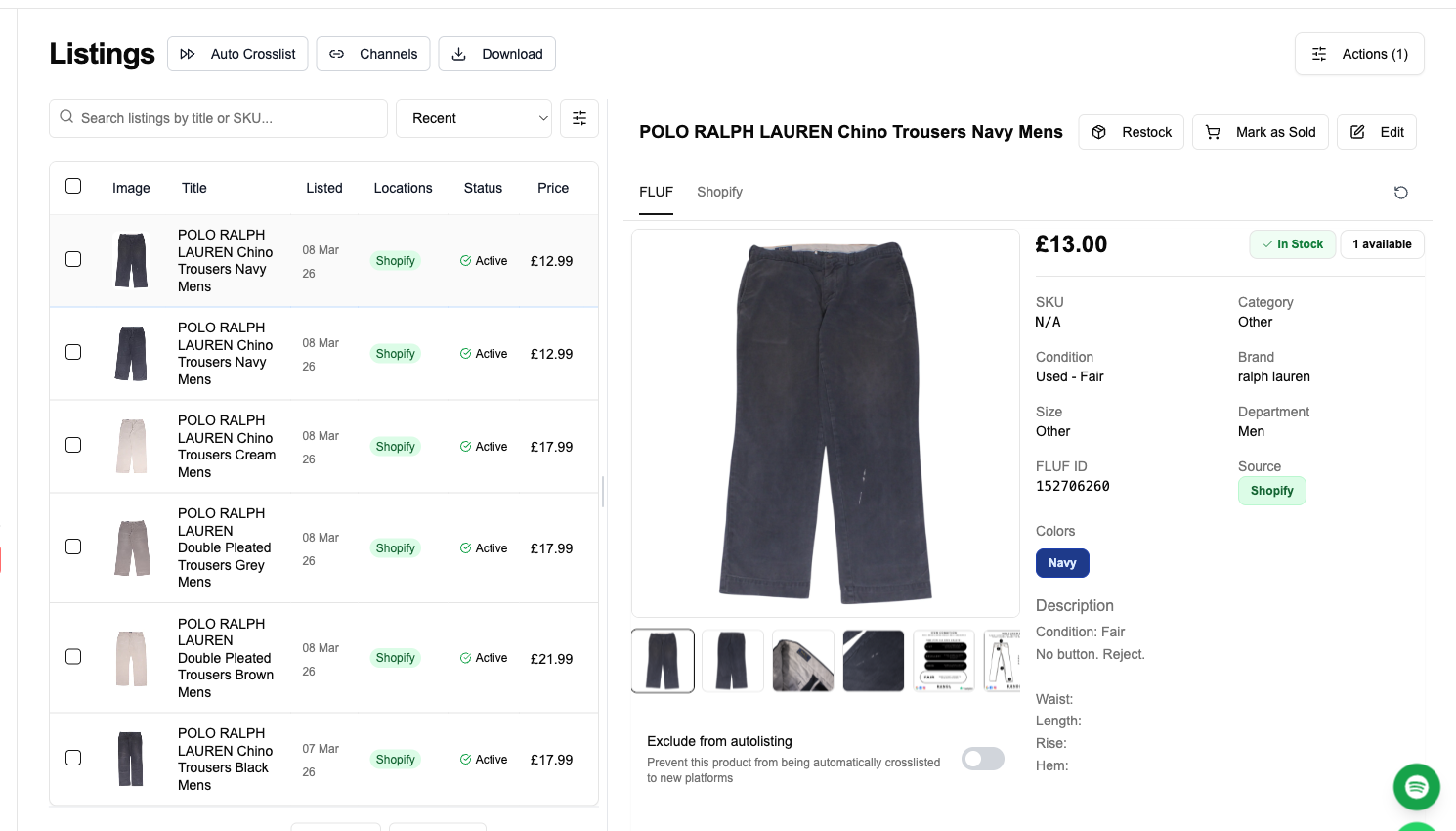
Your WooCommerce products appear in the FLUF dashboard with their Facebook Marketplace status — already live, queued, or WordPress-only. Filter by category, brand, size, tag, stock level, or location to push exactly the SKUs that match the platform. Most WooCommerce sellers do not push every product — they pick the items where Marketplace’s local-buyer audience is the natural fit and leave the rest WordPress-only.
Step 4: Push to Facebook Marketplace with photos, condition, and currency mapped
FLUF takes each WooCommerce product’s title, description, gallery, price, condition, brand, and colour and creates a corresponding Marketplace listing through Facebook’s GraphQL composer mutation. Up to ten photos transfer per listing — Marketplace’s hard limit — using your WooCommerce featured image as the primary slot and the gallery in order. HTML in your description is stripped to plain text while preserving paragraph breaks, because Marketplace’s composer is plain-text only and silently collapses unhandled markup. Your seller currency is read from your WooCommerce store and locked to the correct Marketplace region ID (GBP → UK, EUR → EU, USD → US, AUD → AU, CAD → CA, NZD → NZ) so prices display in the currency you actually set.
Step 5: Inventory and listing state stay synchronised
When stock changes in WooCommerce — a sale on your WordPress store, a manual adjustment, a supplier feed — the corresponding Facebook Marketplace listing is marked unavailable or hidden within minutes. When something sells on Marketplace through Facebook Checkout, the WooCommerce stock_quantity decreases automatically to match. Local-pickup sales (which Facebook does not transact through Checkout) are surfaced in your FLUF dashboard so you can mark them sold manually with one click; FLUF then delists across other channels.
Step 6: Facebook Marketplace orders appear in your WooCommerce admin
Every Marketplace order processed through Facebook Checkout flows back into your WooCommerce orders screen so you can fulfil from the workflow you already use — your shipping plugin, accounting integration, or warehouse system. Add a tracking number in WooCommerce and FLUF pushes the carrier and tracking ID back to Marketplace so the buyer sees a clean delivery status. Local-pickup sales remain offline by design — they are cash, bank transfer, or whatever you agreed in Messenger — and stay outside the Checkout pipeline.
Ready to put your WooCommerce store on Facebook Marketplace?
FLUF Connect vs Listing on Facebook Marketplace by Hand
Marketplace’s composer was designed for a private seller with a single coffee table. It does not scale to a WordPress store catalogue.
| Task | Manual | With FLUF Connect |
|---|---|---|
| Creating Marketplace listings | Open Facebook, click Create New Listing, upload photos one by one, type title and description, pick category, click through category-specific attributes, set location and delivery method per item. | Select WooCommerce products in the dashboard and click crosslist. Photos, attributes, condition, currency, and category mapped automatically. |
| Photos (10-photo limit) | Manually pick and upload up to 10 photos per listing from your phone or desktop. Crop and reorder by hand. | First 10 images from your WooCommerce gallery push automatically with featured image first. |
| Currency and region | Marketplace silently uses the region your browser opened in. Wrong region = wrong currency symbol on the listing. | Currency locked to your WooCommerce seller currency; routed to the correct regional Marketplace ID (GBP/USD/EUR/AUD/CAD/NZD). |
| Keeping inventory accurate | Manually mark Marketplace items sold whenever they sell on WordPress. Mark WordPress out-of-stock when something sells locally on Marketplace. | Two-way sync. Stock in either system updates the other within minutes. Local-pickup sales marked sold with one click in the FLUF dashboard. |
| Processing checkout orders | Manage Marketplace shipped orders inside Facebook. Manually create WooCommerce orders for accounting and fulfilment. | Marketplace Checkout orders flow into WooCommerce admin. Fulfil from your existing dashboard. |
| Tracking numbers | Add tracking on Marketplace separately from your WooCommerce shipping plugin. | Tracking added in WooCommerce pushes to Marketplace automatically. |
| Listing refresh / renewal | Manually delete and re-list items every 7 days to bump them in the feed (the well-known Marketplace seller workaround). | Smart refresh re-publishes ageing listings on a per-product schedule. Included in every plan, not a paid add-on. |
| Price changes | Update on both platforms separately every time you reprice. | Update in WooCommerce; FLUF pushes the change to Marketplace. |
For a WooCommerce store with even fifty active listings, manual Marketplace management is a part-time job and an algorithm-visibility tax (because manual sellers never refresh consistently). With FLUF Connect it is a few minutes of dashboard oversight per week.
What Makes FLUF Connect the Right WordPress Plugin for Facebook Marketplace
A handful of services claim to integrate WooCommerce with Facebook Marketplace. Most actually integrate with Facebook Shops — the product-catalogue feed product, which is a separate surface from Marketplace and which buyers reach through Facebook Pages and Instagram, not the Marketplace tab. FLUF Connect targets Marketplace specifically. The two differ in three meaningful ways.
Marketplace listings, not Shops catalogue items
Facebook Shops feeds CSV or API catalogues into a separate product surface tied to a Page or Instagram account. It is useful but it is not the Marketplace feed your local buyers scroll. FLUF Connect creates real Marketplace listings through the same GraphQL composer mutation a hand-listing seller would, which is what gets your items into the feed, search, and local results that Marketplace buyers actually see. If you want Shops as well you can run both — but Shops alone does not put you in Marketplace.
Currency locked to your WooCommerce seller currency
A common manual-listing failure is the listing appearing in the wrong currency — a UK seller’s £30 item showing as $30 because the browser opened the US Marketplace region by accident. FLUF Connect reads the canonical seller currency from your WooCommerce store and routes every push to the matching regional Marketplace ID, so a GBP-priced product always renders in pounds on the UK Marketplace, USD on the US one, EUR on the EU one, and so on. Six currency regions are explicitly mapped today (GBP, USD, EUR, AUD, CAD, NZD).
Built around Marketplace’s actual API constraints
Facebook does not expose a public listing API for personal Marketplace sellers. Many “Marketplace integrations” work by uploading a catalogue feed into Facebook Shops and hoping the items also appear in Marketplace search — they usually do not, because the Marketplace feed is a different surface with different ranking signals. FLUF Connect uses a bundled Chrome extension that signs operations as the seller through their existing browser session — the path Meta tolerates for power-seller workflows — combined with FLUF’s server-side orchestration. This is more robust than scraping and survives Marketplace’s UI changes; FLUF’s engineering team refreshes the underlying GraphQL doc IDs when Facebook updates them.
Smart refresh keeps visibility without manual delete-and-re-list
Marketplace’s feed favours recent listings, which is why experienced sellers manually delete and re-create items every week or two to keep them surfacing. FLUF Connect’s smart refresh re-publishes ageing listings on a per-product schedule, preserving the listing’s accumulated saves and message history rather than starting from zero. Included in every plan, not a paid add-on.
Centralised order management inside WordPress
Every Marketplace checkout order appears in your WooCommerce admin. Your existing shipping plugin, accounting integration, and warehouse system all continue to work because they listen to standard WooCommerce order hooks. Local-pickup sales surface in the FLUF dashboard with a one-click “mark sold” — which then triggers cross-channel delisting so the same item does not sit on eBay or Vinted after it walked out your front door.
One plugin for many marketplaces
FLUF Connect also supports Vinted, eBay, Etsy, Depop, and Shopify from the same WordPress install. Most WooCommerce stores end up on three or four channels; doing that through one plugin avoids credential sprawl and gives you a single source of truth for inventory across every surface.
What Data Transfers from WooCommerce to Facebook Marketplace
| Data Field | WooCommerce Source | Facebook Marketplace Destination |
|---|---|---|
| Title | WooCommerce product name | Marketplace listing title |
| Description | WooCommerce description (HTML stripped to plain text with paragraph breaks preserved) | Marketplace listing description (plain text only) |
| Photos | Featured image + product gallery | Marketplace listing photos (up to 10) |
| Price | sale_price ?: regular_price | Marketplace listing price (in seller currency) |
| Currency | WooCommerce store currency | Regional Marketplace ID (UK, US, EU, AU, CA, NZ) |
| Condition | Product attribute (pa_condition or similar) | Marketplace condition (new / used_like_new / used_good / used_fair) |
| Brand | Brand product attribute or taxonomy | Marketplace brand attribute |
| Colour | pa_color attribute | Marketplace colour (mapped to Facebook’s 16-colour palette) |
| Category | WooCommerce category | Marketplace category (auto-matched against Facebook’s category tree, editable per product) |
| Location | fc_facebook_location → seller location → IP fallback | Marketplace listing location (lat/long) |
| Delivery type | Product-level setting in FLUF | IN_PERSON (local pickup) and/or SHIPPING_ONSITE (Facebook Checkout) |
Photos and the Facebook Marketplace 10-Image Limit
Marketplace allows up to ten photos per listing — significantly more than Depop‘s four-photo cap and a key advantage when you are selling furniture or anything where buyers want to see angles, condition detail, and dimensions before driving across town. FLUF Connect uses the first ten images from your WooCommerce product gallery, with the featured image taking the primary slot.
The first photo is what surfaces in the Marketplace feed and search results, so it matters most. WooCommerce stores that already maintain high-quality lifestyle photography for their WordPress shop have a head start here — Marketplace buyers respond well to clean, well-lit photos that are noticeably better than the camera-phone snaps most casual sellers post. The remaining slots are for context: scale (a household object next to the item), condition (close-ups of any wear), and any included accessories or original packaging.
Image format is flexible — Marketplace accepts JPEG and PNG at most reasonable resolutions and crops in-feed itself. There is no square-cropping requirement on Marketplace the way there is on Depop. WooCommerce gallery images push as-is in their original aspect ratio, which means landscape product shots and portrait full-outfit photos both display correctly.
Local Pickup vs Shipped Checkout: Which Should Your WooCommerce Catalogue Use?
Marketplace supports three delivery modes — local pickup only, shipping only, or both — and FLUF Connect lets you set this per product in your WooCommerce catalogue. The right choice depends on what you sell.
Local pickup is fee-free and best for bulky items
When a buyer collects in person and pays directly (cash, bank transfer, PayPal F&F, or whatever you agree in Messenger), Facebook charges zero commission. No listing fee, no final value fee, no payment processing fee. This is unmatched by any other major channel. For furniture, appliances, exercise equipment, garden tools, and anything else that would cost £15–£50+ to ship, local pickup makes Marketplace the most cost-efficient channel by a wide margin.
Shipped Checkout adds reach but takes a commission
Facebook Checkout extends a Marketplace listing’s reach beyond your local area. For UK sellers Meta charges a 2% commission on shipped orders, EU sellers pay 5% (or a €0.40 minimum on items under €8), and US sellers pay 10% with a $0.40 minimum as of the 2025 fee restructure. Across every region the commission only applies to shipped sales — local pickup remains fee-free. For lighter items where the shipping economics work (clothing, accessories, collectibles, small electronics) enabling Checkout multiplies your addressable buyer pool.
FLUF’s product-level toggle
In the FLUF dashboard each WooCommerce product carries a delivery-mode flag. A sofa might be local-only; a watch might be shipping-only; a pair of trainers might be both. FLUF pushes the corresponding delivery_types array to Marketplace’s composer mutation (IN_PERSON, SHIPPING_ONSITE, or both) so the listing displays the right options to buyers from the moment it goes live.
WordPress Admin Tips for Multi-Channel Marketplace Sellers
WP-CLI for catalogue audits
wp post meta get <product_id> pushed_facebook_id tells you whether a specific WooCommerce product is on Marketplace and what its FB listing ID is. wp post list --post_type=product --post_status=publish --format=csv exports your full catalogue for spot-checking. Useful when auditing a large initial push or investigating why a specific item is not showing up on Marketplace despite a successful push.
WooCommerce hooks for custom Marketplace behaviour
Hook woocommerce_product_set_stock to fire a Slack notification when a Marketplace bestseller hits low stock. Hook woocommerce_order_status_completed to trigger downstream actions when a Marketplace order is fulfilled. FLUF Connect uses standard WooCommerce hooks so any code that listens to product or order events continues to work without modification.
WPML and multi-region stores
If your WordPress store runs WPML, FLUF Connect uses your primary language for the Marketplace push and routes by your store currency. If you sell across multiple currencies, the seller-currency map determines which regional Marketplace your listings go to — set the canonical currency in WooCommerce to the region you actually want to sell in.
Self-Hosted WordPress: Why Marketplace Sellers Should Care About Owning Their Catalogue
Facebook can change its Marketplace fees, algorithm, or seller policies at any time and historically has — the US fee jumped from 5% to 10% in 2025, and listing-volume caps were tightened the same year. A WordPress store running in parallel is insurance. Every Marketplace buyer you can convert to a direct WooCommerce customer is a customer Meta cannot take away.
Data ownership matters here too. Your WordPress install owns the canonical product, order, and customer records on hosting you control. Marketplace buyer messages and personal data stay on Facebook per their privacy policy, but order references and SKU sales history accumulate in your WP database. If a Facebook account is suspended, restricted, or hit by one of Meta’s periodic Marketplace policy sweeps, the WooCommerce-side records persist intact and your other channels keep running.
Marketplace Account Trust, Verification, and Listing Volume Caps
New Facebook accounts face significant Marketplace restrictions enforced by Meta — initial active-listing caps as low as 1–10 items, messaging rate limits, and temporary posting cooldowns. These restrictions lift progressively as you build seller history, account age, friends, and clean buyer interactions, up to the platform-wide cap of 150 active listings per account at the time of writing. Established personal Facebook accounts with a few years of organic activity typically face fewer restrictions from day one.
This is enforced at the Facebook account layer, not by FLUF. We cannot push 500 listings to a brand-new account regardless of plan tier — Meta will reject or shadow-hide most of them. If you are starting from scratch, expect to scale up gradually, prioritise items most likely to sell to build legitimate seller history, and use a clean, real-name profile with a verified location and a real photo. The same advice applies whether you list manually or via FLUF Connect.
FLUF Connect surfaces rejections, shadow-hides, and any composer errors in the dashboard so you can react. The plugin is honest about what is happening on the Facebook side rather than pretending pushes succeeded when Meta has actually suppressed the listing.
Which WooCommerce and Facebook Marketplace Setups Are Supported?
The FLUF Connect plugin requires WordPress 6.0+ and WooCommerce 7.0+ on PHP 7.4 or higher. On the Marketplace side, the bundled Chrome extension is supported on Chrome, Edge, and Brave on macOS and Windows; Firefox support is in beta. A real Facebook personal account is required — Marketplace is not available to Pages, business accounts without a linked personal profile, or Facebook accounts younger than the platform’s minimum trust threshold. Vehicle listings (the dedicated Marketplace vehicles category) carry extra Meta-side attributes that FLUF Connect handles separately; most WooCommerce stores will never hit this path.
FLUF Connect Pricing
FLUF Connect uses transparent, simple pricing. Every plan includes the WordPress plugin, all channels — Facebook Marketplace, Depop, Vinted, eBay, Etsy, Shopify, and more — and every automation feature. The only difference between plans is the active product cap. The cheapest paid tier is Growth at £19/month for 500 active products. Plans start at £19/month (Growth — 500 products). There is no free plan.
| Plan | Price | Active Products | Channels & Features |
|---|---|---|---|
| Growth | £19/month | 500 | All channels, all features |
| Seller | £99/month | 5,000 | All channels, all features |
| Super Seller | £299/month | Unlimited | All channels, all features |
Facebook Marketplace’s own commission applies separately on shipped Checkout sales (2% UK, 5% EU, 10% US) and is zero on local-pickup sales. Automation features — smart refresh, smart pricing, offer responses, bulk operations — are included in every plan, not a paid add-on.
Related Guides
- All channels FLUF Connect supports — overview hub including WooCommerce and Facebook Marketplace
- WooCommerce crosslisting — the full hub for crosslisting your WooCommerce store to every channel
- Crosslist from WooCommerce to Vinted — reach Vinted’s 100M+ European buyers from your WordPress store
- How to sell on Facebook Marketplace — the 2026 guide — full Marketplace seller fundamentals
- Crosslist from Shopify to Facebook Marketplace — the same workflow for Shopify store owners
- Crosslist from WooCommerce to Depop — for WordPress fashion sellers
- Crosslist from WooCommerce to eBay — for WordPress stores expanding to the largest auction marketplace
- Inventory Sync — how two-way sync prevents overselling across every channel
- FLUF Connect pricing — plans start at £19/month, all channels included
- Crosslist Facebook Marketplace to WooCommerce
Sources & Verification
- Facebook Marketplace fee structure (local vs shipped): Meta business help — selling fees on Marketplace
- Facebook Marketplace audience scale and demographics: Meta — Marketplace milestones and Statista — Marketplace monthly active users
- Facebook Marketplace seller help and policies: Facebook Marketplace help centre
- Facebook Shops vs Marketplace: Meta business — Facebook Shops overview
- WooCommerce REST API reference: WooCommerce REST API docs
Also from a store platform: Crosslist from BigCommerce to Facebook Marketplace.
Frequently Asked Questions
Most product categories do. Marketplace's strongest categories are furniture, large appliances, exercise equipment, electronics, baby and kids' gear, fashion, and homewares — anything where the 1.2 billion-user local audience adds reach a WordPress shop alone cannot. Categories Marketplace explicitly disallows include alcohol, weapons, animals, adult products, prescription items, and digital goods. FLUF Connect lets you crosslist selectively so you push only the WooCommerce SKUs that fit the platform.
No. The plugin installs from wp-admin: Plugins → Add New → search FLUF Connect → Install → Activate. It auto-generates a WooCommerce REST API key and prompts you to connect Facebook Marketplace. The Marketplace connection requires the bundled Chrome extension (Chrome, Edge, or Brave) because Facebook does not expose a public listing API for personal Marketplace sellers. Setup typically takes ten minutes.
No. Listing creation, inventory sync, and order ingestion all happen on FLUF infrastructure. Your wp-admin only handles the lightweight handshake and incoming webhooks. The initial catalogue push touches the WooCommerce database briefly but is paginated to stay polite to your hosting and shared-hosting plans.
Marketplace allows up to ten photos per listing, and FLUF Connect uses the first ten images from your WooCommerce product gallery — significantly more than the four-photo cap on Depop. The featured image takes the primary slot and the rest follow in gallery order. There is no square-cropping requirement on Marketplace, so WooCommerce gallery images push in their original aspect ratio and Marketplace's feed handles the in-context crop.
Marketplace specifically. Facebook Shops is a separate product-catalogue surface tied to a Facebook Page or Instagram account and shown in Shops tabs — it is useful but it is not what local Marketplace buyers see when they browse the Marketplace tab. FLUF Connect creates real Marketplace listings through the same composer flow a hand-listing seller uses, which is what gets your items into the Marketplace feed, search, and local results.
FLUF lets you set delivery mode per WooCommerce product — local pickup only, shipping only, or both. Local-pickup sales are fee-free on Facebook's side and stay outside Facebook Checkout (cash, bank transfer, or whatever you agree in Messenger); you mark them sold with one click in the FLUF dashboard, which then delists across other channels. Shipped sales go through Facebook Checkout and the corresponding order flows into your WooCommerce admin like any other channel order, with tracking pushed back from WooCommerce.
For shipped Checkout sales the order flows into your WooCommerce admin so you can fulfil from your existing dashboard, and the WooCommerce stock_quantity decreases automatically to match. When you add a tracking number in WooCommerce, FLUF pushes the carrier and tracking ID back to Marketplace so the buyer sees a clean delivery status. For local-pickup sales (which Facebook does not transact through Checkout) you confirm the sale in the FLUF dashboard and FLUF handles delisting across other channels.
That is a Meta-enforced trust restriction on new and low-activity Facebook accounts, not a FLUF limitation. New accounts face listing-volume caps, messaging limits, and posting cooldowns that lift progressively as the account ages and accumulates clean activity. FLUF Connect cannot bypass that — Meta enforces it server-side. If you are starting from scratch, scale up gradually, list to build seller history first, and use a real-name profile with a verified location.
FLUF reads your seller currency from WooCommerce and routes every push to the matching regional Marketplace ID — GBP to the UK Marketplace, USD to the US, EUR to the EU, AUD to AU, CAD to CA, NZD to NZ. Facebook Marketplace displays the listing's currency based on the regional marketplace_id, not on the price object, so locking this server-side prevents the common manual-listing failure where a UK seller's £30 item displays as $30 because the browser happened to open the US Marketplace.
FLUF Connect plans start at £19/month (Growth — 500 active products), with Seller at £99/month for 5,000 products and Super Seller at £299/month for unlimited. There is no free plan. Every plan includes the WordPress plugin, all channels, automation, and centralised orders. Facebook's own Marketplace commission applies separately on shipped Checkout sales (2% UK, 5% EU, 10% US with a $0.40 minimum) and is zero on local-pickup sales.