
Crosslist from Vestiaire Collective to Shopify — Automatically
Build your own brand store on Shopify while keeping Vestiaire Collective for international designer-resale traffic — synced automatically with FLUF Connect.



- Vestiaire Collective: founded 2009; community of millions across 70+ countries; pre-owned designer and luxury only; tiered commission — 25% under $100, 20% $100–499, 18% $500–1,999, 15% $2,000–4,999, 12% above $5,000[1].
- Shopify: your own-brand storefront. UK Basic plan £19/month (billed yearly) with 2% + 25p online card rates; Grow £49/month at 1.7% + 25p; Advanced £259/month at 1.5% + 25p[2]. No platform commission — only payment processing.
- The brand-ownership angle: Vestiaire Collective owns the customer relationship — buyer email, repeat-purchase data, marketing channel. Shopify gives you a direct-to-buyer store where the email list, customer profile and repeat-purchase journey are yours.
- Lifts Vestiaire’s brand-allowlist ceiling: Vestiaire Collective only accepts ~12,000 approved designer and heritage brands. Shopify accepts anything. Items Vestiaire rejects can still live on your Shopify store.
- Shopify as central inventory hub: FLUF Connect lets you manage your inventory in Shopify; Vestiaire Collective becomes one of several sales channels. Vestiaire sales mirror back into Shopify as orders, so stock, customer records and reporting all live in one place.
- Authentication-aware sync: when a Vestiaire Collective buyer pays for an authenticated item, FLUF Connect reserves the Shopify listing for the 5–10 days Vestiaire takes to verify; if authentication fails the Shopify listing is reactivated automatically.
- Cost: from £9/month (Starter). Every plan includes the full automation feature set.
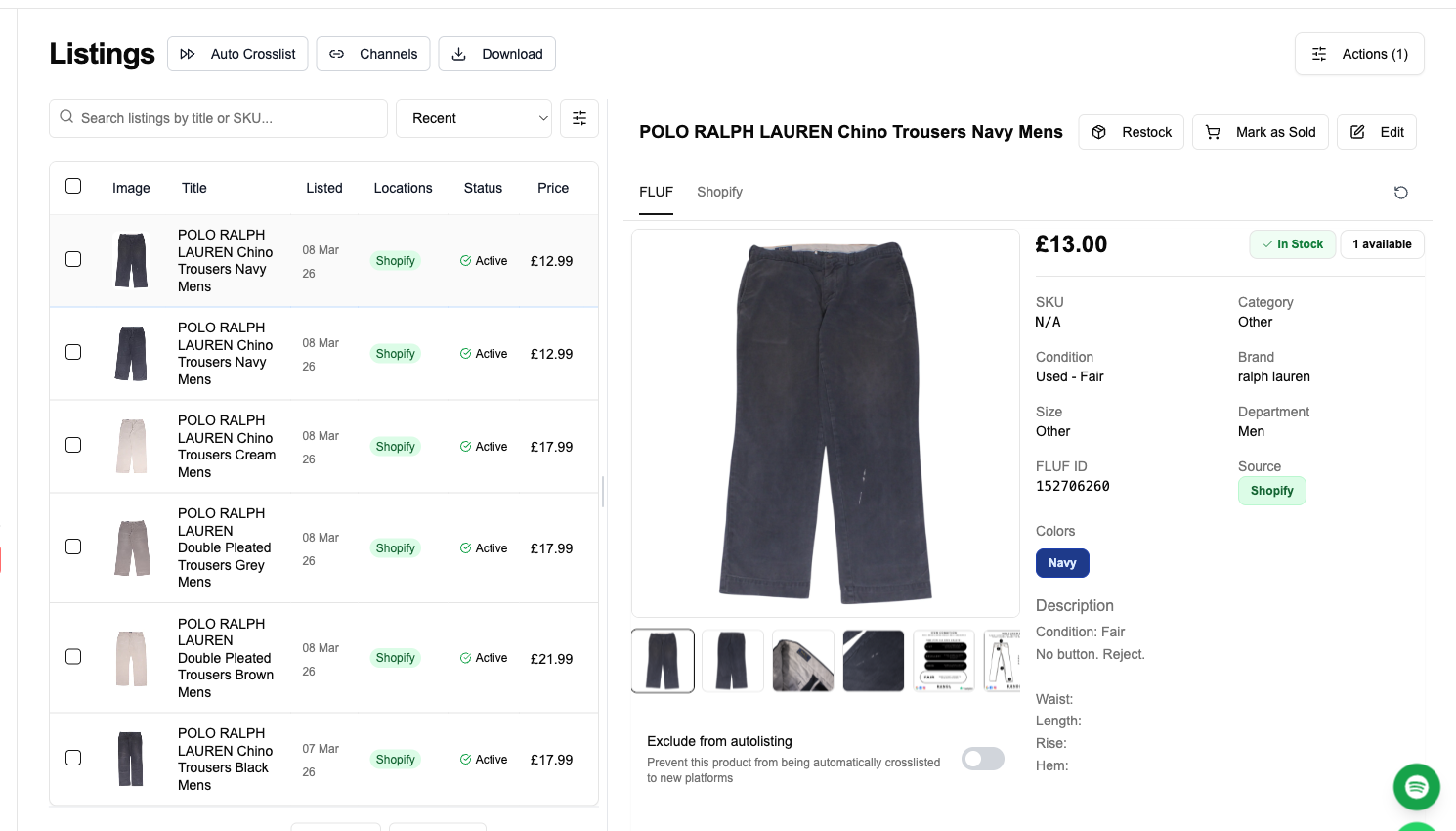
Vestiaire Collective is exceptional at one thing: putting your designer items in front of pre-owned-luxury buyers in 70+ countries. What it does not give you is a buyer email, a marketing channel, or a customer relationship you can re-engage. Every sale lives inside Vestiaire’s ecosystem. Add a second Vestiaire-Collective-only competitor tomorrow and your buyer pool can move with them.
Shopify is the opposite. You own the storefront, the domain, the customer record, the email list and the brand. There is no platform commission — only payment processing (in the UK, 2% + 25p online on the Basic plan)[2]. Repeat buyers come back to your URL. Email marketing, retargeting and loyalty programmes are yours to run.
This pair is for the seller who wants both: Vestiaire’s discovery firehose for new buyers, Shopify’s direct relationship for the long-term business. It is also for the seller whose Vestiaire-rejected inventory (anything outside Vestiaire’s ~12,000-brand allowlist — high-street, mid-market, contemporary, homeware, vintage outside the heritage canon) needs a home. Shopify accepts whatever you list.
Why Pair Vestiaire Collective with Shopify?
Vestiaire Collective and Shopify are not competing channels — they solve different problems. Vestiaire is a marketplace; Shopify is a storefront. The members of one are buyers hunting for designer pieces and trusting the platform’s authentication; the visitors of the other are people who already know your brand and came to your URL on purpose. A serious resale business needs both.
The economics make the pairing especially attractive at the price points where Vestiaire’s commission bites. Vestiaire takes 25% on items under $100 and 20% from $100 to $499[1]. A £200 designer dress earns you about £160 net on Vestiaire after commission. On Shopify, the same dress, sold at the same price, earns about £195 after card processing (2% + 25p)[2] — a £35 difference per item. Once your direct-traffic flywheel starts turning, the Shopify side of the pair quietly becomes the more profitable channel even though Vestiaire keeps doing the discovery work.
The brand-allowlist ceiling is the other reason. Vestiaire Collective maintains a strict approved-brand catalogue of roughly 12,000 designer, heritage and luxury labels. Cross any of those off your inventory — Lululemon, Free People, Madewell, J. Crew, Anthropologie, Banana Republic, Zara, H&M, Sézane, Réalisation, Reformation, ME+EM, & Other Stories — and Vestiaire will reject them on review. Shopify has no such filter. Sellers who pair the two suddenly have somewhere to put the 30–60% of their closet that Vestiaire turned away.
| Vestiaire Collective | Shopify | |
|---|---|---|
| Type | Marketplace (third-party platform) | Own-brand storefront (your domain, your URL) |
| Audience | Millions of members in 70+ countries[3] | Whoever you drive to your URL — email list, social, SEO, paid |
| Customer relationship | Owned by Vestiaire — no buyer email, no remarketing | Owned by you — email, repeat purchases, loyalty programme |
| Accepted products | ~12,000 approved designer / heritage / luxury brands; fashion + accessories only | Any product, any brand |
| Authentication | Expert authentication above brand-specific price thresholds | Seller’s responsibility (no platform layer) |
| Seller fees | Tiered commission: 25% <$100 / 20% $100–499 / 18% $500–1,999 / 15% $2,000–4,999 / 12% $5,000+[1] | Monthly plan from £9/month + payment processing from 2% + 25p[2] |
| Discovery | Strong — buyers arrive looking for designer resale | You build it — SEO, social, email, paid traffic |
| Best for | International luxury reach; new-buyer acquisition | Repeat-buyer revenue; non-allowlisted inventory; brand building |
The strategic move is not “replace Vestiaire with Shopify” — it is “use Vestiaire to acquire buyers, then convert them into Shopify repeat customers.” Every Vestiaire shipment is an opportunity to insert a thank-you card with your Shopify URL and a returning-buyer discount. Within twelve months a healthy pair sees 25–40% of revenue migrate from Vestiaire to Shopify as the email list grows, while Vestiaire continues to do the heavy lifting on new-buyer acquisition.
Build a brand store around your Vestiaire Collective inventory — synced automatically.
How to Crosslist from Vestiaire Collective to Shopify with FLUF Connect
1. Sign Up to FLUF Connect
Create an account at fluf.io/connect. The Starter at £9/month, with no cap on how much you list. Every plan includes the full automation feature set.
2. Connect Your Vestiaire Collective Account
Sign in to Vestiaire Collective via the FLUF Connect dashboard. Your existing Vestiaire listings (titles, descriptions, photos, prices, brand attributes, condition, size, colour, recommended retail price) are imported into a unified inventory view.
3. Connect Your Shopify Store
Install the FLUF Connect app from the Shopify App Store or enter your store URL in FLUF Connect, then follow Shopify’s authorisation prompts.
4. Choose the Direction of Truth
Pick whether new products start on Shopify (most common — Shopify becomes the central inventory hub) or on Vestiaire Collective (when you discover designer pieces by listing on Vestiaire first). The choice can be different per category, and changed any time.
5. Import or Mirror Existing Listings
For each Vestiaire Collective listing FLUF Connect proposes a matching Shopify product. Title transfers; description carries across; all photos transfer (Vestiaire’s up-to-25 photo set comes into Shopify’s unlimited-image gallery untouched); price converts to your Shopify store currency; brand becomes a Shopify vendor or product tag; condition becomes a Shopify metafield. Variants (size, colour) map onto Shopify’s variant model.
6. Review and Publish
FLUF Connect previews each Shopify product before publish. Edit anything that benefits from longer-form copy — Shopify product pages support full HTML, multiple sections, lookbook layouts and storytelling that Vestiaire’s structured form does not. Hit publish to push to Shopify, and the live listing is up in seconds.
7. Inventory and Orders Sync Automatically
When a Vestiaire Collective buyer purchases, FLUF Connect creates a mirror order in Shopify with the buyer’s name, shipping address (and email when Vestiaire’s API exposes it), line items, sale price and channel tag — then decrements the Shopify inventory count and ends the Shopify listing. When a Shopify customer buys directly, the Vestiaire Collective listing comes down within minutes.
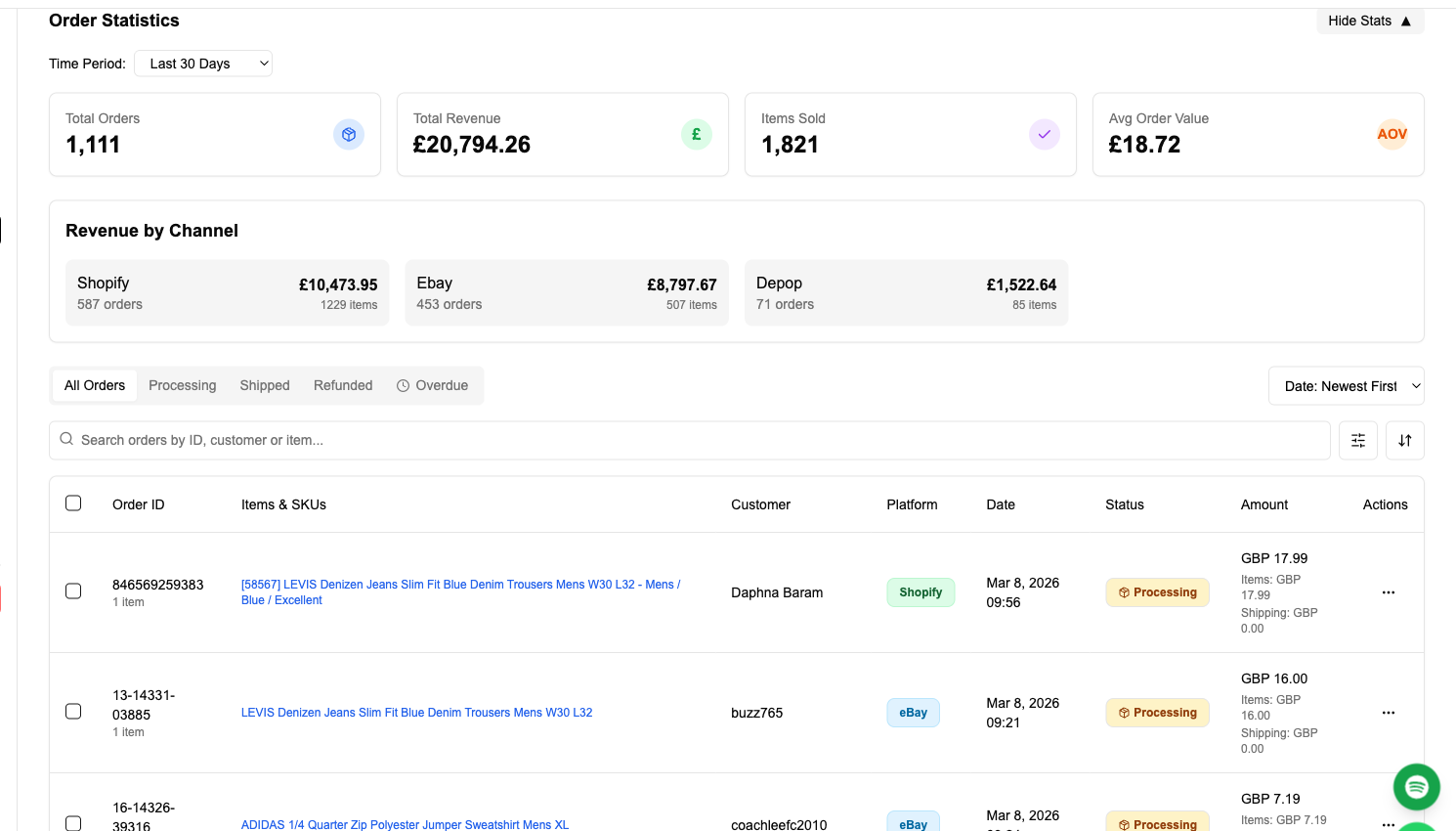
What Transfers When You Crosslist from Vestiaire Collective to Shopify
| Vestiaire Collective Field | Shopify Field | Transfer Status | Notes |
|---|---|---|---|
| Title | Product title | ✅ Automatic | Vestiaire’s brand-first title style works as a Shopify product title without rewriting |
| Description | Product description (HTML) | ✅ Automatic | Vestiaire’s structured description text becomes the Shopify body; HTML enhancement optional |
| Photos (up to 25) | Product media (unlimited) | ✅ All transfer | Order preserved; cover photo becomes Shopify’s featured image |
| Price + currency | Variant price | ✅ Automatic | Currency converted to your Shopify store’s primary currency at current rate |
| Recommended retail price | Compare-at price | ✅ Automatic | Shopify’s strike-through original-price field — surfaces the discount on the storefront |
| Brand | Vendor (and / or brand tag) | ✅ Automatic | Brand becomes the Shopify vendor field and is added as a product tag for filtering |
| Condition (6-point scale) | Condition metafield + tag | ⚡ Mapped | “Never worn with tag” / “Never worn” / “Very good” / “Good” / “Fair” stored as a metafield on the product |
| Size | Variant option (Size) | ⚡ Mapped | Vestiaire’s per-category size systems map onto Shopify’s variant options |
| Colour | Variant option (Colour) + tag | ⚡ Mapped | Becomes a Shopify variant option and a filterable storefront tag |
| Material | Material metafield | ⚡ Mapped | Stored as a metafield for use in templates, filters and Google Merchant feed |
| Category (universe → category → sub-category) | Product type + collection | ⚡ Smart mapped | Vestiaire’s taxonomy translates to Shopify product types; matching collections suggested |
| Inventory level | Inventory level at location | ✅ Automatic | Each one-of-a-kind item starts at quantity 1 against your default Shopify location |
| SKU | Variant SKU | ✅ Automatic | FLUF Connect generates a stable SKU mirroring the Vestiaire identifier when no SKU exists |
| — | SEO title and description | ✅ Generated | FLUF Connect drafts Shopify SEO copy from the Vestiaire listing — editable per product |
| — | Storefront URL handle | ✅ Generated | Slugified from title — vital for search-engine discoverability of your Shopify URLs |
Legend: ✅ Automatic. ⚡ Mapped. ⚠️ Validated, defaults or manual. ❌ Not available.
The Brand-Allowlist Lift
Roughly 10% of Vestiaire Collective submissions are rejected during review, almost always because the brand is not on the approved catalogue. Items rejected by Vestiaire often have nowhere to go — they are returned to your inventory but cannot be relisted on Vestiaire. With Shopify in the pair, those items get a home. FLUF Connect surfaces a “Vestiaire-rejected” filter so you can bulk-publish the rejected slice straight to Shopify in one click. Cross-channel sellers report that this single workflow recovers roughly £200–£600 of dormant inventory per month, depending on how mid-market the closet leans.
Shopify as Central Inventory Hub
Once Shopify is in the mix, the smart architecture is to make it the central inventory hub and treat every marketplace — including Vestiaire Collective — as a sales channel feeding into it. There are concrete reasons:
- One product database: instead of maintaining inventory across Vestiaire, eBay, Depop, Vinted and Whatnot separately, you maintain it in Shopify and FLUF Connect pushes the canonical product out to each marketplace.
- One orders feed: every sale — whether it originated on Vestiaire, eBay, Depop or Shopify-direct — appears in Shopify’s orders tab with a channel tag. Accounting, fulfilment, returns and analytics all run from one place.
- One customer record: marketplace buyers (where the marketplace exposes an email) become Shopify customer records you can re-engage. The Vestiaire buyer who bought a Chanel jacket last quarter can be retargeted with an email when a new Chanel piece lands.
- One source of truth for accountants: HMRC self-assessment, VAT thresholds, reconciliation against Stripe or Shopify Payments — all materially easier when every channel’s revenue flows into one general ledger.
- Google and Bing visibility: Shopify product pages get indexed by search engines and feed into Google Merchant Center. Vestiaire listings do not give you that — Vestiaire owns the SEO juice. Shopify gives you the SEO surface area to capture branded and long-tail search demand.
FLUF Connect’s mirror-order pipeline is built around this pattern. Every Vestiaire Collective sale creates a Shopify order with all the buyer detail Vestiaire exposes — name, shipping address, line items, sale price, channel tag — and decrements the Shopify inventory level on the matching product. The same pipeline handles Depop, eBay, Etsy and Vinted, so adding more channels later does not change the architecture.
Inventory and Order Sync Between Vestiaire Collective and Shopify — What Stays in Sync?
| Event | What Happens | Timing |
|---|---|---|
| Item sells on Vestiaire Collective (authenticated) | Shopify inventory reserved at 0; Shopify listing pulled from storefront; Shopify mirror order created | On Vestiaire payment event (minutes) |
| Vestiaire authentication completes successfully | Shopify order marked paid + fulfilled; Vestiaire listing stays ended | 5–10 days after sale[1] |
| Vestiaire authentication fails | Item returned to seller; Shopify inventory restored; Shopify listing republished; mirror order cancelled | Hours after Vestiaire notification |
| Item sells on Vestiaire Collective (direct shipping) | Shopify inventory decremented; Shopify listing pulled; Shopify mirror order created | Within minutes |
| Item sells on Shopify | Vestiaire Collective listing taken down automatically | Within minutes |
| Product created in Shopify (with eligible brand) | Crosslisted to Vestiaire Collective (manual or auto-rule) | Seconds to push; Vestiaire review may take hours |
| Product price changed in Shopify | Optional sync to Vestiaire — off by default (Vestiaire pricing follows different category dynamics) | Within minutes when enabled |
| Product deleted in Shopify | Vestiaire Collective listing ended on next sync | Within hours |
| Buyer details from Vestiaire Collective | Created or matched as a Shopify customer record (name + address; email when exposed) | On order create |
The Vestiaire Collective authentication workflow takes 5–10 days from buyer payment to delivery. During that window the seller has shipped to the authenticator but the sale is not yet final. If a Shopify customer buys the same item in that window, you cannot honour both. FLUF Connect reserves the Shopify inventory the moment the Vestiaire buyer pays — not when authentication completes — so the conflict cannot happen. If Vestiaire’s authenticator rejects the item, the Shopify listing is restored automatically and the mirror order is cancelled.
Crosslisting from Vestiaire Collective to Shopify: Before and After FLUF Connect
Without FLUF Connect (Manual)
- Open the Vestiaire Collective seller dashboard; open the listing you want to mirror.
- Save each photo individually (up to 25 per item).
- Open the Shopify admin; create a new product.
- Upload each photo one at a time.
- Re-type title; reformat description as HTML; add headings and storytelling sections.
- Set vendor (brand); add brand tag.
- Add condition metafield; add material metafield.
- Configure variants — size, colour.
- Set price; convert from Vestiaire currency if different.
- Set compare-at price from Vestiaire’s recommended retail price.
- Generate SKU; assign to default location at quantity 1.
- Write SEO title and meta description.
- Assign to a collection.
- Publish.
- When the item sells on Vestiaire: open Shopify admin, find the product, set inventory to 0, mark as unavailable.
- When the item sells on Shopify: open Vestiaire dashboard, find the listing, end it.
- Manually re-key the Vestiaire order into Shopify so accounting captures the revenue.
Time per item: 15–25 minutes. Time per 50 designer pieces: ~15 hours, before any of the ongoing sync work.
With FLUF Connect
- Connect Vestiaire Collective and Shopify in the FLUF Connect dashboard.
- Tick items in the unified inventory view; click “Push to Shopify.”
- Review (title, description, photos, brand, condition, variants, compare-at price all mapped).
- Confirm.
- Done — inventory sync, mirror orders and authentication-aware reservation handled automatically.
Time per item: about 45 seconds. Time per 50 designer pieces: under an hour. Ongoing sync work: zero.
Automation Features for Vestiaire Collective and Shopify Sellers
Auto-Crosslisting Rules
Set rules so every new product created in Shopify is pushed to Vestiaire Collective (when the brand is on Vestiaire’s allowlist) and every new Vestiaire Collective listing is pushed to Shopify (always — Shopify accepts any brand). Typical setups: “all new Vestiaire listings → Shopify, draft status for editing” or “all Shopify products with brand in [Chanel, Hermès, Louis Vuitton, Gucci, Prada] → Vestiaire, immediate publish.”
Mirror Orders into Shopify
Every Vestiaire Collective sale appears in your Shopify orders feed within minutes with channel tag, buyer name, shipping address and line items. Inventory levels decrement against the corresponding Shopify product. The same pipeline runs for eBay, Depop, Vinted, Etsy and Whatnot — Shopify becomes the single orders dashboard for your entire business.
Bulk Operations
Apply find-and-replace across both Vestiaire and Shopify descriptions, adjust prices by per-channel rules (a 5–8% Shopify markdown is common to undercut Vestiaire’s commission while keeping Vestiaire prices intact for the marketplace algorithm), or bulk-update vendor, tags and collections. Bulk operations handle both channels in one job.
Shopify SEO Helpers
FLUF Connect drafts Shopify SEO title and meta description from the Vestiaire listing, generates a clean URL handle, suggests collections for cross-linking, and proposes structured data for Google Shopping feed eligibility. Vestiaire’s listings do not show up in Google Shopping — your Shopify products do, and that is a meaningful long-tail traffic channel.
Email-List Capture from Vestiaire Orders
Use your own store to build relationships with customers. If you collect marketing sign-ups, get the buyer’s permission and follow the marketplace’s rules for customer communication.
Feature Support Per Channel
| Feature | Vestiaire Collective | Shopify |
|---|---|---|
| Crosslisting | ✅ | ✅ |
| Auto-relisting | Not algorithmically refreshed | N/A — own store |
| Offer management | Vestiaire native | Shopify Discounts |
| Inventory sync | ✅ (authentication-aware) | ✅ (canonical source) |
| Order sync | ✅ Mirrors into Shopify | ✅ Central feed |
| Bulk operations | ✅ | ✅ |
| Authentication routing | ✅ Automatic above threshold | N/A |
| SEO surface | None for seller | ✅ Product pages, sitemap, Google Merchant |
| Email capture | API-dependent | ✅ Native customer records |
How Much Does It Cost to Crosslist from Vestiaire Collective to Shopify?
| Plan | Monthly | Crosslisted products |
|---|---|---|
| Starter | £9/month | Unlimited |
| Seller | £29/month | Unlimited |
| Pro | £99/month | Unlimited |
| Super Seller | Custom pricing — tell us what you need | Unlimited |
Separately, you pay Shopify for the storefront — UK Basic is £19/month when billed yearly, with 2% + 25p online card processing; Grow is £49/month at 1.7% + 25p; Advanced is £259/month at 1.5% + 25p[2]. Vestiaire Collective’s tiered commission (25% under $100 down to 12% above $5,000) is billed by Vestiaire directly on each sale[1].
The economics of the pair: on a £200 sale, Vestiaire’s 20% commission costs £40 (net £160); Shopify’s 2% + 25p costs about £4.25 (net £195.75). The £35 per-item gap means the Shopify side of the pair pays for itself within a handful of sales per month — and unlike Vestiaire’s commission, your Shopify side keeps building an asset (the customer list) you actually own.
Start building a brand store around your Vestiaire Collective inventory.
Related Guides
- Crosslist from Shopify to Vestiaire Collective — the reverse direction
- Crosslist from Vestiaire Collective to Vinted — for European mid-market reach
- Crosslist from Vestiaire Collective to Depop — for Y2K, vintage and streetwear designer
- Crosslist from Vestiaire Collective to eBay — for any-brand global reach
- How to Sell on Vestiaire Collective
- How to Sell on Shopify
- Crosslisting Hub
- Crosslist Vestiaire Collective to WooCommerce
- Vestiaire Collective to Leboncoin
Sources & Verification
- Vestiaire Collective tiered commission rates and authentication payout windows: Vestiaire Collective fees 2026 — Underpriced.
- Shopify UK plan pricing and online card processing rates 2026 (Basic £19/month at 2% + 25p; Grow £49/month at 1.7% + 25p; Advanced £259/month at 1.5% + 25p, all billed yearly): Shopify UK pricing.
- Vestiaire Collective country reach and founding year: Vestiaire Collective — Wikipedia.
Related guides
Frequently Asked Questions
You need a Shopify plan — Basic is currently £19/month when billed yearly in the UK and includes everything FLUF Connect needs to push listings, sync inventory and pull orders. You do not need any products in Shopify already; your Vestiaire Collective inventory becomes the seed catalogue.
No. Shopify is your own store — there is no platform brand allowlist. Items that Vestiaire Collective rejects (mid-market, fast-fashion, non-approved labels) can still live on your Shopify store. This is the single biggest reason Vestiaire sellers add Shopify: it absorbs the inventory Vestiaire will not list.
When a Vestiaire Collective buyer pays for an item that requires authentication, FLUF Connect reserves the Shopify listing immediately — not when authentication completes 5 to 10 days later. If authentication fails and the item is returned to you, the Shopify listing is reactivated automatically.
Vestiaire Collective takes a tiered commission of 25% under $100, 20% from $100 to $499, 18% from $500 to $1,999, 15% from $2,000 to $4,999 and 12% above $5,000, with no listing or processing fees beyond commission. Shopify charges its monthly plan plus card processing — in the UK, Basic is £19/month with 2% + 25p online card rates. On a £200 sale you keep roughly £160 on Vestiaire (after 20% commission) versus roughly £195 on Shopify (after 2% + 25p), minus the monthly plan amortised across your volume.
Yes — this is the most common architecture for sellers who run both. FLUF Connect treats Shopify as the source of truth: products created in Shopify push out to Vestiaire Collective; orders from Vestiaire Collective mirror back into Shopify so inventory, customer records and accounting all live in one place. You can layer eBay, Depop, Vinted and Whatnot on top of the same Shopify catalogue.
Both directions. When you connect Vestiaire Collective, your existing listings are imported into FLUF Connect's unified inventory view. You can then create matching Shopify products with one click — title, description, photos, price, brand and condition transfer across. From that point onwards, edits flow from Shopify to Vestiaire Collective unless you choose a different direction in settings.
Yes. FLUF Connect mirrors every Vestiaire Collective sale into your Shopify orders with the buyer's name, shipping address (and email when Vestiaire's API exposes it), line items, sale price and channel tag. The Shopify inventory level is decremented on the corresponding product so stock counts stay accurate without manual entry.
No. FLUF Connect supports any product type Shopify supports — homeware, books, collectibles, electronics, anything. The Vestiaire Collective side is fashion and accessories only because Vestiaire itself is designer-fashion-only, but on the Shopify side you can sell whatever you want.
About fifteen minutes. Connect Shopify and Vestiaire Collective in FLUF Connect, import your existing listings, choose your source catalogue and review the products before crosslisting.