
Crosslist from Vestiaire Collective to Leboncoin
Take your curated luxury pieces from Vestiaire Collective to France's biggest domestic marketplace — one euro-priced catalogue, two very different French audiences, seller-free listing on Leboncoin.



- Vestiaire Collective is the Paris-founded (2009) curated pre-owned luxury marketplace, with more than 23 million members across 70-plus countries and around 5 million curated items live (source). Leboncoin is France’s number-one private-sales site and its number-two e-commerce platform, drawing more than 28 million unique visitors a month (source).
- This is a rare same-currency, same-country pair. Both sell in EUR, both are anchored in France — but they reach very different buyers. Vestiaire is a curated luxury niche; Leboncoin is a vast domestic generalist. Listing on both puts your designer-but-not-ultra-luxury pieces in front of a huge French audience Vestiaire’s curation never surfaces to.
- The fee direction flips. On Vestiaire the seller pays: a 12% selling fee plus 3% payment processing (source). On Leboncoin the seller lists free — it is the buyer who pays the secure-payment protection fee, capped at just €0.99 regardless of item price (source).
- Title, description, images, price, quantity and SKU carry across from Vestiaire Collective to Leboncoin automatically — you build the listing once and FLUF Connect pushes it out.
- Sync is honest and asymmetric. FLUF lists to Leboncoin automatically, but Leboncoin has no order sync and no mark-as-sold, so when an item sells there you mark it sold in FLUF yourself and it clears the channels that support automatic removal. Vestiaire has full sync (order sync, mark-as-sold, relisting and offers); when an item sells on Vestiaire you end the Leboncoin ad by hand.
- FLUF Connect crosslists your whole catalogue from one dashboard. Plans start from £19/month (Growth — 500 products). There is no free plan, and automation is included on every plan.
Why sell on both Vestiaire Collective and Leboncoin
Most crosslisting stories are about reaching a new country or a new currency. This one is different, and more interesting for it: Vestiaire Collective and Leboncoin are both French, both priced in euros, and both places a French seller already trusts. What changes when you list on both is not the geography — it is the kind of buyer you reach. FLUF Connect lets you keep one catalogue and put the same pieces in front of two audiences that barely overlap: the international luxury hunter on Vestiaire and the domestic bargain-and-brand hunter on Leboncoin.
Vestiaire Collective is a curated proposition by design. Founded in Paris in 2009, it has grown into a community of more than 23 million members across 70-plus countries, holding roughly 5 million curated items with around 30,000 new listings added every day (source). It positions itself firmly at the pre-owned luxury and designer end of the market, with an optional physical-authentication service run by more than 80 experts who inspect higher-value pieces before they reach the buyer. That curation is exactly what makes Vestiaire powerful for genuine luxury — and exactly what makes it a narrow window for everything else. A well-known contemporary label, a mid-tier designer bag, a premium high-street coat: these can list on Vestiaire, but they compete inside an audience that arrived specifically hunting Chanel, Hermès and Prada.
Leboncoin is the opposite kind of marketplace. It is the default place French consumers buy and sell almost anything second-hand — France’s number-one private-sales site and its number-two e-commerce platform overall, pulling in more than 28 million unique visitors a month (source). It is a generalist: cars, property, furniture and electronics dominate the headlines, but “Mode” (fashion) is a large and growing vertical, and the sheer scale of the domestic audience means even a niche brand finds its French buyer quickly. Owned by Adevinta, Leboncoin is woven into everyday French commerce in a way a luxury-only platform never is — it is where someone browses on their commute, not where they go for an occasion purchase.
The contrast is the whole point. A designer piece that has to shout to be noticed among the true luxury on Vestiaire can read as a standout find on Leboncoin, where most of the fashion is high-street and casual. You are not simply adding listing volume by selling on both — you are changing the competitive context your item sits in. On Vestiaire your bag is one of hundreds of similar designer bags; on Leboncoin, in front of a French buyer scrolling local listings, it is the nice one. The two channels do different jobs: Vestiaire is your international, authentication-backed luxury shop window; Leboncoin is your enormous domestic reach engine.
There is a demand-side logic too. Vestiaire buyers are label-literate and willing to pay for provenance, so it is the right home for your highest-value, most authenticatable stock. Leboncoin buyers span every price point and shop by need and by search, so it is the right place to move the designer-but-not-ultra-luxury pieces, the older-season items, and anything a local French buyer would simply grab because it is a good deal near them. Running the same item across both means one channel is your premium-price attempt and the other is your fast, wide, low-friction sell — and once the crosslisting is set up, keeping both populated costs you nothing extra.
The honest caveat here is not geography or currency — it is sync, and it runs the other way from most pairs. Leboncoin is a classifieds-first platform without the order-sync plumbing Vestiaire has, so the convenience is not perfectly symmetric. That is covered in detail below, and it is manageable, but it is the one thing to understand before you lean on this pair. Everything else about the combination — same money, same country, complementary audiences — is unusually clean.
How to crosslist from Vestiaire Collective to Leboncoin
The mechanics are simple once your catalogue lives in one place. FLUF Connect treats your inventory as a single source of truth and pushes each item to the channels you enable, so “crosslisting from Vestiaire Collective to Leboncoin” really means “list the item once in FLUF and switch Leboncoin on”.
Here is the path from a standing start:
- Create your FLUF Connect account and install the extension. Sign up at fluf.io and add the FLUF browser extension. The extension is what lets FLUF act on your behalf inside marketplaces that don’t expose a full public listing API — which matters for a classifieds platform like Leboncoin.
- Connect Vestiaire Collective as your source. Link your Vestiaire account so FLUF can read your existing listings — titles, descriptions, photos, prices and quantities — and pull them into your central catalogue. If you are starting fresh you can build items directly in FLUF and treat Vestiaire as one of the outputs instead.
- Connect Leboncoin as a destination. Authorise the Leboncoin channel from the FLUF dashboard. Once connected, Leboncoin becomes a toggle on each product, exactly like every other channel.
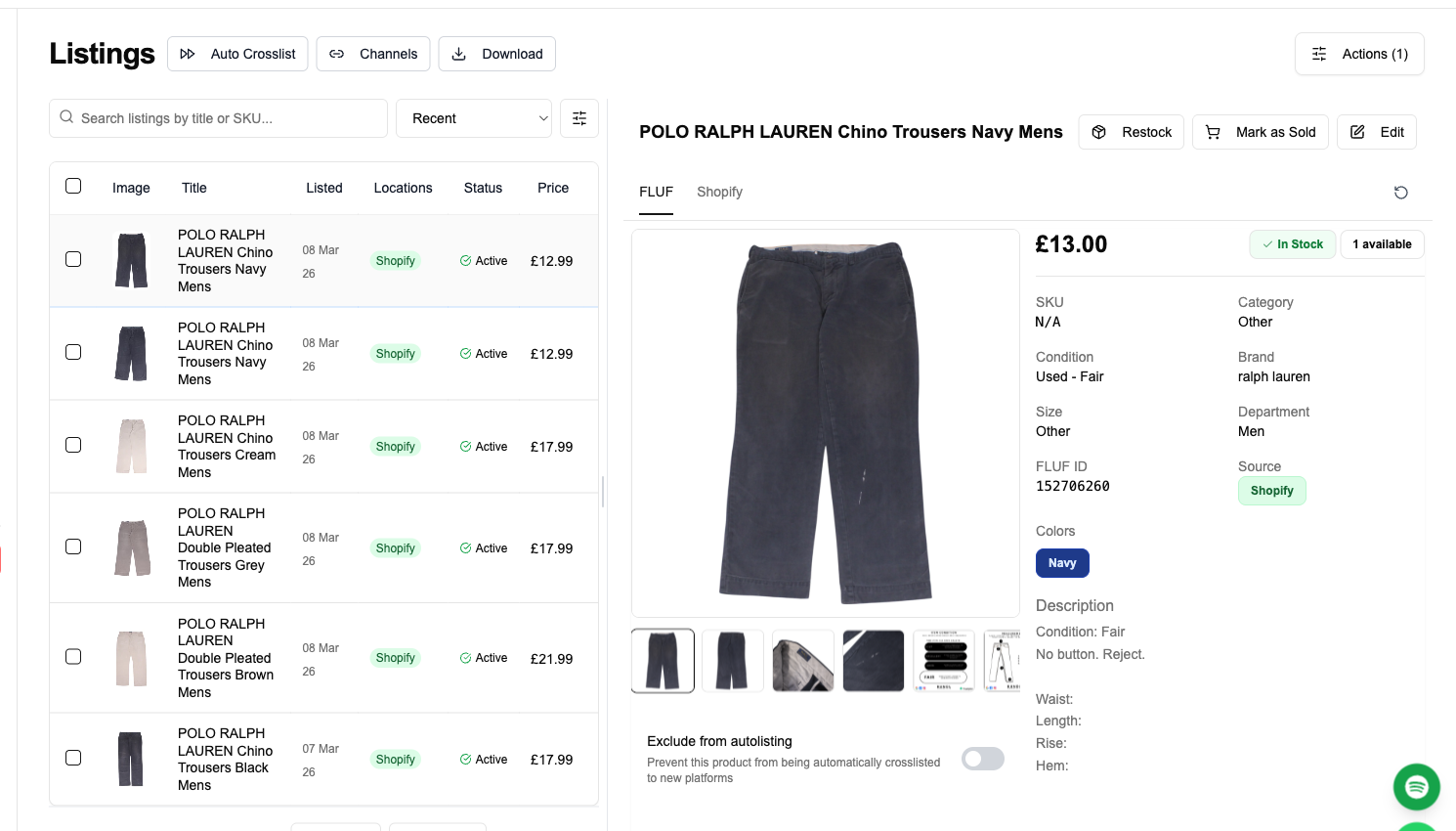
- Import and review your catalogue. FLUF brings your Vestiaire items into the listings view (shown above). Check that photos, descriptions and prices imported cleanly before you push anything live.
- Adapt the copy for a French domestic browse. Both platforms use euros, so there is no currency to convert — a genuine convenience of this pair. But Vestiaire listings are often written for an international, English-reading luxury audience, whereas Leboncoin buyers browse and search in French. Adding or leading with a clear French title and a short French description will do a lot of your discovery work on Leboncoin.
- Set your Leboncoin price with the fee flip in mind. On Vestiaire you carry the 12% selling fee plus 3% payment processing yourself, so your headline price already bakes that in. On Leboncoin listing is free for you and the buyer pays only a capped €0.99 protection fee, so you keep essentially your whole price — which means you can often price the same item a little keener on Leboncoin and still net more.
- Choose “Transaction sécurisée” for a shippable sale. Enabling Leboncoin’s integrated secure payment and delivery lets buyers pay in-app and pick a carrier — Colissimo, Mondial Relay, Relais Colis or Shop2Shop — rather than transacting off-platform (source). This is the right mode for crosslisting fashion you intend to post.
- Push live and monitor. Enable Leboncoin on the products you want in front of French buyers, publish, and manage everything from the same dashboard. Because Leboncoin does not report sales back automatically, plan to check it when items move — more on that in the sync section.
The mindset shift is the same as with any crosslister: you are not running two separate storefronts, you are running one catalogue with two audiences attached. Every edit you make to an item’s title, description or photos in FLUF can be pushed out, so there is no drift between your Vestiaire listing and your Leboncoin ad unless you deliberately want them to read differently for their respective buyers.
What transfers — fields & categories
FLUF Connect maps the core listing fields from your source catalogue onto each destination’s own structure. For the Vestiaire Collective to Leboncoin route, the fields that carry across reliably are title, description, images, price, quantity and SKU — the essentials of a complete listing on both platforms.
| Field | Vestiaire Collective (source) | Leboncoin (destination) | Notes |
|---|---|---|---|
| Title | Yes | Yes | Transfers directly. Lead with brand and item type in French so Leboncoin keyword searches surface it. |
| Description | Yes | Yes | Carries across as written. Vestiaire copy is often English and luxury-framed; a French summary reads more naturally to a Leboncoin buyer. |
| Images | Yes | Yes | Your photos are your biggest asset — the clean, authentication-grade shots that sell on Vestiaire stand out sharply against everyday classifieds imagery. |
| Price | Yes (EUR) | Yes (EUR) | Same currency, so no conversion. You can price keener on Leboncoin because you avoid the seller-side fees you carry on Vestiaire. |
| Quantity | Yes | Yes | Stock levels are tracked in FLUF and reflected on each channel. |
| SKU | Yes | Yes | Your SKU travels with the item, keeping it identifiable across your catalogue even though Leboncoin doesn’t sync sales back. |
| Category | Deep luxury-fashion taxonomy | General/horizontal taxonomy (Mode vertical) | Leboncoin is a generalist, so fashion sits alongside cars, property and furniture — FLUF maps your item into the closest Mode category. |
The category difference is worth dwelling on. Vestiaire Collective is a fashion-and-luxury-only marketplace, so its taxonomy is deep and specific — brand, designer, material, sub-category — and its filters are built for buyers who know exactly which house and which model they want. Leboncoin is horizontal: fashion is one vertical among cars, real estate, home and electronics. A designer piece there will not get the same fine-grained luxury filtering it enjoys on Vestiaire, but it also faces far less direct like-for-like competition on any given results page. Lean into brand, size, colour and material in your title and description so that buyers who reach you through search — rather than deep category browsing — can find you.
Attributes such as brand, size, category and condition transfer wherever the destination exposes a field for them. Because Leboncoin is classifieds-first rather than a structured luxury catalogue, your free-text title and description carry more of the load than they would on Vestiaire’s tightly structured forms. Writing a descriptive, keyword-rich French listing is not optional on this route — it is how your item gets discovered by a domestic buyer scanning a general marketplace.
What syncs and what doesn’t
This is the section to read carefully, because the Vestiaire Collective to Leboncoin pair is asymmetric — one side is fully automated, the other is deliberately manual — and being clear about it is what keeps you from overselling a one-of-a-kind piece.
Vestiaire Collective has full sync. On the Vestiaire side, FLUF supports order sync, mark-as-sold, automated relisting and offers. That means when something sells on Vestiaire, FLUF knows immediately, records the sale, and can clear the item from the other channels that support automatic removal. Vestiaire’s own relisting and offer tools are available through FLUF too, so your luxury shop window stays fresh and negotiable without extra effort.
Leboncoin has no order sync and no mark-as-sold. This is the honest constraint. FLUF lists to Leboncoin automatically — your listing goes up without you retyping anything — but Leboncoin does not report sales back to FLUF, and FLUF cannot automatically pull a Leboncoin ad down when the item sells elsewhere. So the workflow splits by where the sale happens:
- When an item sells on Leboncoin: mark it sold yourself in FLUF. Once you do, FLUF removes it from the channels that support automatic removal — including Vestiaire, which honours mark-as-sold — so your Vestiaire listing comes down for you. You only have to tell FLUF once; it handles the automated channels from there.
- When an item sells on Vestiaire: FLUF registers that sale automatically (Vestiaire has order sync), but because Leboncoin can’t be delisted programmatically, you end the Leboncoin ad by hand. FLUF flags the item as sold so you know which Leboncoin listing to close.
In short: crosslisting to Leboncoin is automatic, but crosslisting sold-status is not — Leboncoin is a manual sold-status channel in both directions. That is not a flaw in FLUF; it reflects what Leboncoin’s platform exposes. The practical habit to build is simple: whenever a unique item sells on either side, take ten seconds to square it up — mark it sold in FLUF if it went on Leboncoin, or close the Leboncoin ad if it went on Vestiaire.
| Capability | Vestiaire Collective | Leboncoin |
|---|---|---|
| FLUF lists automatically | Yes | Yes |
| Order sync (sale reported back to FLUF) | Yes | No — check manually |
| Mark-as-sold (auto delist on sale elsewhere) | Yes | No — end the ad yourself |
| Automated relisting | Yes | No |
| Offers via FLUF | Yes | No |
The bottom line: this pair gives you Leboncoin’s enormous domestic reach with almost no extra listing effort, in exchange for a small, honest manual step around sold-status. For most sellers that trade is well worth it — a designer piece that would only ever have been seen by Vestiaire’s luxury audience now reaches 28 million monthly French visitors, and the only ongoing cost is remembering to close a listing when the item finds its buyer.
Your workflow, before & after
It helps to see what actually changes day to day, because the value of a crosslister is measured in the minutes it removes from your routine.
Before FLUF Connect. Your listings live inside Vestiaire Collective. To reach the huge domestic audience on Leboncoin you would open Leboncoin, create a fresh ad from scratch, re-upload every photo, retype the title and description, rewrite the copy in French, set your price by hand, and configure secure payment and shipping. Then you would repeat that for every item. On top of the duplicate data entry, you would carry the constant risk that a Vestiaire sale leaves a live Leboncoin ad still selling the same physical garment — so you would be manually policing both platforms and apologising to a French buyer whenever you were too slow. For a wardrobe of any size that is hours of retyping plus a permanent low-grade anxiety about double-selling.
After FLUF Connect. You build the item once. The title, description, images, price, quantity and SKU flow to Leboncoin automatically; you adapt the copy to French and set your Leboncoin price once. From then on your listing is live in both places, managed from a single dashboard. The one habit you keep is the sold-status step: when a unique item sells on Leboncoin you mark it sold in FLUF and it clears the automated channels for you; when it sells on Vestiaire, FLUF flags it and you close the Leboncoin ad. Your daily job shrinks to photographing new stock, writing one good listing, packing what sells, and squaring up sold-status — a fraction of the work of running two storefronts by hand.
The fee flip changes the after-state in your favour too. Because Leboncoin lists free for you and pushes the small protection fee onto the buyer, the incremental revenue you capture there arrives almost whole — there is no 12%-plus-3% seller haircut to plan around as there is on Vestiaire. That makes the reach essentially free to keep populated once set up: every extra sale on Leboncoin is a sale you would not otherwise have made, at a better margin than your Vestiaire equivalent.
Automation & bulk tools
Automation is where crosslisting stops being a data-entry chore and starts being leverage, and on FLUF Connect it is included on every plan rather than sold as a paid add-on.
For this pair the automation is concentrated on the Vestiaire side, and that is by design. Vestiaire supports order sync, mark-as-sold, relisting and offers through FLUF, so your luxury channel is fully hands-off: sales register themselves, ageing listings can be refreshed automatically, and offers flow through the dashboard. The Leboncoin side is automated for the part the platform allows — FLUF creates and populates the listing for you — and manual only for sold-status, which is the one thing Leboncoin’s platform does not expose. The net effect is that FLUF removes the heavy, repetitive work (building and populating the Leboncoin ad, keeping Vestiaire fresh, catching Vestiaire sales) and leaves you a single lightweight check.
The bulk tools matter most at the moment of expansion. If you already have a populated Vestiaire wardrobe, you do not want to push items to Leboncoin one at a time. FLUF’s bulk actions let you select a batch, apply a pricing rule — handy for pricing keener on Leboncoin to reflect the absent seller fee — and publish to Leboncoin en masse, so bringing a hundred existing listings to a new audience is a single afternoon’s work rather than a hundred separate ones. Bulk editing also lets you append a French-language summary or a shipping note across many listings at once, which is exactly what you need when adapting Vestiaire’s internationally-framed copy for a domestic French browse.
Inventory sync underpins all of it. FLUF keeps a single quantity for each item and reconciles it across the channels that report back, so the moment you mark a Leboncoin sale in FLUF, or FLUF catches a Vestiaire sale, your stock count and your other automated channels update together. That shared count is what makes it safe to run genuinely one-of-a-kind fashion across two marketplaces at once — with the single, honest exception that the Leboncoin ad itself is the one listing you close by hand.
Pricing
FLUF Connect plans start at £19/month (Growth — 500 products). There is no free plan. Inventory sync, order sync, mark-as-sold, relisting where the channel supports it, and the bulk tools are all included on every plan — automation is part of the product, not a paid extra.
It is worth separating FLUF’s subscription from the marketplaces’ own fee structures, because the fee direction is the most distinctive thing about this particular pair. On Vestiaire Collective, the seller carries the cost: listing is free, but as of 18 July 2025 the platform charges a 12% selling fee (in the mid band, with a fixed minimum on low-value items) plus a 3% payment-processing fee, on a minimum item price of $18 (source). On Leboncoin the model inverts almost completely: listing is free for private sellers, the seller pays no commission on a standard sale, and the “Transaction sécurisée” secure-payment protection fee is paid by the buyer — capped at just €0.99 no matter how expensive the item is (source, source).
What that means in practice: a €200 designer piece selling on Vestiaire gives up roughly 15% — around €30 between the 12% selling fee and 3% processing — before you see your payout. The same item sold on Leboncoin leaves your €200 essentially intact, with the buyer paying at most €0.99 for secure-payment protection on top. That flip is the strongest reason to run both channels: Vestiaire buys you international reach and authentication-backed trust for your highest-value stock, while Leboncoin lets you net far more on the pieces a domestic French buyer will happily take. One note of caution — while standard private fashion sales are free for the seller, Leboncoin has introduced category-specific commissions in some verticals such as collectibles (around 6.5–12% from September 2025), so check the fee for the exact category you list in (source). Buyer sentiment on Leboncoin is strong, with a Trustpilot rating of 4.5 out of 5 across roughly 289,900 reviews (source).
The FLUF subscription pays for itself the moment crosslisting saves you more time — or captures more sales — than £19 a month is worth. For a seller with a stocked Vestiaire wardrobe eyeing a domestic audience of 28 million-plus monthly French visitors, at a better margin than Vestiaire’s own fees, that threshold is low.
Sources & verification
The figures and fee details on this page come from the following primary and reference sources:
- Vestiaire Collective seller fees (12% selling fee + 3% payment processing, min item price) — faq.vestiairecollective.com Seller Selling Fees
- Vestiaire Collective members, countries, catalogue size & founding — en.wikipedia.org/wiki/Vestiaire_Collective
- Leboncoin audience (28M+ monthly visitors, #1 private-sales / #2 e-commerce), ownership (Adevinta) — adevinta.com/brand/leboncoin
- Leboncoin secure payment & integrated carriers (Colissimo, Mondial Relay, Relais Colis, Shop2Shop) — leboncoin.fr/service/paiement-securise
- Leboncoin buyer secure-payment fee capped at €0.99 — assistance.leboncoin.info (buyer)
- Leboncoin private seller pays no secure-payment fee — assistance.leboncoin.info (seller)
- Leboncoin category-specific commissions (collectibles ~6.5–12%, Sept 2025) — geekinfos.fr
- Leboncoin buyer sentiment (Trustpilot 4.5/5, ~289,900 reviews) — trustpilot.com/review/www.leboncoin.fr
Frequently Asked Questions
Yes. FLUF Connect keeps one catalogue and pushes your items to both channels, so the same piece reaches Vestiaire Collective's international luxury buyers and Leboncoin's huge domestic French audience at once. Title, description, images, price, quantity and SKU transfer across automatically, and because both platforms use euros there's no currency to convert.
No. Leboncoin has no order sync and no mark-as-sold, so FLUF lists to Leboncoin automatically but cannot pull the ad down programmatically when the item sells. When an item sells on Leboncoin you mark it sold in FLUF and it clears the channels that support automatic removal (including Vestiaire); when it sells on Vestiaire, FLUF flags it and you end the Leboncoin ad by hand.
The fee direction flips. On Vestiaire Collective the seller pays a 12% selling fee plus 3% payment processing. On Leboncoin the seller lists free and pays no commission on a standard sale — the buyer pays the secure-payment protection fee, which is capped at just €0.99 regardless of item price.
Not if you keep the sold-status habit. Vestiaire supports order sync and mark-as-sold, so a Vestiaire sale is caught automatically and clears the automated channels. Leboncoin can't be delisted programmatically, so when an item sells there you mark it sold in FLUF (which clears Vestiaire), and when it sells on Vestiaire you close the Leboncoin ad yourself.
They reach different buyers. Vestiaire is a curated luxury niche with 23M+ members across 70+ countries; Leboncoin is France's #1 private-sales site with 28M+ monthly visitors. Listing on both puts designer-but-not-ultra-luxury pieces in front of a massive domestic French audience Vestiaire's curation never surfaces to — often at a better margin because Leboncoin has no seller fee.
Title, description, images, price, quantity and SKU carry across, plus brand, size, category and condition where Leboncoin exposes a field for them. Because Leboncoin is a generalist classifieds site, a keyword-rich French title and description do a lot of the discovery work.
Enable Leboncoin's 'Transaction sécurisée' secure payment so buyers pay in-app and choose an integrated carrier — Colissimo, Mondial Relay, Relais Colis or Shop2Shop — rather than transacting off-platform. That's the right mode for fashion you intend to post.
Plans start at £19/month (Growth — 500 products). There is no free plan. Inventory sync, order sync, mark-as-sold, relisting where supported, and bulk tools are included on every plan — automation is part of the product, not a paid add-on.