
Promote your Shopify products on Instagram
Turn the photographs already on your Shopify products into Instagram posts and carousels, schedule them, and send the traffic back to your own store. Not crosslisting, and this page is honest about the difference.



- This page is filed under crosslisting, but Instagram is not a crosslisting channel. FLUF Connect does not push stock to Instagram, does not read orders back, does not relist, manage offers or mark anything sold there. It turns a Shopify product’s photographs into an Instagram post or carousel, lets you edit the caption, publishes it now or at a time you choose, and emails you when it has gone out.
- Shopify already ships its own Meta channel, and the two do different jobs. Shopify’s Facebook and Instagram channel is for product tagging and a shop tab; it needs a Facebook Page, a business portfolio, a verified domain and Meta’s commerce review. FLUF posts are ordinary feed posts with no shoppable tags, and they need none of that.
- Checkout inside Instagram is gone. Meta retired on-platform checkout in 2025, so even a fully approved Shopify shop tab now sends the buyer to your Shopify checkout. Every route from Instagram ends on your own store, which is the point of posting in the first place.
- Carousels outperform single images. Socialinsider’s benchmark of 35 million posts put carousels at 0.50% engagement against 0.33% for single images in the most recent quarter. FLUF builds a carousel of up to ten images from the photos you already uploaded to Shopify.
- Your Shopify photos may need reshaping. Instagram’s publishing route accepts JPEG only, up to 8 MB, between 4:5 and 1.91:1, and it crops every slide in a carousel to match the first one. Very tall portrait product shots will lose their top and bottom.
- The click home is the bio, not the caption. Captions are not clickable. Instagram allows up to five links in your profile, and Shopify’s own Linkpop tool closed in July 2025, so plan where that link points before you post.
- Cost. 7 days for £1, then from £9/month, then plans from £9/month. Instagram posting is included; it is not an add-on.
On this page
- What FLUF does with a Shopify product on Instagram, and what it does not
- Why a Shopify merchant needs Instagram at all
- Shopify’s own Facebook and Instagram channel, honestly compared
- Carousels, single images and the engagement numbers
- From Shopify product to published post
- The image rules Shopify photos tend to break
- Captions, hashtags and the 2,200-character ceiling
- Getting the click back to your Shopify store
- When to post, and what scheduling can and cannot do
- What Shopify costs, what FLUF costs
- Sources and verification
- Related guides
What FLUF does with a Shopify product on Instagram, and what it does not
Start with the boundary, because the URL implies something the product does not do. Every other guide under /crosslisting/ describes keeping two marketplaces in step. Instagram holds no inventory, has no listing to keep in step, and Meta’s publishing route offers nothing for a tool to synchronise. So FLUF Connect does not crosslist to Instagram, does not sync stock or prices there, does not detect a sale from an Instagram post, and has no relisting or offer feature for it. There is nothing on the other side to connect to.
What FLUF does is narrower and, for a merchant with a catalogue already photographed, useful. Once your Shopify store is connected, your products and their images are available inside FLUF. From the Instagram screen you search for a product by title or SKU, pick up to ten of its photographs, write a caption or let FLUF draft one from the images, and either publish immediately or set a date and time. When the post is live you get an email with the link to it; if a scheduled post could not be published, you get an email saying so and why, rather than silence.
That is the whole feature. It requires an Instagram professional account, meaning Business or Creator; Meta’s publishing route does not accept personal accounts, and Meta’s own documentation says so. If your account is personal, the switch is done in the Instagram app under account type, and it is reversible.
Why a Shopify merchant needs Instagram at all
A Shopify store is the one sales surface you fully own, and also the one with no built-in audience. A marketplace sends you buyers it already has; a storefront sends you nobody until you send people to it. That is the structural reason Shopify merchants spend so much time on Meta’s apps, and the numbers explain the scale.
Meta reported 3.60 billion daily active people across its family of apps for June 2026, up 3% on the year, with ad impressions up 14%. Instagram on its own passed three billion monthly users in September 2025, a figure Meta had not updated since it announced two billion in 2022. Those are audience figures, not buying figures, but they describe where the attention that a storefront lacks is currently sitting.
The practical reason is that a following is portable. Ad costs rise and rankings shift, but people who follow you and tap through to your store can be reached again next week without paying twice. Posting consistently is how that audience accumulates, and consistency is what a small merchant runs out of time for.
Shopify’s own Facebook and Instagram channel, honestly compared
Shopify has offered a Meta sales channel for years, and if you are asking whether FLUF replaces it, the answer is no. They do different things, and you can run both.
Shopify’s channel, called Facebook and Instagram by Meta, syncs your product catalogue into Meta’s Commerce Manager so that you can tag products in posts and Stories and run a shop tab on your profile. Shopify’s requirements page lists what it takes: an active online store that is not password-protected, a published Facebook Page you fully control, a business portfolio connected to that Page, an Instagram professional account associated with the Page, a verified domain that products can be bought from directly, and every product passing Meta’s commerce policy review. Merchants must also be located in one of Meta’s supported countries for Shops, a list that Meta cut sharply in August 2023 and which, according to Meta’s shop setup guidance, is now a short roster of markets in North America, Europe and Asia-Pacific. Domain verification is the step most merchants stall on; it is done in Meta Business settings by DNS record, HTML file or a meta tag pasted into your theme.
The other thing to know is that checkout inside the apps is finished. Meta began phasing out on-platform checkout in June 2025 and, per reporting on the change, most shops completed the move by the end of August 2025. Shopify’s own help page now describes the model as buyers adding to a cart in the Facebook or Instagram app and then selecting checkout on the seller’s website, with native Meta checkout discontinued from 26 August 2025. In plain terms: a tagged product no longer completes a sale inside Instagram. It opens a product card that hands the buyer to your Shopify checkout.
That leaves one practical difference: whether the product is tagged. A tagged post shows a price and a product card on tap; a FLUF post shows your photographs and a caption and relies on the bio link or a Story sticker. Tagging is worth having if you qualify. It is also a review, a domain verification and a catalogue sync that merchants outside Meta’s supported countries cannot complete, and none of it is a prerequisite for putting a good carousel in front of your followers.
| What you want | Shopify’s Facebook and Instagram channel | FLUF Instagram posts | Posting by hand |
|---|---|---|---|
| Shoppable product tags | Yes, after commerce approval | No | Only with the Shopify channel set up |
| Purchase completed on Instagram | No, since August 2025; checkout is on your store | No; bio link or sticker to your store | No |
| Needs a Facebook Page and business portfolio | Yes | No | No |
| Needs domain verification and policy review | Yes | No | No |
| Restricted to Meta’s supported shop countries | Yes | No | No |
| Carousel of up to ten product photos | Built in the Instagram app | Built from your Shopify product’s images | Photos moved to your phone first |
| Caption drafted from the photographs | No | Yes, editable before it goes out | No |
| Schedule for a later time | Through Meta’s own tools | Yes, with an email when it publishes | Through Meta’s own tools |
| Inventory, price or order sync with Instagram | Catalogue sync only, for tags | None, by design | None |
Carousels, single images and the engagement numbers
If you post one thing from a Shopify product, make it a carousel. Socialinsider’s Instagram benchmark, drawn from 35 million posts across 447,613 profiles, put carousels at 0.50% engagement per post in Q2 2026 against 0.33% for single images, with Reels at 0.48% between them. Their engagement rate is likes plus comments divided by followers, so it measures how hard a post works relative to the audience you already have, which is the right lens for a small merchant. Single images have been trailing both other formats for over a year, and the study’s own advice is to stop treating static images as a core tactic.
The reason is mechanical. A carousel invites a swipe, a swipe is a signal, and a product page on Shopify already holds the front, back, detail and label shots in the right order. Slide one is the hero on a clean background, slide two the detail that justifies the price, slide three the item worn or in use, then the label and the remaining angles. Ten is the maximum; six strong images beat ten padded ones.
From Shopify product to published post
The sequence, from a connected store to a live post, is short.
- Connect Shopify. Shopify is a full crosslisting channel in FLUF, with order sync and mark-as-sold to the marketplaces you list on. Once connected, your products and their images are in FLUF’s listings view. Nothing about the Instagram feature changes how the Shopify connection behaves.
- Connect Instagram. A separate, one-off authorisation with the professional account you want to post from. FLUF asks Meta for your basic profile details and permission to publish, nothing more; it does not read your messages or your follower list. If the account is personal, Instagram will refuse the connection and FLUF will tell you why.
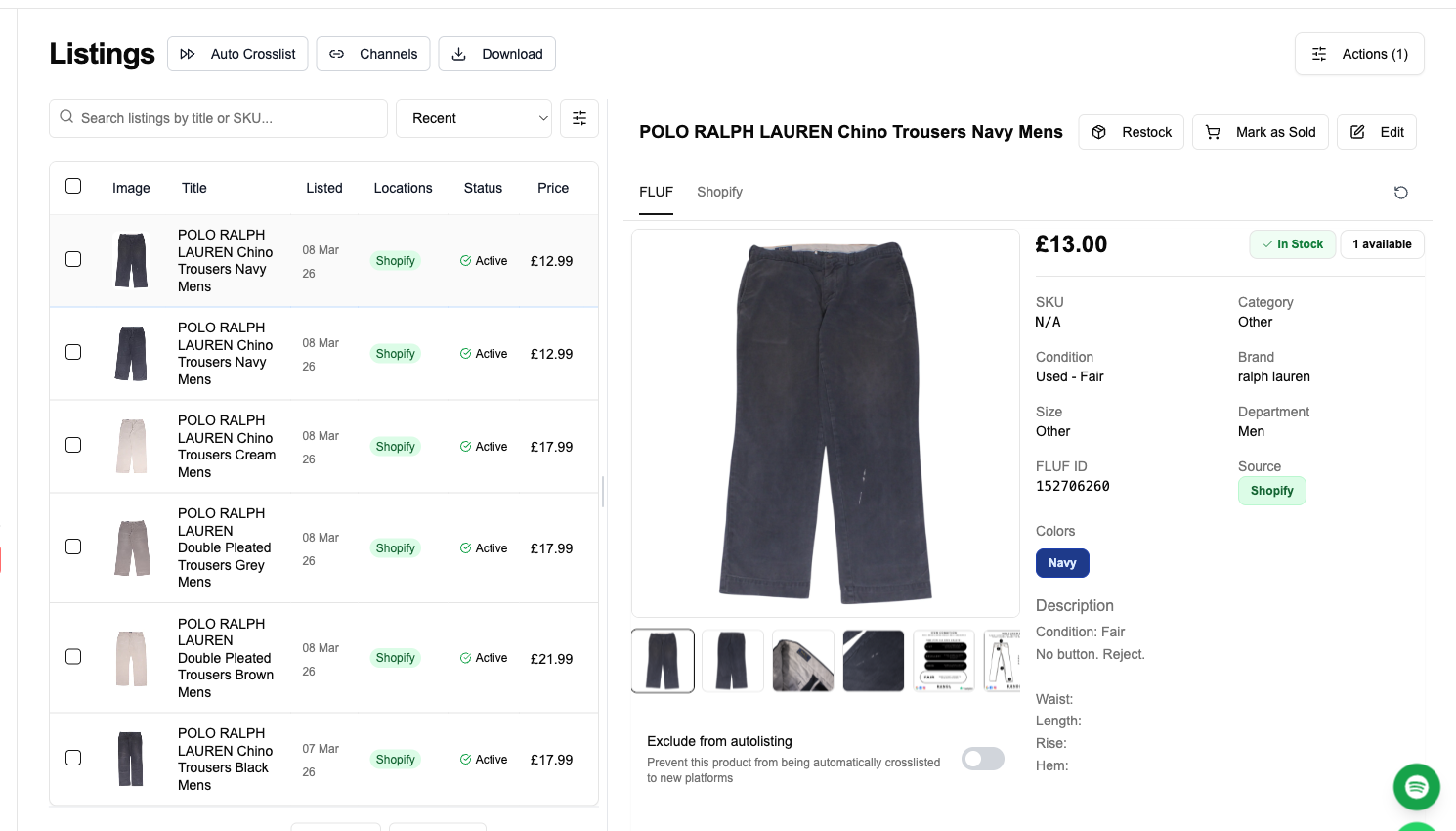
- Find the product. On the Instagram screen, search by title or SKU. Results come from your FLUF listings, so a product that has not been imported from Shopify yet will not appear until it has.
- Choose the images. Tick up to ten. The order you tick them is the order of the slides, and the first one sets the crop for the rest, so pick the hero first.
- Write or draft the caption. Type your own, or ask FLUF to draft one from the images and edit it. The draft describes what is in the photographs and adds hashtags; it is a starting point, not a finished caption, and nothing publishes until you have read it.
- Post or schedule. Publish now, or set a date and time at least a few minutes ahead. Scheduled posts email you when they go out, with the link, and email you if they fail.
There is a log of what you have posted and scheduled. There is no analytics view, and no way to edit or delete a published post from FLUF; those are done in the Instagram app.
The image rules Shopify photos tend to break
Meta publishes hard limits for images sent through its publishing route, and the specification page is worth reading once. Images must be JPEG, no larger than 8 MB, in sRGB, between 320 and 1440 pixels wide, and with an aspect ratio between 4:5 and 1.91:1. Anything outside that range is rejected, not cropped. PNGs, which Shopify accepts happily and many merchants upload for transparent backgrounds, are refused outright, and FLUF does not convert them for you, so a product whose only images are PNG will need a JPEG export uploaded to Shopify first.
The ratio limit is the one that catches Shopify merchants. A lot of apparel stores shoot at 2:3 or 3:4 portrait because that is what their theme’s product grid wants. 3:4 is 0.75 and 2:3 is 0.667; the tallest Instagram will take is 4:5, which is 0.8. A 2:3 product shot is too tall and will be refused unless it is cropped first. 1:1 catalogue images are fine, and so is 4:5.
The second rule is the carousel crop. Meta states that all images in a carousel are cropped to match the first image, and its content publishing guide says so explicitly. If slide one is 1:1 and slide four is 4:5, slide four loses its top and bottom. The fix is boring and effective: export the set for a product at one ratio before uploading to Shopify, and you will never think about it again.
Finally, the profile grid changed. In January 2025 Instagram moved the grid on profiles from 1:1 thumbnails to taller rectangles, with 4:5 uploads showing a 3:4 centre crop on the profile page. A 1:1 product shot still posts fine, but on your profile it now shows with its sides trimmed. If the grid is your shop window, 4:5 with the product centred is the safe shape for every image in the catalogue.
Captions, hashtags and the 2,200-character ceiling
The caption limits are set by Meta and enforced at publish time: 2,200 characters, 30 hashtags and 20 @-mentions. Go over and the post is refused with an error, which FLUF shows you rather than swallowing. In practice the feed truncates a caption after the first couple of lines behind a more link, so the first sentence has to carry the product, and the price if you are going to state it.
On hashtags, the ground shifted in late 2024. Instagram removed the ability to follow hashtags, effective 13 December 2024, saying users could still add them to posts and search by them. What went away was the mechanism that put a hashtagged post into the feed of someone who had never heard of you; what remains is search and Instagram’s own recommendation system, which reads the caption, the image and how people react to it. So a caption written for a person, naming the product, the brand, the size and the condition or material, does more for you now than a block of thirty tags. Five to ten specific hashtags at the end is plenty. FLUF’s drafted captions cap the hashtags well below the limit for this reason.
Getting the click back to your Shopify store
Instagram captions are not clickable, and a pasted URL is just text. Without product tags, the routes from a post to your Shopify checkout are the links in your profile, the link sticker in a Story, and a direct message. That makes the profile link a piece of infrastructure rather than an afterthought.
Instagram allows up to five links in the bio, with no follower threshold, since April 2023. Point one at the collection you are currently pushing rather than the homepage; it lands the buyer on the thing they just saw.
If you were relying on Linkpop, Shopify’s own link-in-bio page that let people buy from the bio, note that Shopify retired it on 7 July 2025. Existing pages stayed up but no longer sell. App Store replacements do the same job, or point the bio at a collection page and skip the intermediate step.
Whichever you choose, append UTM parameters to the URL, because Shopify’s analytics attribute a session by its referrer and an Instagram in-app browser is often recorded as direct. A link of the form yourstore.com/collections/new?utm_source=instagram&utm_medium=bio is enough for Shopify to show you Instagram as a source in its sales reports, which is the only way you will learn whether the posting is paying for itself.
A Story link sticker is the one place a post can carry a specific product URL, so reposting a carousel’s first slide to your Story with a sticker to that product page is the cheapest conversion step in the routine. FLUF does not publish Stories; that is done in the app.
When to post, and what scheduling can and cannot do
Two large 2026 studies agree on the shape of the week and disagree on the hour, which tells you how much to trust either. Hootsuite, from over one million business posts, found reach highest on Mondays, Tuesdays and Thursdays, with Monday strongest between 3pm and 9pm and Tuesday split between early morning and late afternoon. Sprout Social, from nearly two billion engagements across 307,000 profiles, landed on midweek afternoons, with Tuesday 1pm to 7pm and Wednesday 12pm to 9pm at the top. Both aggregate across time zones and industries, so use them to pick the day and your own Instagram insights to pick the hour.
Scheduling in FLUF is a date and a time. Set the post for the window you have chosen and it publishes then, with an email confirming the link. What scheduling cannot do is bulk: there is no calendar view and no drag-and-drop of a month of posts, and each post is scheduled individually. Fine for a merchant posting daily; the wrong tool for an agency posting fifty a day. Meta itself caps accounts at 100 published posts in a rolling 24 hours through its publishing route, with a carousel counting as one, so the ceiling is Meta’s before it is ours.
One honest limitation: if you connect a different Instagram account after scheduling, or the connection lapses, a scheduled post will fail at its publish time, and you will get an email saying so. Reconnect and schedule it again. The post is not silently dropped, but it is not automatically retried either.
What Shopify costs, what FLUF costs
For context, because the two bills sit next to each other, Shopify’s UK plans as published on its pricing page are below. Prices are per month, with the lower figure for annual billing, and online card rates apply to each sale through Shopify Payments.
| Shopify plan | Monthly billing | Annual billing | Online card rate |
|---|---|---|---|
| Basic | £25 | £19 | 2% + 25p |
| Grow | £65 | £49 | 1.7% + 25p |
| Advanced | £344 | £259 | 1.5% + 25p |
| Plus | From £1,800 | Negotiated | Negotiated |
Shopify’s Facebook and Instagram channel is included on every one of those plans; what it costs you is the setup described above, not money. Instagram itself charges nothing to post organically.
7 days for £1, then from £9/month, then plans from £9/month. The Starter plan at £9 gives you unlimited listings, crosslisting to 51 marketplaces, inventory sync, order sync and bulk operations, and the Instagram posting described on this page. Relisting, offer management and smart pricing come with the plans above Starter. Paying yearly saves 40% on every plan.
Sources and verification
- Meta, second quarter 2026 results, 29 July 2026 — 3.60 billion family daily active people for June 2026, up 3%; ad impressions up 14%.
- CNBC, Instagram now has 3 billion monthly active users, 24 September 2025
- Socialinsider, Instagram organic engagement benchmarks — carousels 0.50%, Reels 0.48%, single images 0.33%, Q2 2026; 35 million posts, 447,613 profiles.
- Meta for Developers, Instagram content publishing — professional accounts only, JPEG only, ten items per carousel, first-image crop, 100 API-published posts per 24 hours.
- Meta for Developers, media specifications — 8 MB, sRGB, 320 to 1440 pixels wide, 4:5 to 1.91:1, 2,200 characters, 30 hashtags, 20 mentions.
- Shopify Help Centre, requirements for Facebook and Instagram by Meta — Page, business portfolio, professional Instagram account, verified domain, supported countries, checkout on seller’s website, native checkout discontinued 26 August 2025.
- Meta Business Help Centre, set up a shop on Facebook and Instagram
- Meta Business Help Centre, about changes to Shops and checkout on Facebook and Instagram
- PPC Land, Meta phases out Facebook and Instagram shops checkout by August 2025
- Social Media Today, Instagram is removing the option to follow hashtags, November 2024
- Kapwing, Instagram’s new grid layout, 2025 — profile grid moved from 1:1 to taller rectangles in January 2025.
- Business Standard, Instagram now lets you add up to five links in bio, April 2023
- Coywolf, Shopify shut down Linkpop, 7 July 2025
- Hootsuite, the best time to post on Instagram, July 2026 — over one million business posts, with Critical Truth.
- Sprout Social, best times to post on Instagram, 2026 — nearly two billion engagements across 307,000 profiles.
- Shopify UK pricing page — Basic, Grow, Advanced and Plus prices in GBP, read September 2026.
What we could not verify: Meta’s Business Help Centre pages on shop setup and on the checkout changes did not render for us at the time of writing, so the current list of supported shop countries is taken from Shopify’s requirements page and secondary reporting rather than read directly from Meta; treat the country roster as indicative and check Meta’s page for your market. The 13 December 2024 date for the end of hashtag following comes from press coverage of Instagram’s in-app notice rather than a dated Meta announcement. Socialinsider notes that its 2026 quarterly figures are rolled forward from 2025 data until each quarter closes, so the engagement percentages will move. Shopify prices are the UK page on the day of reading; other countries are billed in local currency at different figures.
Related guides
Frequently Asked Questions
No, and no tool can in the sense the word usually carries. Instagram holds no inventory, so there is nothing to sync stock, prices or orders with. FLUF Connect turns a Shopify product’s photographs into an Instagram post or a carousel of up to ten images, lets you edit the caption, and publishes it now or at a scheduled time. That is promotion, not crosslisting, and the page says so plainly.
No. An Instagram post is not a listing, so there is nothing for FLUF to end or zero out. If a product you featured sells through, the post stays up unless you delete it in the Instagram app. Sold detection and mark-as-sold in FLUF apply to your marketplaces, not to Instagram.
Only if you want shoppable product tags and a shop tab. Shopify’s channel needs a Facebook Page, a business portfolio, an Instagram professional account linked to the Page, a verified domain and Meta’s commerce review, and it is limited to Meta’s supported shop countries. FLUF posts need none of that. You can run both; they do different jobs.
Not any more. Meta phased out on-platform checkout during 2025, and Shopify’s help pages now describe buyers adding to a cart in the app and then choosing “Checkout on seller’s website”, which sends them to your Shopify checkout. Whether a product is tagged or promoted with a FLUF post, the sale completes on your store.
A professional account, meaning Business or Creator. Meta’s publishing route does not accept personal accounts, so FLUF cannot post from one. You can switch in the Instagram app under account type, and the switch is reversible.
Almost always the shape or the format. Instagram accepts JPEG only, up to 8 MB, with an aspect ratio between 4:5 and 1.91:1. A 2:3 or 3:4 portrait shot, which many Shopify themes favour, is taller than 4:5 and is refused, and PNGs are refused regardless of shape. Crop to 4:5 or 1:1 and export as JPEG before uploading to Shopify.
Through your profile links or a Story link sticker, because captions are not clickable. Instagram allows up to five links in the bio, so point one at the collection you are currently promoting rather than the homepage, and add UTM parameters so Shopify’s reports attribute the visit to Instagram. Shopify’s own Linkpop tool was retired in July 2025, so use a collection page or an App Store alternative.
It is part of every FLUF Connect plan. The trial is seven days for £1, then plans start at £9 a month for Starter, which includes unlimited listings, crosslisting to 50+ marketplaces, inventory sync, order sync, bulk operations and Instagram posting. Relisting, offer management and smart pricing come with the plans above Starter. Yearly billing saves 40%.
Not in one go. Each post is scheduled individually with a date and time, and you get an email when it publishes or if it fails. That suits a merchant posting once a day; it is not a bulk content calendar. Meta also caps accounts at 100 posts published through its tools in any rolling 24 hours.