
Crosslist from Temu to Facebook Marketplace — Automatically
Push your Temu catalogue into Facebook Marketplace's 1.1 billion local-pickup audience. FLUF Connect maps fields, publishes via Chrome extension, and keeps inventory in sync — no overselling, no double admin.



- Temu: ~530 million monthly active users globally, three seller programs (Fully Managed, Semi-Managed, Local-to-Local), commissions of 2–15% depending on category and seller model.[1][2]
- Facebook Marketplace: 1.1 billion+ monthly active users, ~250 million sellers, 0% seller fees on local pickup sales, 10% selling fee (minimum $0.80) on shipped sales.[3][4]
- Why this pair: Temu Local-to-Local sellers (and resellers sourcing inventory from Temu) can clear bulky or cheap stock through Facebook Marketplace’s local-pickup audience — no shipping label, no Temu algorithm dependency, no fees on local sales.
- Fields that transfer automatically: title, description, images, price (with currency conversion), condition, brand, category (best match).
- Inventory sync: When an item sells on either platform, the other listing is removed within minutes — no overselling.
- Cost: From £19/month on the FLUF Connect Growth plan (500 products). Automation is included in every plan, not a paid add-on.
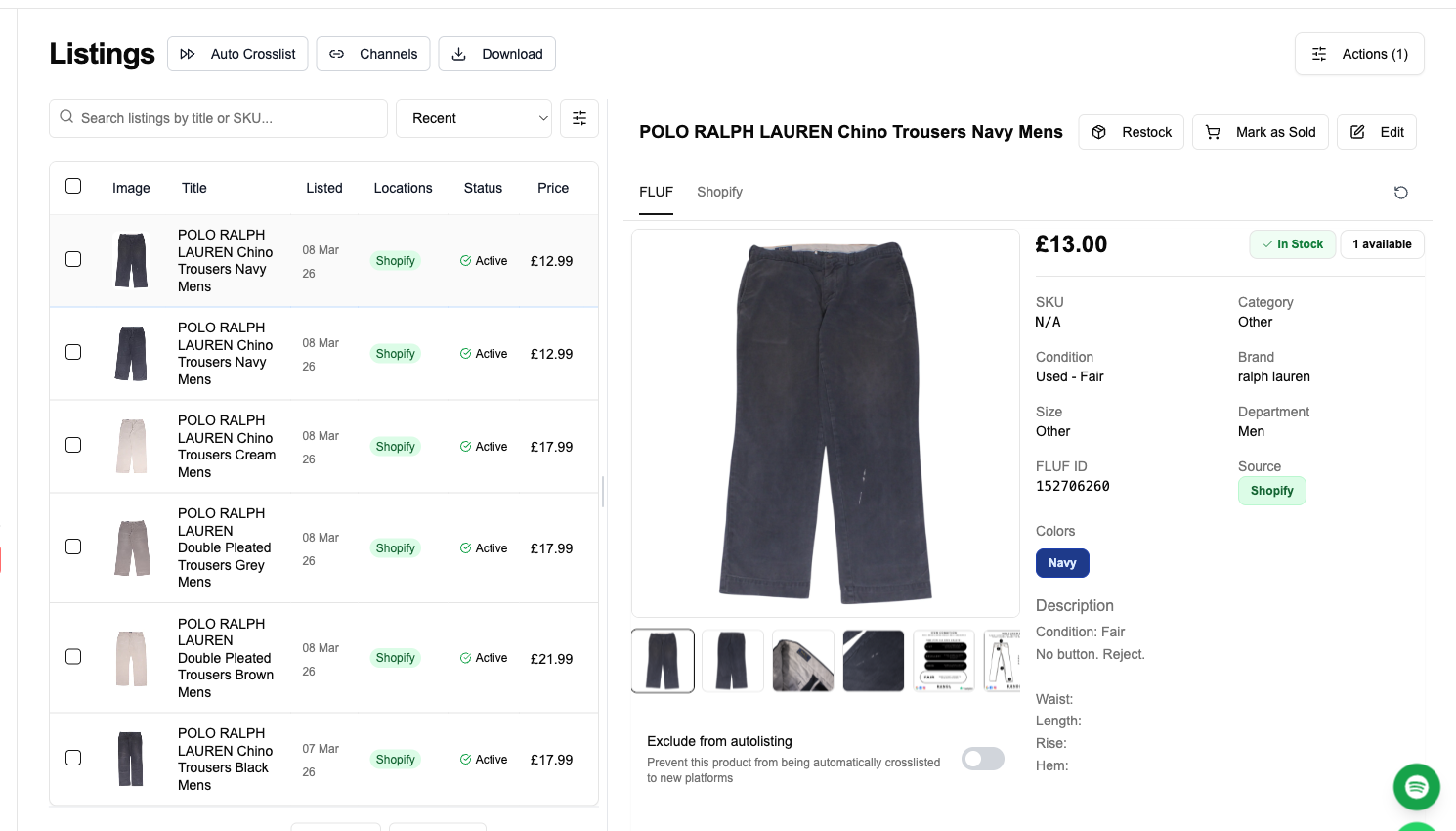
Why Crosslist from Temu to Facebook Marketplace?
Crosslisting from Temu to Facebook Marketplace lets a Temu seller (or a reseller sourcing inventory from Temu) reach a 1.1 billion-user local audience that browses by postcode rather than by Temu’s recommendation algorithm. Facebook Marketplace charges no seller fee on local-pickup sales, which makes it a particularly strong outlet for the bulky, cheap, or oversized stock that is awkward to ship at Temu’s race-to-the-bottom prices.[3][4]
Temu and Facebook Marketplace serve almost entirely different buying behaviours. Temu is a new-goods marketplace where buyers actively search for the lowest price on commodity SKUs — apparel basics, electronics accessories, homeware, beauty. Facebook Marketplace buyers are locally-located, scrolling through a feed sorted by distance, often looking for a specific thing they need this week (a desk, a dehumidifier, a child’s bike, a coffee table). They will pay more if they can collect the item today, in cash, without paying for shipping. For a Temu Local-to-Local seller with regional warehouse stock, this is free demand — the item is already sitting near the buyer.
The fee maths makes the case stronger. Temu commission runs 2–15% depending on category and seller program, with Semi-Managed sellers also covering shipping, returns, and a US$39/month subscription.[2] Facebook Marketplace local-pickup sales carry no platform fee at all — the buyer pays cash or arranges payment off-platform, and the seller keeps 100%.[4] Even on shipped Marketplace sales (10% fee, minimum $0.80), the per-item margin is often higher than the equivalent Temu sale because there is no Temu warehouse handling fee, no Temu return cost, and no Temu price-match pressure on the listing.[4]
| Temu | Facebook Marketplace | |
|---|---|---|
| Monthly active users | ~530 million globally[1] | 1.1 billion+ globally[3] |
| Primary buyer behaviour | Search-led, price-comparison, recommendation feed | Location-led browsing, local pickup, messenger negotiation |
| Top markets | US, EU, UK, Australia, Japan, Korea | Global — every country where Facebook operates |
| Strongest categories | Apparel basics, electronics accessories, home, beauty, kids | Furniture, electronics, fashion, vehicles, homeware, baby/kids |
| Seller fees | 2–15% commission depending on category and seller model; Semi-Managed sellers pay US$39/month subscription[2] | 0% on local pickup; 10% (minimum $0.80) on shipped sales[4] |
| Seller program | Fully Managed, Semi-Managed, Local-to-Local[1] | Individual sellers + business pages; no application required |
| Listing format | Catalogue-led, often standardised SKU with structured attributes | Free-form individual listings with photos, title, price, location |
| Shipping expectation | Mandatory (managed by Temu or by seller depending on model) | Local pickup default; shipping optional |
| Buyer payment | On-platform card payment | Cash, bank transfer, or Messenger payment for local; on-platform for shipped[5] |
The honest version: Temu’s seller flow is complex, and not every Temu seller benefits from Facebook Marketplace. If you are a Fully Managed seller with stock sitting in Temu’s warehouse on the other side of the world, you cannot offer local pickup — you’d need to enable shipping on Marketplace, and at that point your fee picture is much closer to Temu’s. The strongest fit is Local-to-Local Temu sellers with regional or national stock; Semi-Managed sellers fulfilling from their own warehouse; or resellers who buy in bulk from Temu and want a second outlet for what doesn’t move. For these sellers, Facebook Marketplace turns dead stock into local cash at a 0% take rate.
FLUF Connect handles the crosslisting workflow itself — pulling your Temu catalogue into one dashboard, mapping each listing’s fields to Facebook Marketplace, publishing through the FLUF Chrome extension (Facebook does not publish a public Marketplace API, so a browser-side bridge is required), and keeping inventory in sync after launch.
Push your Temu catalogue into Facebook Marketplace’s 1.1B local audience — fee-free on local pickup.
How to Crosslist from Temu to Facebook Marketplace with FLUF Connect
The end-to-end Temu to Facebook Marketplace crosslisting flow takes about 60 seconds for a single item and a few minutes for bulk batches. Here is exactly what happens.
1. Connect Temu
From the FLUF Connect Channels page, connect your Temu seller account using the credentials for your Seller Center login. FLUF imports your live Temu catalogue — every listing’s title, description, images, price, condition, brand, size chart, and category. This works for all three Temu seller models (Fully Managed, Semi-Managed, Local-to-Local), though only Semi-Managed and Local-to-Local sellers tend to use Facebook Marketplace as a complementary outlet because they have direct control over fulfilment.
2. Connect Facebook Marketplace
Install the FLUF Connect Chrome extension and sign into your Facebook account in the same browser. The extension creates a secure bridge between Marketplace and the FLUF dashboard — required because Facebook does not offer a public Marketplace API to third-party tools. Setup takes under two minutes. Once connected, you do all your crosslisting from the FLUF Connect web dashboard; the extension runs in the background only when listings are being published or delisted.
3. Filter Temu Listings for Marketplace Suitability
Open the Listings page and filter your Temu catalogue. Good candidates for Facebook Marketplace are items that are bulky, fragile, or low-margin (where shipping would erode profit), high-volume basics (where you want a second outlet), and anything that has been sitting on Temu without selling. You can filter by category, price band, age of listing, or stock level. Bulk-select hundreds at once for batch crosslisting.
4. Review the Preview
FLUF previews each listing as it will appear on Facebook Marketplace — title (trimmed to Marketplace’s 100-character limit, original kept on Temu), description (Temu’s SKU-style descriptions can be rewritten for Marketplace’s casual tone), photos, price (converted to your local currency), category (mapped from Temu’s structured taxonomy to Marketplace’s category list), and condition (Temu items are usually “New”, which maps directly). You can adjust any field per item or apply bulk rewrites.
5. Set Pickup vs Shipping Defaults
This is the step that matters most for Temu sellers. Default to local pickup if your stock is regional and you can be at home for collection. Enable shipping if you’d rather post the item — you’ll pay the 10% Marketplace fee but you reach buyers outside collection range.[4] FLUF lets you set a global default for all crosslisted items and override per listing.
6. Publish
Click crosslist. The Chrome extension publishes the listings to Facebook Marketplace one by one — your location is read from your Facebook account so listings appear in the correct local area. Listings typically appear on Marketplace within a few minutes of clicking publish, depending on batch size.
7. Inventory Syncs From Here Forward
Once both channels are connected and listings are live, you don’t manage them separately. A sale on Temu marks the listing as sold on Facebook Marketplace within minutes; a Marketplace sale removes the corresponding Temu listing. The same applies to any other channels you connect later (Vinted, Depop, eBay, Etsy, Shopify) — they all share one inventory state through FLUF.
What Transfers When You Crosslist from Temu to Facebook Marketplace?
Temu and Facebook Marketplace are structurally different. Temu is catalogue-led, with structured attributes, mandatory size charts on apparel, and standardised SKU descriptions. Facebook Marketplace is informal — a title, a description box, a handful of photos, a price, a location, and a category. FLUF Connect maps every supported field between the two.
Field Mapping — Temu to Facebook Marketplace
| Temu Field | Facebook Marketplace Field | Transfer | Notes |
|---|---|---|---|
| Title | Title | Automatic | Marketplace caps titles at 100 characters. Temu titles are often longer with SEO keywords — FLUF trims intelligently, keeping the most descriptive words. |
| Description | Description | Automatic | Temu’s SKU-style descriptions transfer as plain text. You can override per item to soften the tone for Marketplace buyers. |
| Images (up to 9 on Temu) | Images (up to 10) | Automatic | All Temu photos transfer comfortably. Marketplace prefers natural-light, real-environment shots — consider replacing white-background studio photos with in-context images. |
| Price (local currency) | Price (local currency) | Automatic with conversion | Temu’s aggressive marketplace pricing tends to be lower than Marketplace’s local-pickup market rate. Many items can be repriced upward 20–40% on Marketplace because there are no platform fees on local pickup.[4] |
| Condition | Condition | Mapped | Temu items are typically “New” — maps directly to Marketplace’s “New” condition. Used categories also map cleanly. |
| Brand | — | In description | Marketplace doesn’t have a dedicated brand field. Brand stays in title/description. |
| Category (Temu taxonomy) | Category (Marketplace category list) | Smart mapped | Temu’s deeper taxonomy folds into Marketplace’s broader categories (Home Goods, Electronics, Clothing & Shoes, etc.). FLUF picks the best match automatically. |
| Size chart (apparel) | — | In description | Marketplace has no structured size chart. Size details are appended to the description. |
| Variations (colour/size) | — | Primary only | Marketplace doesn’t support variations. The primary variant is published. For multi-variant items, create separate Marketplace listings. |
| SKU | — | Stored, not displayed | SKU is kept inside FLUF for inventory sync purposes. |
| — | Location | Auto-set | Uses your Facebook account location. Critical for local pickup — set it correctly before crosslisting. |
| — | Delivery method | Manual default | Local pickup default in FLUF; switch to shipping per item or globally. |
Category Mapping Examples
| Temu Category | Facebook Marketplace Category |
|---|---|
| Women’s Clothing > Dresses | Clothing & Shoes |
| Home & Kitchen > Storage > Shelving | Home Goods |
| Consumer Electronics > Audio > Headphones | Electronics |
| Tools & Home Improvement > Power Tools | Tools |
| Baby & Toddler > Toys | Toys & Games |
| Pet Supplies > Dog Beds | Pet Supplies |
| Garden > Outdoor Furniture | Garden & Outdoor |
Fields That Need Your Attention
- Location: Marketplace listings are filtered by buyer distance. Confirm your Facebook account location is accurate before publishing — a wrong city means zero local-pickup buyers will see your stock.
- Pricing strategy: Temu prices are competitive against global low-cost sellers. Marketplace prices are competitive against other local sellers, and there is no platform fee on pickup. Plan a price uplift on items that will go local-pickup-only.
- Photos for context: Studio-style Temu photos can look generic next to Marketplace’s “phone-camera-in-living-room” norm. For higher-ticket items, replacing the lead image with an in-context shot will increase clicks.
Inventory Sync Between Temu and Facebook Marketplace
FLUF Connect’s bidirectional inventory sync means a sale on either platform removes the listing from the other within minutes. For Temu sellers with finite local stock, this is the protection layer that makes selling on both platforms safe.
| Event | What Happens | Timing |
|---|---|---|
| Item sells on Temu | Automatically removed from Facebook Marketplace and any other connected channels | Within minutes |
| Item sells on Facebook Marketplace | Automatically removed from Temu and any other connected channels | Within minutes |
| Item deleted on Temu | Marketplace listing is removed | Within minutes |
| Item edited on Temu (title/description) | Marketplace not auto-updated — edit in FLUF to push to both channels | — |
| Price changed on Temu | Marketplace not auto-updated — edit in FLUF to push to both channels | — |
| Stock quantity change on Temu | Marketplace listing reflects only “available” vs “sold” — quantity field is not used on Marketplace | — |
The biggest risk with multi-channel selling is selling the same physical item twice — particularly painful on Temu, where late dispatch metrics drag your seller rating down hard. FLUF Connect’s inventory sync removes the listing from Facebook Marketplace within minutes of the Temu sale (and vice versa). For Local-to-Local Temu sellers with single-piece stock, this is essential.
Before and After FLUF Connect
The cost of doing this manually is one of the reasons most Temu sellers stay single-channel for too long. Here is the realistic comparison.
Without FLUF Connect (Manual Crosslisting)
- Open Temu Seller Center, find the listing
- Copy the title, paste into a text editor, trim to 100 characters for Marketplace
- Download each product photo individually (right-click, save image — Temu uses CDN URLs that don’t always work as direct downloads)
- Open Facebook Marketplace in another tab
- Click “Create new listing”
- Upload photos one by one
- Paste title
- Rewrite the description for Marketplace’s tone (or paste Temu’s SKU-style description and hope)
- Pick a category from Marketplace’s list
- Set condition
- Set price (decide manually whether to bump from Temu’s price)
- Set local pickup vs shipping
- Publish
- Log the cross-listing in a spreadsheet so you remember to delist on Marketplace when it sells on Temu
- Check Temu daily for sales; when one sells, log into Marketplace and manually mark sold
Time per item: ~10–15 minutes. Time per 100 items: 16–25 hours.
With FLUF Connect
- Filter Temu catalogue in the FLUF dashboard
- Bulk-select items
- Review the preview (fields are pre-mapped, prices pre-adjusted)
- Click crosslist
- Done. Inventory sync runs from here forward.
Time per item: ~30 seconds. Time per 100 items: ~50 minutes.
Manual: 16–25 hours. With FLUF Connect: ~50 minutes. That’s enough hours back to source the next Temu batch, photograph local-pickup-only items, and answer Messenger enquiries — the actual money-making work.
Automation Features for Temu + Facebook Marketplace Sellers
FLUF Connect’s automation features are included on every plan, not a paid add-on. Here is what works on this specific channel pair.
Auto-Crosslisting Rules
Set rules so any new Temu listing is automatically pushed to Facebook Marketplace. Filter by category (e.g. “only home goods over $30 cross to Marketplace”), price band, brand, or tag. New stock appears on both platforms without manual intervention.
Bulk Operations
Find & replace across all Temu and Marketplace listings simultaneously. Bulk price adjustments (raise all Marketplace prices by 15% in one click). Bulk delisting if you ever want to wind a channel down.
Listings Edits
Edit a title, description, price, or photo in FLUF Connect and push the change to both Temu and Marketplace — keeps the canonical state in one place rather than two tabs.
Order Sync
Temu orders flow into FLUF (and into Shopify if you have it connected) so you have a single place to manage fulfilment across both channels. Facebook Marketplace orders are managed inside Messenger — FLUF marks the Marketplace listing as sold but doesn’t pull the order record because there is no Marketplace orders API.
Feature Coverage
| Feature | Temu | Facebook Marketplace |
|---|---|---|
| Crosslisting (push listings) | Yes | Yes (via Chrome extension) |
| Inventory sync (delist on sale) | Yes | Yes |
| Listing edits via FLUF | Yes | Yes |
| Bulk operations | Yes | Yes |
| Auto-relisting | No | No (Marketplace doesn’t expose a relist API) |
| Offer management | No | No (Marketplace offers happen inside Messenger) |
| Order sync | Yes (orders flow into FLUF / Shopify) | No (no Marketplace orders API; sales tracked via delisting only) |
Pricing
Temu to Facebook Marketplace crosslisting is included on every FLUF Connect plan. Automation is part of every plan; not a paid add-on.
| Plan | Monthly Price | Products | Temu + Marketplace |
|---|---|---|---|
| Growth | £19/month | 500 products | Both included |
| Seller | £99/month | 5,000 products | Both included |
| Super Seller | £299/month | Unlimited | Both included, priority sync |
Every plan includes crosslisting between all supported channels, not just Temu and Facebook Marketplace — connect Vinted, Depop, eBay, Etsy, Shopify, Vestiaire, or Yaga at any time without changing plan. See the full FLUF Connect pricing page for details.
Start crosslisting from Temu to Facebook Marketplace today.
Related Guides
- How to Sell on Temu — The Complete Guide for 2026
- How to Sell on Facebook Marketplace — The Complete Guide
- Crosslist from Facebook Marketplace to Vinted
- Crosslist from Temu to Vinted
- Crosslist from Depop to Facebook Marketplace
- All crosslisting pair guides
Sources & Verification
- Digital Commerce 360 — Temu’s Local Seller Program Explained (2026 Update): digitalcommerce360.com
- OneCart — Temu Seller Fees 2026 (2–15% commission + Semi-Managed US$39/month): getonecart.com/temu-seller-fees
- Capital One Shopping Research — Facebook Marketplace Statistics: capitaloneshopping.com
- Spocket — Facebook Marketplace Fees 2025: spocket.co
- Facebook Marketplace selling fees update (Feb 2025, prepaid labels removed): litcommerce.com
Frequently Asked Questions
Yes. FLUF Connect imports your Temu catalogue, maps each listing's fields to Facebook Marketplace's format, and publishes through the FLUF Chrome extension (required because Facebook does not offer a public Marketplace API). You can crosslist individually, in bulk, or set rules to auto-crosslist new Temu listings as they're added.
No. Facebook Marketplace charges 0% on local-pickup sales — the buyer pays you off-platform (cash, bank transfer, or Messenger payment) and you keep 100% of the price. The 10% selling fee (minimum $0.80) only applies if you enable shipping. For bulky or low-margin Temu stock, local-pickup-only is often the most profitable configuration.
Local-to-Local and Semi-Managed Temu sellers benefit most because they hold stock themselves and can fulfil local-pickup orders. Fully Managed sellers have inventory in Temu's warehouses and can only realistically use Marketplace's shipped-sale flow, which carries the standard 10% fee. The Local-to-Local model was rolled out specifically to give regional sellers control over fulfilment and is the strongest fit for Marketplace's local audience.
Yes. FLUF Connect's inventory sync removes the Marketplace listing within minutes of the Temu sale, and the reverse direction works the same way. This is essential for single-piece Local-to-Local stock and prevents the late-dispatch penalty that comes with double-selling on Temu.
Facebook Marketplace doesn't have a structured size chart field — listings are free-form. FLUF appends size-chart details (measurements, fit notes) to the Marketplace listing description so buyers still have the information. The structured chart stays inside Temu where it's required.
Yes. Temu pricing is competitive against global low-cost sellers, while Marketplace pricing competes against local sellers in your area. Since there's no platform fee on local pickup, most resellers price Marketplace items 20–40% above their Temu listing. FLUF lets you set a per-channel price markup rule or override individual listings.
No. FLUF Connect pushes whatever you publish but lets you customise each channel separately. Titles can differ (Marketplace caps at 100 characters, Temu doesn't), descriptions can be rewritten for tone, prices can vary, and category choices can be tailored. The only field that must stay linked across both channels is the inventory state — that's what prevents overselling.
Not fully. Facebook Marketplace doesn't expose a third-party orders API — conversations and payment confirmations happen inside Messenger. FLUF Connect tracks sales by detecting the listing being marked as sold and then delists the item across all other connected channels. Temu orders, by contrast, flow into FLUF (and Shopify if connected) as full order records you can fulfil from one dashboard.
Plans start at £19/month (Growth — 500 products). Seller is £99/month for 5,000 products and Super Seller is £299/month for unlimited. Every plan includes crosslisting, inventory sync, bulk operations, and listing edits across all supported channels — automation is included in every plan, not a paid add-on. There is no free plan.
Yes. Every FLUF Connect plan includes crosslisting between all supported channels — Vinted, Depop, eBay, Etsy, Shopify, Vestiaire Collective, and Yaga, plus Temu and Facebook Marketplace. Connect as many as you want without changing plan; inventory stays in sync across the whole set.