Crosslist from Shopify to Kloset Klub
Take curated pieces from your own Shopify storefront to Kloset Klub, South Africa's community resale marketplace — one catalogue, ZAR pricing, honest stock sync.



- Shopify is the hosted own-store platform behind merchants in 175+ countries and $292.3B of GMV in 2024 (source) — your own domain, your own brand, but an audience you have to bring yourself. Kloset Klub is South Africa’s curated resale marketplace for quality pre-loved fashion, with a ready-made community of local buyers hunting designer, occasion-wear, streetwear and sneakers (source).
- This is a “storefront meets community” play: you keep running your own Shopify boutique and, at the same time, put curated pieces in front of a South African resale audience you cannot reach from your storefront alone.
- Kloset Klub is free to list, charges a 5% success fee when an item sells, applies a R5 (excl VAT) withdrawal fee, and enforces a R400 minimum listing price — all in South African rand, with payments handled by TradeSafe and shipping by Pudo (source).
- Title, description, images, price, quantity and SKU carry across from Shopify automatically, and Shopify variants map to Kloset Klub per SKU — you write the listing once. Prices convert from your Shopify store currency to a deliberate ZAR figure at or above the R400 floor.
- Sync is honest, not magic: FLUF Connect keeps stock in step by reading orders on both sides, but Kloset Klub has no mark-as-sold, so when an item sells you end the Kloset Klub listing yourself. A Kloset Klub sale can still auto-remove the item from Shopify and other channels that support removal.
- FLUF Connect crosslists your whole catalogue from one dashboard. Plans start from £9/month (Starter). There is no free plan, and automation is included from Seller upwards.
Why sell on both Shopify and Kloset Klub
A Shopify store gives you something no marketplace can: your own domain, your own brand, and total control over how your shop looks and reads. That is exactly why Shopify powers merchants in more than 175 countries and processed $292.3B of gross merchandise volume in 2024, up 24% year on year and past $1 trillion cumulatively (source). But a hosted storefront has one structural weakness: it does not come with an audience. Every visitor to your Shopify boutique is one you paid for, ranked for, or earned through your own social following. The shop is yours, but so is the entire job of driving traffic to it.
Kloset Klub solves the opposite problem. It describes itself as South Africa’s curated resale platform for quality pre-loved fashion — a peer-to-peer marketplace where the buyers are already there, already browsing, and already looking specifically for the kind of recognisable designer brands, occasion wear, African designers, streetwear and sneakers that a curated boutique carries (source). You do not build that audience; you tap into it. For a South African fashion store owner, or a boutique that ships into South Africa, that is a genuinely different distribution channel from your own storefront: it is discovery-led rather than destination-led, and it is native to the local resale community in a way your standalone domain can never be on its own.
The reason to run both, rather than pick one, is that they do different jobs. Your Shopify store is where your brand lives — full-price drops, your own photography and story, repeat customers who came for you specifically, and the margin that comes with owning the customer relationship. Kloset Klub is where curated pieces reach fresh local buyers who would never have found your domain: end-of-season stock, one-off designer items, sample-sale pieces, or pre-loved inventory that suits a resale audience better than a full-price shopfront. One channel builds your brand; the other borrows an existing community’s attention. Listing the same pieces in both places means your inventory works twice without you photographing or writing it twice.
It helps that Kloset Klub is curated rather than a free-for-all. It leans into recognisable brands, occasion wear, African designers, streetwear and sneakers, and it actively discourages ultra-fast-fashion — which means a considered boutique piece sits comfortably in that environment instead of drowning under thousands of low-value listings (source). If your Shopify shop already curates for quality, your inventory is a natural fit for the exact audience Kloset Klub cultivates, and your listings should read as belonging rather than as an outsider dumping stock.
Be clear-eyed about what Kloset Klub is and is not. It is a South African marketplace that transacts in rand, settles through TradeSafe, and ships through Pudo lockers and counters — so this pairing makes sense when you can fulfil to South African buyers and are comfortable pricing and being paid in ZAR (source). It does not publish audience or transaction figures, so nobody should promise you a specific number of buyers; what it offers is a curated, community-driven local resale audience rather than a mass-market firehose. Treated as a targeted reach channel for the right pieces, it complements a Shopify storefront rather than competing with it.
How to crosslist from Shopify to Kloset Klub
The mechanics are simple once your catalogue lives in one place. FLUF Connect treats your inventory as a single source of truth and pushes each item out to the channels you enable, so “crosslisting from Shopify to Kloset Klub” really means “have the item in FLUF once, then switch Kloset Klub on”.
Here is the path from a standing start:
- Create your FLUF Connect account and install the extension. Follow the Kloset Klub connection prompts while signed in to your marketplace account.
- Connect Shopify as your source. Link your Shopify store so FLUF can read your existing products — titles, descriptions, photos, prices, quantities and per-variant SKUs — and pull them into your central catalogue. Shopify’s product-and-variant model means each size or colour variant comes across with its own SKU, price and stock, so nothing is flattened on the way in.
- Connect Kloset Klub as a destination. Authorise the Kloset Klub channel from the FLUF dashboard. Once connected, Kloset Klub becomes a toggle on each product, exactly like every other channel.
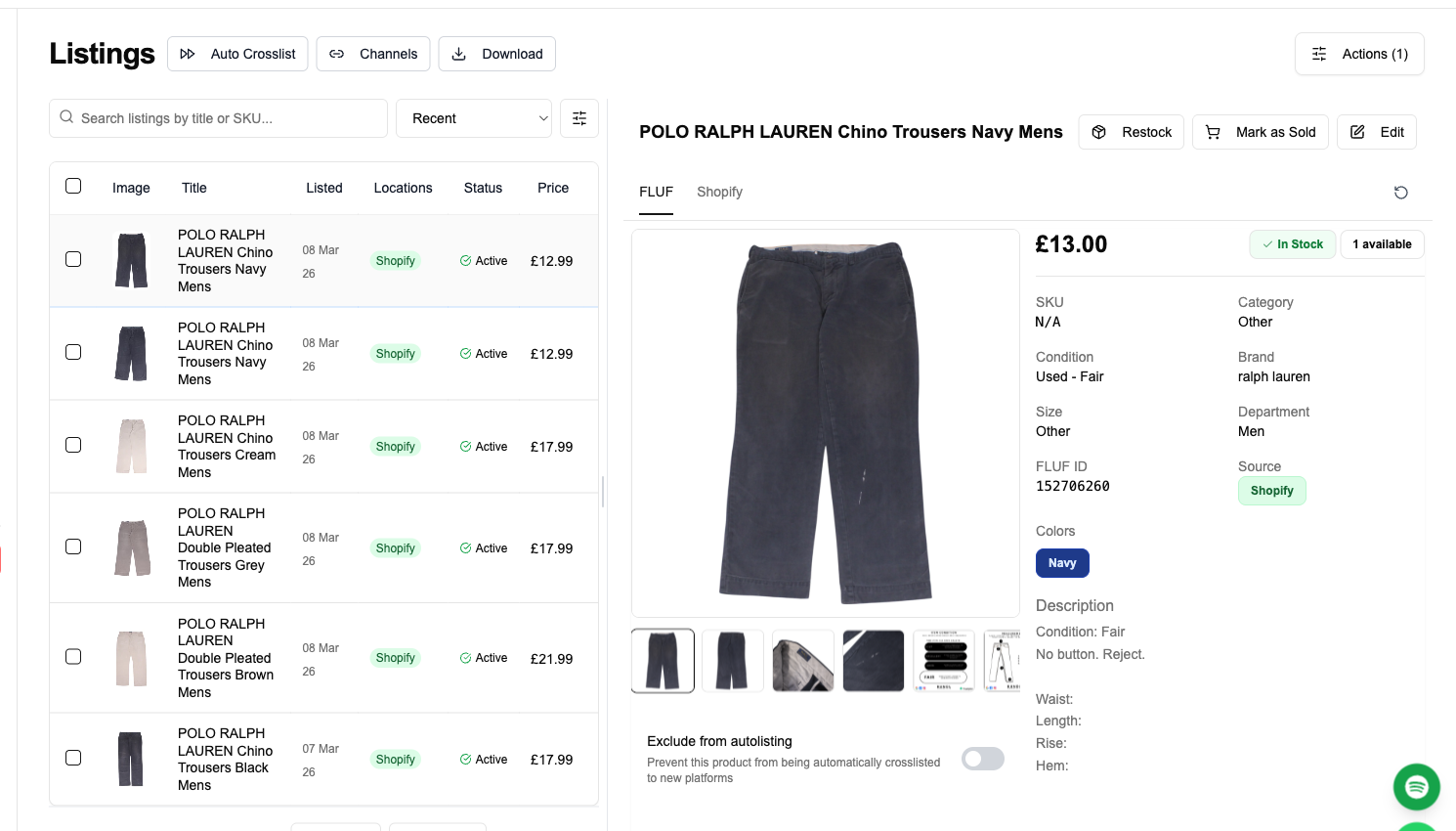
- Import and review your catalogue. FLUF brings your Shopify products into the listings view (shown above). Check that photos, descriptions and variant SKUs imported cleanly, and choose which pieces genuinely suit a curated South African resale audience — you probably do not want to push your entire storefront, only the items that fit.
- Set your ZAR pricing. This is the step specific to this pair. Kloset Klub prices in South African rand and enforces a R400 minimum listing price, so convert from your Shopify store currency deliberately rather than letting a raw exchange rate decide. Make sure every item you push clears the R400 floor, and price with the 5% success fee and local resale expectations in mind (source).
- Push live and monitor. Enable Kloset Klub on the products you want in front of South African buyers, publish, and watch orders flow back into the same dashboard. From here the automation and sync do the ongoing work — with the one manual step on sold items that the next section explains honestly.
The important shift in mindset is that you are not running two disconnected storefronts. You are running one catalogue with two audiences attached to it. An edit to an item’s title, description, images or price in FLUF can be pushed to Kloset Klub, so there is no drift between your Shopify product and your Kloset Klub listing unless you deliberately want them to differ — for example, a lower resale price on Kloset Klub than your full-price Shopify listing.
What transfers — fields & categories
FLUF Connect maps the core listing fields from your Shopify catalogue onto Kloset Klub’s own structure. For this route, the fields that carry across reliably are title, description, images, price, quantity and SKU — the essentials that make up a complete listing — plus brand, size, category and condition wherever Kloset Klub exposes a field for them.
| Field | Shopify (source) | Kloset Klub (destination) | Notes |
|---|---|---|---|
| Title | Yes | Yes | Transfers directly; keep it brand- and model-led so Kloset Klub’s curated buyers surface it in search. |
| Description | Yes | Yes | Carries across as written. Lean into the designer name, condition and occasion to fit the curated audience. |
| Images | Yes | Yes | Your Shopify product photography is your biggest asset and travels with the listing — clean shots read as quality in a curated marketplace. |
| Price | Yes (store currency) | Yes (ZAR) | Set the rand figure deliberately at or above the R400 minimum; do not rely on a raw currency conversion. |
| Quantity | Yes | Yes | Stock levels are tracked and kept consistent across both channels. |
| SKU | Yes (per variant) | Yes | Shopify variants map per SKU, so each size/colour is matched individually — this is what lets order sync tie a sale back to the right item. |
| Category | Your store taxonomy | Curated fashion taxonomy | Kloset Klub is fashion-only and curated, so FLUF maps your item into the closest fashion category — brand, occasion, streetwear or sneakers. |
Shopify variants each have their own SKU, price and stock. Review each Kloset Klub listing to make sure it represents the correct size or colour, with the right photos, price and quantity.
Because Kloset Klub is a curated fashion marketplace rather than a general classifieds site, the structured fields it does expose — brand, size, condition and category — carry real weight with buyers who are hunting labels and specific pieces. Fill them in thoughtfully. A descriptive, brand-forward title and an honest condition note are how a pre-loved item gets discovered and trusted in a community that prizes quality and discourages ultra-fast-fashion.
What syncs and what doesn’t
This is the section to read carefully, because Shopify and Kloset Klub do not have identical sync capabilities, and it would be dishonest to pretend otherwise. Here is the accurate picture, using the real capabilities of each channel.
Order sync works on both sides. Shopify supports order sync, and so does Kloset Klub. That means FLUF reads sales from both channels and keeps a single, shared stock count. When something sells on either platform, FLUF knows about it and updates your central quantity — you are not manually reconciling two separate sales feeds.
Mark-as-sold works on Shopify but not on Kloset Klub. Shopify supports mark-as-sold, so when an item sells on Kloset Klub, FLUF can automatically remove or zero out that item on Shopify and on any other connected channel that supports removal. The gap is on the Kloset Klub side: Kloset Klub does not support mark-as-sold through FLUF. So when an item sells on Shopify, FLUF cannot automatically end the matching Kloset Klub listing for you — you end that Kloset Klub listing yourself. In short, a sale is detected everywhere by order sync, but the actual takedown is automatic on Shopify and manual on Kloset Klub.
Relisting and offers are not part of this pair. Neither Shopify nor Kloset Klub exposes automated relisting or an offers/negotiation capability through FLUF, so there is no automatic bump to fire and any price negotiation happens natively on the platform rather than through the crosslister.
| Capability | Shopify | Kloset Klub |
|---|---|---|
| Order sync | Yes | Yes |
| Mark-as-sold (auto delist on sale) | Yes | No — you end the listing yourself |
| Automated relisting | No | No |
| Offers via FLUF | No | No |
The practical routine that follows from this is easy to internalise. If a piece sells on Kloset Klub, FLUF registers the sale via order sync and can pull the item down from Shopify automatically — you do nothing. If a piece sells on Shopify first, FLUF still registers the sale and updates stock, and it can clear the item from channels that support removal — but you should hop into Kloset Klub and end that listing yourself so a second buyer cannot purchase an item you no longer have. For one-of-a-kind pre-loved pieces, that single manual habit on the Kloset Klub side is the price of admission for reaching a curated South African audience, and it is a small one. Nothing here overclaims: FLUF keeps your stock honest by reading orders on both sides, and it is transparent about the one takedown it cannot do for you.
Your workflow, before & after
It helps to see what actually changes day to day, because the value of a crosslister is measured in the minutes it removes from your routine.
Before FLUF Connect. Your products live inside Shopify. To reach South African resale buyers you would open Kloset Klub, create each listing from scratch, re-upload every photo, retype the title and description, work out a sensible ZAR price by hand while making sure it clears the R400 minimum, and set the right category. Then you would repeat that for every piece you wanted to list. Worse, you would carry the ongoing risk that a Shopify sale leaves a live Kloset Klub listing still selling the same physical garment — so you would be manually policing both platforms every time something sold. For a curated selection of any size, that is hours of duplicate data entry plus a permanent low-grade worry about overselling a one-off item.
After FLUF Connect. You build the product once in Shopify — or maintain it there — and it flows into your central catalogue with its variants, SKUs, photos and copy intact. You set the ZAR price once, above the R400 floor, and push the pieces that suit a resale audience to Kloset Klub. From then on, orders from both channels arrive in a single dashboard and stock stays consistent because order sync reads sales on both sides. A Kloset Klub sale auto-clears the item from Shopify; a Shopify sale updates your stock and prompts your one manual step — ending the Kloset Klub listing yourself, since Kloset Klub has no mark-as-sold. Your daily job shrinks to photographing and writing new pieces once, choosing which belong on Kloset Klub, and remembering that single takedown habit when a Shopify order lands. The reach into a curated South African community becomes largely passive once the setup is done.
The selection discipline is worth building into the after-state deliberately. Because Kloset Klub is curated and discourages ultra-fast-fashion, the workflow is not “dump the whole store” — it is “choose the designer, occasion, streetwear and sneaker pieces that fit”. FLUF makes that a per-item toggle rather than a second listing job, so curating for the channel costs you a click, not an afternoon.
Automation & bulk tools
Automation is where crosslisting stops being a data-entry chore and starts being leverage, and on FLUF Connect it is included from Seller upwards rather than sold as a paid add-on.
For this pair, the automation that earns its keep is order sync and the Shopify-side mark-as-sold. Together they mean a sale on Kloset Klub clears the item from your Shopify store without you touching it, and your central stock count stays accurate no matter which channel a piece sells on. The honest boundary — that you end the Kloset Klub listing yourself when a Shopify sale lands — is a single deliberate action, not an ongoing chore, and everything around it is automated. There is no relisting or offers automation on this route, so the sync is the whole of the value, and it is substantial: for unique pre-loved items, not overselling is the thing that matters most.
The bulk tools matter most at the moment of expansion. If you already have a stocked Shopify catalogue, you do not want to push items to Kloset Klub one at a time. FLUF’s bulk actions let you select a batch of suitable pieces, apply a ZAR pricing rule that respects the R400 minimum, and publish to Kloset Klub together, so bringing a curated set of existing products to a new market is a single session’s work rather than dozens of separate ones. Bulk editing also lets you append a shipping note or tidy a set of titles across many listings at once — useful when you are adapting store copy for a resale audience.
Inventory sync underpins all of it. FLUF keeps a single quantity for each SKU and reconciles it across every connected channel, so the number a Kloset Klub buyer sees reflects the same stock your Shopify store holds. Because Shopify variants map per SKU, that reconciliation is precise down to the individual size or colour — which is exactly what makes it safe to run genuinely one-of-a-kind fashion across your own storefront and a community marketplace at the same time.
Pricing
FLUF Connect plans start at £9/month (Starter). There is no free plan, but every new account gets a 7-day trial for £1. Inventory sync, order sync, and the bulk tools are all included on every plan — automation is part of the product, not a paid extra.
It is worth separating FLUF’s subscription from each platform’s own costs, because they sit in very different places. Shopify is a hosted SaaS you pay a monthly fee for: US pricing runs Basic at $39/month, Grow at $105 and Advanced at $399 (UK equivalents Basic £25, Grow £65, Advanced £344), with Shopify Payments card rates from 2.9% + 30c on Basic down to 2.5% + 30c on Advanced, and a surcharge if you use a third-party gateway instead (source). You are paying Shopify for the storefront and the checkout, not for access to a marketplace audience.
Kloset Klub inverts that. It is free to list — there is no monthly platform fee and no cost to put a piece up. Instead it takes a 5% success fee only when an item actually sells, applies a R5 (excl VAT) fee when you withdraw your balance, and enforces a R400 minimum listing price, with payments secured through TradeSafe and delivery through Pudo (source). In other words, you pay Shopify a fixed subscription to own your storefront, and you pay Kloset Klub a small slice of each successful sale to reach its community — a marketplace fact about Kloset Klub, entirely separate from FLUF’s plan.
What that means in practice: a piece that sells on Kloset Klub gives up 5% to the marketplace before your payout (plus the flat R5 when you withdraw), whereas the same item sold through your Shopify store carries your Shopify subscription and card-processing costs but no marketplace commission. That difference is a good reason to price your Kloset Klub listing on its own merits — clearing the R400 floor and accounting for the 5% fee — rather than mechanically converting your full-price Shopify figure. The FLUF subscription pays for itself the moment crosslisting saves you more time, or captures more sales into a South African community, than £19 a month is worth. For a Shopify seller with curated stock and no other route into that audience, that threshold is low.
Sources & verification
The figures and fee details on this page come from the following primary and reference sources:
- Shopify GMV ($292.3B in 2024, +24% YoY, past $1T cumulative) — sec.gov Shopify Q4 2024 press release
- Shopify pricing, card rates, 175+ countries and the product/variant model — shopify.com/pricing
- Kloset Klub — curated South African resale positioning, categories, free to list, 5% success fee, R5 (excl VAT) withdrawal fee, R400 minimum listing price, TradeSafe payments and Pudo shipping — klosetklub.com/how-it-works
Frequently Asked Questions
Yes. FLUF Connect keeps one catalogue and pushes the pieces you choose to Kloset Klub, so your own Shopify storefront and a curated South African resale audience both work from the same inventory. Title, description, images, price, quantity and SKU transfer automatically, and Shopify variants map to Kloset Klub per SKU.
No. Kloset Klub has order sync but no mark-as-sold, so when a piece sells on Shopify, FLUF updates your central stock and can clear it from channels that support removal — but you end the Kloset Klub listing yourself. A sale on Kloset Klub, by contrast, can auto-remove the item from Shopify because Shopify supports mark-as-sold.
Kloset Klub is free to list. It charges a 5% success fee only when an item sells, applies a R5 (excl VAT) withdrawal fee, and enforces a R400 minimum listing price, with payments via TradeSafe and shipping via Pudo. That is a marketplace fact about Kloset Klub, separate from FLUF's subscription.
Kloset Klub prices in South African rand and requires a minimum listing price of R400. Set the ZAR figure deliberately in FLUF rather than relying on a raw conversion of your Shopify store-currency price, making sure every item clears the R400 floor and accounts for the 5% success fee.
Yes. Shopify gives each variant its own SKU, price and stock, and FLUF maps Kloset Klub listings per SKU, so a variant-heavy product is not flattened. When a specific size or colour sells, the sync knows exactly which SKU moved and keeps your stock count accurate.
Often, yes. Kloset Klub is a curated South African resale marketplace focused on recognisable designer brands, occasion wear, African designers, streetwear and sneakers, and it discourages ultra-fast-fashion. Considered boutique pieces fit that environment well. It is a South African, rand-based channel, so it suits sellers who can fulfil to South African buyers.
Plans start at £9/month (Starter). There is no free plan, but every new account gets a 7-day trial for £1. Inventory sync, order sync and bulk tools are included on every plan — automation is part of the product, not a paid add-on.
Sign up for free
Join the community
You're in.
Open your dashboard