
Crosslist from PrestaShop to Depop
Depop charges a French or Spanish PrestaShop shop three times what it charges a British one, refuses supplier photographs, and has no size grid to receive your combinations. What survives the move, and what syncs back across 70+ marketplaces.



- Where you are based sets the fee before anything else does. A PrestaShop merchant in the UK, US or Australia pays no Depop selling fee, only payment processing. A merchant in France, Spain, Italy or Poland — PrestaShop’s four biggest markets — pays a 10% selling fee plus PayPal’s cut, because Depop Payments and Depop Shipping do not reach the EU.
- Depop is hostile to catalogue-style selling. Stock images, supplier photographs and goods bought to order are listed under prohibited drop-shipping. Your own photographs of your own stock are the price of admission.
- Combinations do not travel. FLUF Connect imports each PrestaShop product as one item; a size or colour grid is not split into separate listings. Plan for that before you push a hoodie that comes in six sizes.
- The listing is shaped differently. Four photographs and one video, no separate title field, up to five hashtags and two brand hashtags, and a description that has to disclose second-hand condition or the listing is removed.
- Stock flows both ways. A Depop sale is mirrored into PrestaShop stock and the product switches off at zero rather than being deleted; a paid PrestaShop order ends the Depop listing. Sales on any other connected marketplace do the same to both.
- Depop’s buyers are young and, since July 2026, owned by eBay. Roughly 90% of active users are under 26; the platform did $1.07 billion of sales in 2025 across 7.0 million active buyers.
- Through FLUF Connect: one PrestaShop catalogue, 78 marketplaces, Depop connected without a browser extension. 7 days for £1, then from £9/month, then plans from £9/month.
Who this route is for
PrestaShop is a European storefront. On Store Leads’ September 2026 count there are 149,297 live PrestaShop stores, and the four largest countries are France with 22,232, Spain with 15,511, Poland with 13,321 and Italy with 11,046 — between them more than two-fifths of the platform. Some 19,540 of those stores sell apparel. PrestaShop’s own figures are broader and older: it says some 300,000 merchants in over 195 countries have used the software, and when the Polish hosting group cyber_Folks completed its purchase of the company on 18 February 2026 it put the active base at 230,000 stores and about €22 billion of annual sales.
Depop is the opposite kind of place: an app-first, consumer-to-consumer fashion marketplace where the seller’s profile matters as much as the product page. Depop has said that roughly 90% of its active users are under 26. Under Etsy‘s ownership it closed 2025 with $1,074.9 million of gross merchandise sales, 7.0 million active buyers and 3.2 million active sellers, with US buyer sales up 60% on the year. On 30 July 2026 eBay completed its acquisition of Depop and said it would keep the brand, platform and customer experience distinct.
This page is for a PrestaShop shop selling clothing, footwear, streetwear or accessories — new, vintage or mixed — that wants those buyers. Two things decide whether the route is worth it: which country you sell from, and whether your stock and photographs can pass Depop’s rules. Both come before anything about software.
Where you sell from decides what Depop costs you
Depop’s fee schedule is split by seller location, and the split falls awkwardly across PrestaShop’s merchant base. Depop’s seller fees page says that no selling fee is charged to sellers based in the UK, the US or Australia. Those sellers must use Depop Payments, which is a requirement in the US, UK and Australia, and pay only a payment processing fee: 2.9% plus £0.30 in the UK, 3.3% plus $0.45 in the US, and 2.6% plus A$0.30 in Australia, each charged on the item price plus shipping plus any tax.
The commission did not vanish; it moved to the buyer. Since 15 April 2024 in the UK and 18 July 2024 in the US, buyers paying in pounds or dollars pay a Marketplace fee of up to 5% of the item price plus a fixed amount of up to £1 or $1, shown at checkout and refunded in full if the item is refunded. Depop’s July 2024 announcement framed the two changes as one package.
Everyone else is on the old model. The same fees page states that sellers outside the UK, US and Australia, selling in a currency other than GBP, USD or AUD, pay a 10% selling fee on the item price and, if they did not use a Depop Shipping label, on the shipping cost as well. They are paid through PayPal rather than Depop Payments, and PayPal’s own processing fee comes on top at whatever rate PayPal charges in that country. A French, Spanish, Italian or Polish PrestaShop merchant lands here.
| Seller based in | Depop selling fee | Payment processing | Buyer pays a Marketplace fee | Boosted Listings fee |
|---|---|---|---|---|
| United Kingdom | None | 2.9% + £0.30 (Depop Payments) | Yes, up to 5% + up to £1 | 12% on new listings from 23 March 2026 |
| United States | None | 3.3% + $0.45 (Depop Payments) | Yes, up to 5% + up to $1 | 12% on new listings from 23 March 2026 |
| Australia | None | 2.6% + A$0.30 (Depop Payments) | Separate Australian policy | 8% |
| France, Spain, Italy, Poland, anywhere else | 10% of item price, plus shipping if you did not use a Depop label | PayPal’s rate for your country | No | 8% |
A UK merchant selling a £40 jacket with £4 shipping pays 2.9% of £44 plus 30p, which is £1.58, and keeps £42.42 before postage. A Spanish merchant selling the same jacket at €45 with €5 self-arranged shipping pays €5.00 in Depop selling fee on the €50 total, and then PayPal’s fee on top. The European seller pays three to four times the platform cost for the same buyer. It should be in your Depop price from the first listing, and it is a good argument for keeping Depop prices independent of PrestaShop prices rather than mirroring them.
Boosted Listings is the only other charge. It is optional, charged only when a buyer interacts with the boosted tile and then buys within 28 days, and set at 12% in the UK and US for listings created from 23 March 2026 and 8% elsewhere. Fees are reversed automatically on a refund through Depop Payments; PayPal sellers have to raise a ticket to get their selling fee back.
Depop’s rules read like a warning to catalogue merchants
Depop was built for individuals clearing wardrobes, and its prohibited and restricted items list was written with that seller in mind. A PrestaShop merchant should read four entries on it before importing anything.
Drop-shipping. Depop prohibits drop-shipped designer, luxury, electronic or cosmetic items; items listed using stock images, customer photos or supplier photos; and items produced at large scale and bought to order from catalogues or other marketplaces. The allowed exceptions are handcrafted items the seller designed, and print-on-demand goods the seller designed. If your PrestaShop store resells a wholesaler’s range using the wholesaler’s photography, that is the description of a listing Depop will remove.
Photographs. The point is repeated in Depop’s selling guide: always use original photos, and a listing that uses stock images will be removed. The community guidelines add no copied listings, no misleading titles and no irrelevant hashtags. For a merchant whose product images came from a supplier, this is the largest piece of preparation on the route, and no software shortens it.
Condition disclosure. A second-hand clothing item that is not disclosed to be second hand or used is itself a prohibited listing. If you mix new and pre-owned stock in one PrestaShop catalogue, the Depop description of every used piece has to say so.
Category bans that catch a general store. Most technology and electronics are prohibited outright — phones, headphones, consoles, laptops, smartwatches, hair stylers — with cameras, phone cases and analogue watches allowed. Used, decanted, tester or unsealed perfumes and cosmetics are banned; unused, sealed and genuine ones are fine. Children’s clothing, toys and protective equipment are allowed only where they meet safety regulations and carry the right labelling. Counterfeits, replicas and “inspired by” goods are banned and are the fastest route to a suspended account.
None of this stops a business selling on Depop. It means the stock that works is stock you hold and photographed yourself, in fashion and accessories, with honest condition notes — a fair description of a good vintage or independent-brand PrestaShop shop.
Mapping a PrestaShop product onto a Depop listing
A PrestaShop product is a multilingual, multi-image, multi-combination record with a default category, a manufacturer, a reference, a condition flag, a weight and a stock quantity per combination. A Depop listing is up to four photos and one video, a description with up to five hashtags and up to two brand hashtags, a category, a shipping price and an item price, plus brand, size, condition and colour picked in the form. The table shows how the two line up and where you should look before you post.
| PrestaShop field | Depop equivalent | What to check |
|---|---|---|
| Product name | Opening line of the description | Depop’s form has no separate title; the first words of the description do that job in search, so keep the name short and specific |
| Description and short description (HTML, per language) | Description (plain text) | The default shop language is the one that imports; formatting is flattened, and third-party tools put the limit at 1,000 characters, so trim long HTML descriptions |
| Product images | Photos, up to four, plus one video | The cover image goes first; extra images beyond four are dropped, and they must be your own photographs |
| Default category | Depop category | Confirm the category on the listing preview; it drives which sizes Depop offers |
| Manufacturer (brand) | Brand | Use the real brand or leave it unbranded; a brand hashtag on an unbranded item is a misleading-title breach |
| Condition flag (new, used, refurbished) | Condition | Used stock must be disclosed as used in the description as well |
| Combinations (size, colour) | Single size and colour per listing | Not expanded — see the next section |
| Price and shop default currency | Item price in your Depop currency | Depop sets currency per account and applies a change only to new listings, so match it to your shop currency before you start |
| Reference (SKU) | No public field | FLUF keeps the reference on the product record so a Depop sale can be matched back to the right PrestaShop product |
| Weight | Parcel size and shipping price | Set shipping in Depop; PrestaShop carrier rules do not apply |
| Stock quantity | Listing live or sold | Depop shows a listing, not a count — see below |
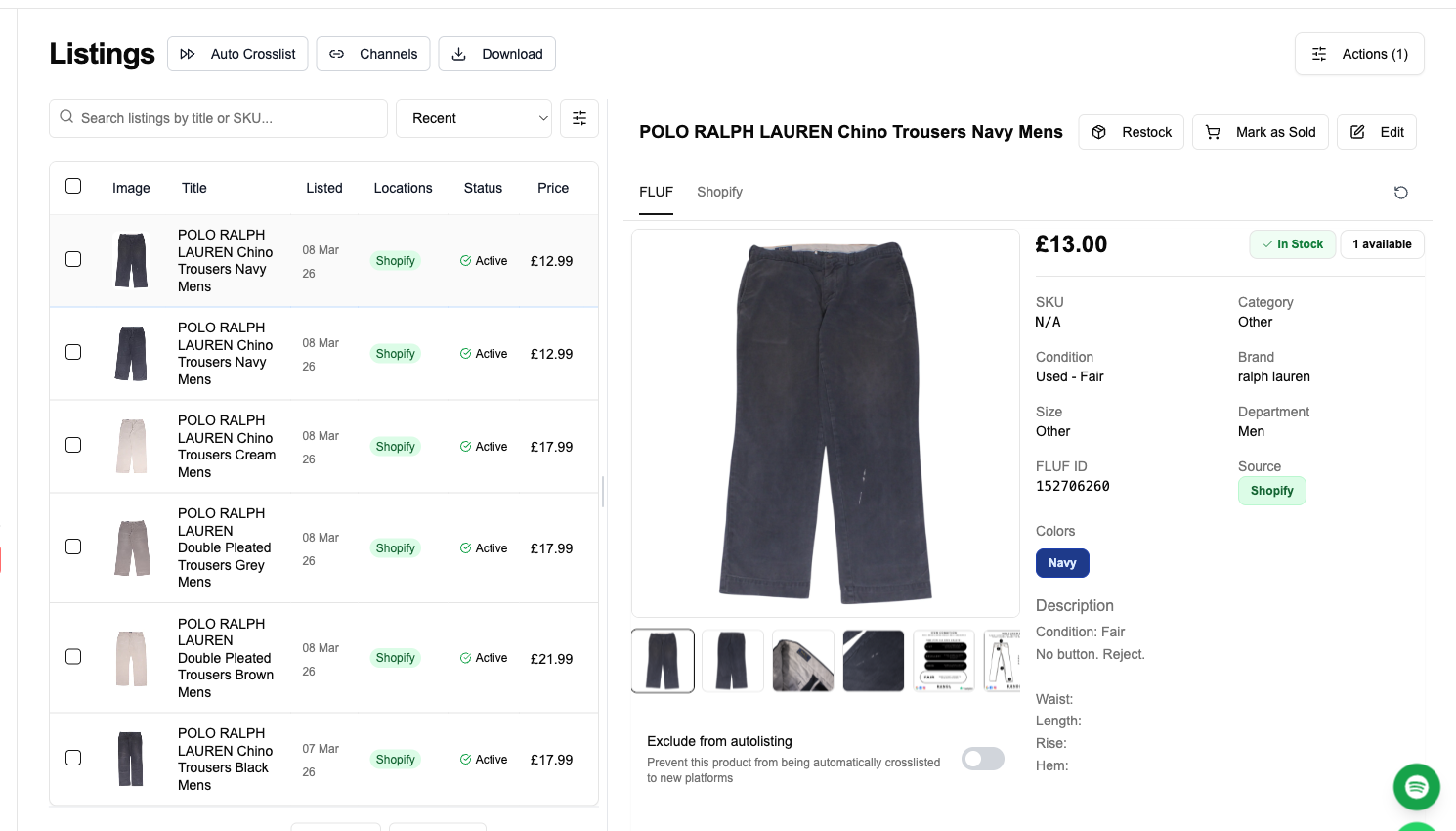
Combinations, stock and the one-item listing
PrestaShop models variation as combinations: one product, many attribute pairs, each with its own reference, stock and optional price impact. The Webservice exposes combinations as a resource separate from products. FLUF Connect imports the product, not its combinations. Each PrestaShop product becomes one item in FLUF, and one item is what gets crosslisted to Depop. A T-shirt in five sizes imports as one T-shirt, and the size that reaches Depop is whatever the product record itself carries, not a grid.
Depop has no variation model to receive a grid into; a listing carries one size. A tool that did expand combinations would have to create five Depop listings from one product and keep five stock counts in step with one.
Three practical responses, in order of effort:
- Crosslist the products that are genuinely one item — vintage pieces, one-offs, single-size accessories, sold-out-bar-one lines. For a vintage shop this is most of the catalogue.
- Put the available sizes in the description for a multi-size product, and let the buyer message you. Many independent brands already sell on Depop this way.
- Split variant-heavy lines into separate PrestaShop products per size if Depop matters enough. This changes your own storefront, so do it only for the lines Depop’s audience wants.
Stock is the other half. A PrestaShop product can be active but not available for order, or available but at zero stock, and the two flags are set separately. Check both before crosslisting; a product that cannot be bought on your own site should not be live on Depop. After a Depop sale, the Depop listing shows as sold and the PrestaShop stock moves down. If you held several units, the listing needs relisting for the next one, which is exactly the job relisting does on the plans above Starter.
Shipping, protection and getting paid
In the UK, Depop Shipping runs through Evri: after a sale you receive a QR code for an Evri drop-off point, or a printable label, and the parcel is fully tracked with no need to mark it shipped by hand. The label is valid for UK Mainland only, which Depop defines as England, Wales, the Isle of Wight, the Isle of Man and most of Scotland, excluding the Highlands and Islands, the Channel Islands, the Isles of Scilly and Northern Ireland. Set your shipping method to Other and you arrange and pay for your own tracked postage, then add the tracking number yourself. In the US, Depop Shipping runs through USPS on the same QR-code-or-label pattern, and an order not shipped within 10 days of purchase is cancelled and refunded automatically.
Outside the US and UK, Depop’s guidance is simply to use your preferred tracked method, quote a domestic or worldwide price when you list, keep proof of postage until delivery, and remember tax identifiers such as an IOSS number on cross-border parcels. Your existing carrier contracts — Colissimo, Correos, Poste Italiane, InPost — are what you would use; Depop simply does not know about them.
Depop Protection for sellers covers loss or damage in transit only for UK, US and Australian sellers who used the Depop label and shipped within five days, up to £250, $300 or A$450 per transaction. A merchant shipping on their own account, in any country, carries the transit risk themselves.
Payout timing follows the same split. A UK seller on Depop Shipping is paid two business days after tracking shows delivery, or ten business days after the sale, whichever is first; a UK seller shipping their own way waits ten business days after delivery. US sellers get the two-or-ten rule too, and withdrawals take up to five days to land. PayPal sellers are paid into PayPal, with the selling fee taken as a separate charge from that account.
What syncs between PrestaShop and Depop
FLUF Connect treats PrestaShop as the source catalogue and Depop as a sales channel, and keeps them in step both ways.
| Event | What happens |
|---|---|
| You connect PrestaShop | FLUF reads your products, images, categories and stock. Each product is one item; combinations are not expanded. |
| You crosslist to Depop | A Depop listing is created from the FLUF record. Review the category, size, condition and description preview before you post the first batch. |
| The item sells on Depop | The sale is detected and the PrestaShop stock is reduced. When it reaches zero the product is switched off — inactive and not available for order — rather than deleted, so its URL, images and history stay in your back office. |
| The item sells on PrestaShop | Once the order is in a paid, shipped or delivered state, the Depop listing is ended, and so is the listing on any other connected marketplace. An order still awaiting payment does not count. |
| The item sells on a third channel | The same in both directions: the Depop listing is ended and the PrestaShop stock is updated. |
| You restock in PrestaShop | A product that came back into stock can be crosslisted again; relisting on the plans above Starter handles the routine version of this on Depop. |
| A buyer makes an offer on Depop | Offer management on the plans above Starter answers it against the floor price you set. |
Two things a seller should do by hand. Combinations, already covered. And edits: once a product is on Depop, treat FLUF as the place to change its price or description, because a change typed into the PrestaShop back office after import is not what Depop shows until the FLUF record is updated. FLUF also shows no link to the PrestaShop order in its order view, because back office addresses differ on every installation.
Neither side needs a browser extension. PrestaShop is connected with a Webservice key, and Depop is connected by signing in to your Depop account from FLUF.
PrestaShop 8, PrestaShop 9 and the Webservice key
The connection uses PrestaShop’s long-standing Webservice, which is present in both current major versions. PrestaShop 9.0 shipped on 10 June 2025, requires PHP 8.1 or later and introduced a new Admin API that PrestaShop itself describes as a work in progress; the classic Webservice is documented for version 9 as it is for 8. PrestaShop 8.2.x is in extended support until PrestaShop 10 is released, and 1.7 stopped being maintained when 9.0 arrived.
Creating the key takes a few minutes. Following PrestaShop’s own instructions: open Advanced Parameters, then Webservice, switch Enable PrestaShop Webservice to Yes, click Add new webservice key, press Generate for a 32-character key, give it a description, and tick permissions per resource. PrestaShop’s documentation warns against giving a key every right on every resource, and FLUF does not need that. It needs View, Add, Modify and Delete on products; View and Modify on stock availables; View and Add on images; and View only on categories, orders, order details, customers, addresses, countries, currencies, order states, configurations, shops and languages. In multistore mode, associate the key with the shop you are connecting. The shop must be reachable over public HTTPS.
Setting it up, step by step
- Decide the fee regime you are in. UK, US or Australia: Depop Payments, no selling fee, Depop Shipping available in the UK and US. Anywhere else: 10% selling fee, PayPal, your own postage. Price for it.
- Audit the catalogue against Depop’s rules. Own photographs only, no drop-shipped or supplier-image stock, no most electronics, used items disclosed as used, children’s goods compliant. Remove or reshoot anything that fails.
- Decide what to do with combinations. Single items go as they are; multi-size lines get sizes in the description or a per-size product.
- Create the Webservice key in PrestaShop with the permissions listed above, and set your Depop currency to match your shop currency.
- Connect PrestaShop in FLUF Connect with the shop URL and the key, and let the import run. Check a handful of products for name, images, category and stock.
- Connect Depop by signing in from FLUF. No extension is required.
- Crosslist a small batch first. Check description, category, size and condition on each, set your shipping price in Depop, then bulk-crosslist the rest.
- Turn on relisting and offer management if you are on a plan above Starter, so multi-unit products return after each sale and offers are answered for you.
What it costs
7 days for £1, then from £9/month, then plans from £9/month.
Crosslisting, inventory sync, order sync and bulk operations are on every plan, including Starter at £9/month with unlimited listings. Relisting, offer management and smart pricing come with the plans above Starter. Paying yearly saves 21%.
| Plan | Monthly | Yearly | You save | Crosslisted products |
|---|---|---|---|---|
| Starter | £9/month | £85/year | 21% | Unlimited |
| Pro | £29/month | £155/year | 55% | Unlimited |
| Priority | Custom pricing — tell us what you need | Unlimited | ||
Automatic relisting, offer management, smart pricing and listing boosts are included from Pro upwards. Starter covers unlimited crosslisting, inventory sync, order sync and Instagram posting without them. Accounting integrations are included from Pro upwards. Yearly billing is charged once a year. New accounts get 7 days for £1, then move onto a plan.
Save 21% when you pay yearlySources and verification
Every fee, rule and figure on this page was checked against the source linked beside it on 9 September 2026.
- Depop’s seller fees and charges page — no selling fee for UK, US and Australian sellers; processing fees of 2.9% + £0.30, 3.3% + $0.45 and 2.6% + A$0.30; the 10% selling fee and PayPal processing for everyone else; the 12% and 8% boosting fees; refund handling.
- Depop on the Marketplace fee — up to 5% plus up to £1 or $1, paid by UK and US buyers, effective 15 April 2024 and 18 July 2024.
- Depop’s July 2024 announcement — the US selling fee removal and the reference to the earlier UK change.
- Depop Payments and Depop on item currency — the three-country requirement, PayPal elsewhere, and currency changes applying only to new listings.
- Depop’s prohibited and restricted items, Selling on Depop and the Community Guidelines — drop-shipping, stock images, undisclosed second-hand items, electronics, cosmetics, safety-regulated goods and counterfeits.
- Depop on listing an item — four photos and one video, five hashtags and two brand hashtags, category, shipping price and item price.
- A third-party crosslisting tool’s Depop FAQ — the 1,000-character description limit and the absence of a separate title, cited as third-party because Depop’s help centre does not publish a figure.
- How to ship — UK, the UK Shipping Policy, How to ship — US and How to ship — Worldwide — Evri and USPS labels, the UK Mainland definition, the 10-day US cancellation, and the self-shipping guidance for other countries.
- Depop Protection for sellers, How do I get paid — UK and How do I get paid — US — the protection limits and payout timings.
- Depop on Boosted Listings — how the boost fee is triggered and the 28-day window.
- Etsy’s Q4 and full-year 2025 results, eBay’s completion announcement and General Atlantic on Depop’s Series C — 2025 sales, buyers and sellers, the 30 July 2026 acquisition, and the under-26 share.
- Store Leads’ PrestaShop report, PrestaShop’s global e-commerce page and the cyber_Folks acquisition report — store counts by country, the 300,000-merchant and 195-country claims, and the 230,000 active stores and €22 billion figures.
- PrestaShop 9.0 release announcement, 8.2.x extended support notice, Creating access to the Webservice and the Webservice resource list — versions, support status, key creation and the combinations resource.
What we could not verify, and therefore left out. Depop’s photograph dimensions: third-party guides quote 1280 by 1280 pixels, but Depop’s own help centre publishes no pixel figure, so none appears above. The exact Evri and USPS label prices for Depop Shipping, which Depop sets inside the app rather than on a public page. Whether Depop applies any additional charge to EU sellers on sales to UK buyers, which some third-party fee guides mention and Depop’s fees page does not. PrestaShop does not publish its own per-country merchant breakdown, so the country figures come from Store Leads’ crawl rather than from PrestaShop. And the age profile of Depop’s users is an investor-cited figure from 2019 that Depop has not restated since; treat “roughly 90% under 26” as the last published number, not a current audit.
Related guides
- Sell on PrestaShop — the complete seller guide
- Sell on Depop — the complete seller guide
- Crosslist from PrestaShop to Vinted
- Crosslist from PrestaShop to eBay
- Crosslist from Shopify to Depop
- PrestaShop vs WooCommerce compared
- All marketplace guides
- All crosslisting routes
- Crosslist from Trendyol to Depop
Frequently Asked Questions
Yes. Depop's fee schedule has a specific row for sellers outside the UK, US and Australia, so the account is open to you. The terms are different, though: a 10% selling fee on the item price (and on shipping if you did not use a Depop label), payment through PayPal with PayPal's own processing fee on top, no Depop Payments, no Depop Shipping label and no Depop Protection. Build the 10% into your Depop price rather than mirroring your PrestaShop price.
Because Depop removed its selling fee only for UK, US and Australian sellers, in 2024, and replaced it with a Marketplace fee that buyers in those countries pay at checkout. A UK seller pays 2.9% plus £0.30 in payment processing and nothing else; a Spanish seller is still on the 10% commission plus PayPal. On a €50 order that is roughly €5 against under €2.
No. Each PrestaShop product imports as one item, and combinations — the size and colour grid — are not expanded. A product in five sizes becomes one Depop listing carrying whatever size the product record itself holds. For multi-size lines, either state the available sizes in the description or split the line into per-size products in PrestaShop; single items such as vintage pieces need no change.
No. Depop's prohibited items list treats goods listed with stock images, supplier photos or customer photos as drop-shipping, and its selling guide says a listing that uses stock images will be removed. Every photograph on a Depop listing has to be your own, of the item you hold. If your PrestaShop catalogue was built on supplier imagery, reshooting is the largest task on this route.
FLUF detects the Depop sale and reduces the PrestaShop stock. When the quantity reaches zero the product is switched off — set inactive and not available for order — rather than deleted, so its URL, images and order history stay in your back office and you can bring it back when you restock.
Once the PrestaShop order reaches a paid, shipped or delivered state, FLUF ends the Depop listing, and any listing for the same item on your other connected marketplaces. An order still waiting for payment does not trigger this, which protects you from a bank-transfer order that never completes taking a live Depop listing down.
No, for either. PrestaShop connects with a Webservice key you create under Advanced Parameters in your back office, and Depop connects by signing in to your Depop account from FLUF Connect. Both work from the FLUF dashboard without anything installed in your browser.
PrestaShop 8 and PrestaShop 9 both carry the classic Webservice that FLUF uses, and PrestaShop 9.0 has been the current release since June 2025. Version 1.7 stopped being maintained when 9.0 shipped, so a shop still on 1.7 should upgrade for its own security before worrying about Depop. The shop must be reachable over public HTTPS.
70+ marketplaces in total, with Depop one of them; Vinted, eBay and Etsy are the usual next steps for a fashion catalogue. Crosslisting, inventory sync and order sync are on every plan from Starter at £9/month with unlimited listings, and relisting, offer management and smart pricing come with the plans above Starter. Paying yearly saves 40% on every plan, with the same features either way.
Sign up for free
Join the community
You're in.
Open your dashboard