Crosslist from Leboncoin to Marktplaats — Reach Dutch Buyers from France
Push your Leboncoin ads to the Netherlands' biggest classifieds site with one euro-priced catalogue, managed from a single FLUF Connect dashboard.



Key Takeaways — Leboncoin to Marktplaats
- Leboncoin is France’s dominant general-goods classifieds marketplace — roughly 30.35 million average monthly active users, priced in euros, and free to list most classified ads.
- Marktplaats is the Netherlands’ dominant classifieds site, with 8–10 million+ unique monthly visitors and around 350,000 new listings a day — a whole second national audience for the same euro-priced inventory.
- Both are everything-marketplaces (cars, home and garden, electronics, fashion), so almost any Leboncoin ad has a natural home on Marktplaats — and both quote in EUR, so no currency conversion is needed.
- Crosslisting from Leboncoin to Marktplaats copies your title, description, photos, price, condition and category (smart-mapped) so you rebuild each Dutch ad in seconds, not by hand.
- On Marktplaats FLUF Connect supports relisting, order-sync and mark-as-sold; on Leboncoin the value is one-click crosslisting plus central management, with automatic cross-channel take-downs when an item sells.
- Plans start at £19/month (Growth — 500 products). There is no free plan. Automation is included in every plan, not a paid add-on.
If you sell on Leboncoin, you already reach one of Europe’s largest domestic buyer pools — but that pool stops almost exactly at the French border. Cross the Rhine into the Netherlands and there is a second everything-marketplace with its own loyal, high-intent audience: Marktplaats. Both sites let people buy and sell anything from a used bike to a designer coat to a second-hand sofa, both price in euros, and — the neat twist — both belong to the same parent company, Adevinta. Yet they run as entirely separate national platforms that do not share your listings. A Leboncoin ad simply does not appear to a shopper in Amsterdam or Rotterdam.
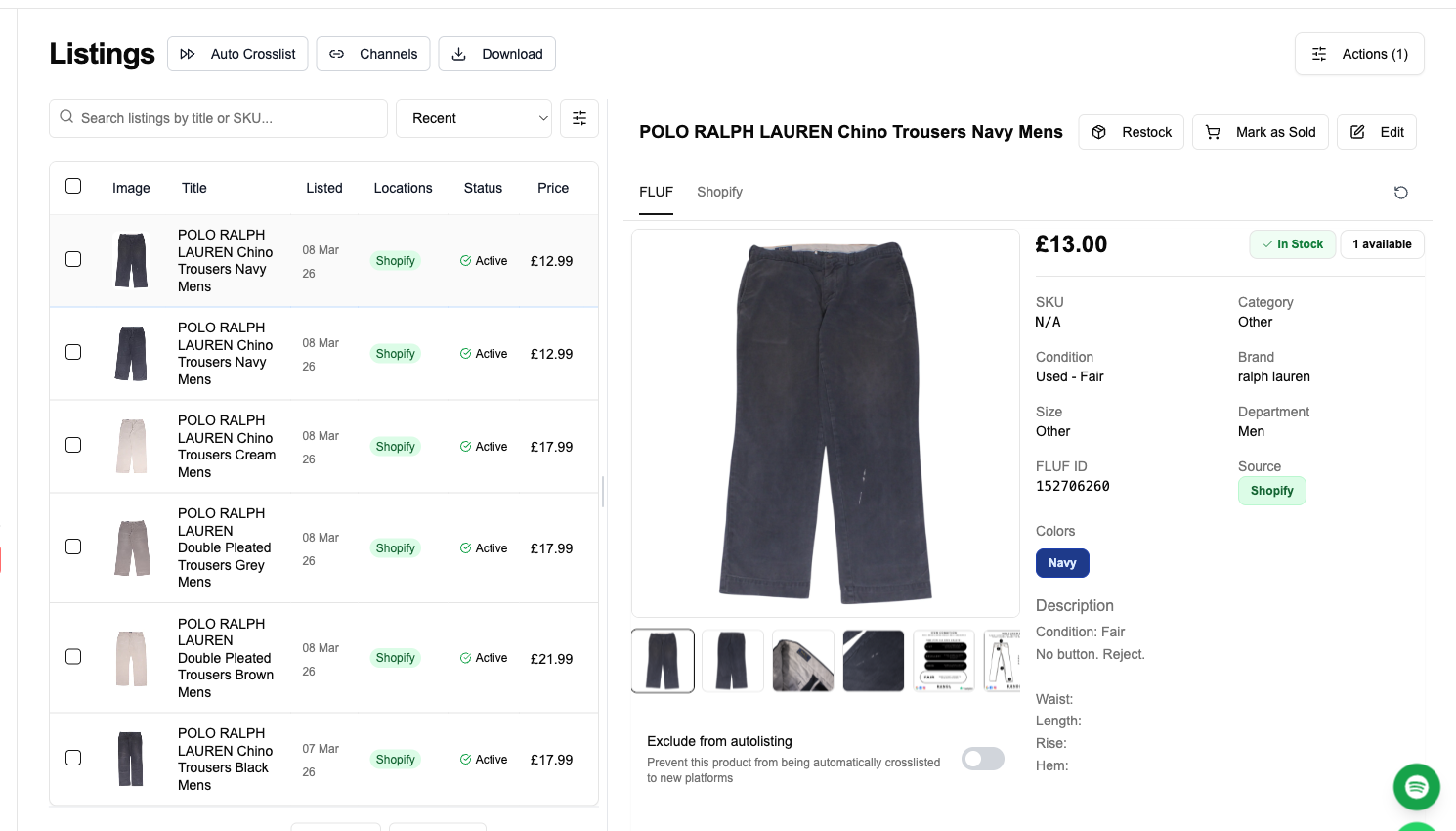
That gap is the opportunity. FLUF Connect bridges the two: you keep listing the way you already do, and FLUF rebuilds each Leboncoin ad as a native Marktplaats listing, keeps your inventory in sync so you are not selling the same item twice, and manages both from a single dashboard. This page explains exactly how the Leboncoin-to-Marktplaats crosslisting works, what transfers, what stays in sync, and what it costs.
Why Sell on Both Leboncoin and Marktplaats?
The strategic case is geographic, not categorical. Leboncoin and Marktplaats are direct analogues of each other — both are the default “sell your stuff” classifieds site in their home country — but they serve populations separated by a national border and a language. Listing on one gives you France; listing on both gives you France and the Netherlands with no extra sourcing, no new inventory and no second photoshoot.
Leboncoin’s scale in France is enormous: an average of 30.35 million monthly active users in the second half of 2025, making it the country’s clear classifieds leader. Its strongest categories are automotive and real estate, but it is genuinely an everything-marketplace that also moves huge volumes of general goods, home items and fashion (source).
Marktplaats plays the identical role in the Netherlands. Adevinta reports 8–10 million+ unique monthly visitors, roughly 350,000 new listings added every day, and about 18.7 million active ads — extraordinary depth for a country of around 18 million people. Its category mix mirrors Leboncoin’s: strong in cars, home and garden, electronics and second-hand goods (source). Through sister brands 2dehands and 2ememain, the same catalogue mindset extends into Belgium, so a Dutch-facing presence sits next to an adjacent Flemish and francophone-Belgian audience too.
Because both platforms sit inside Adevinta’s classifieds portfolio (source), you might expect them to talk to each other — but they do not. There is no button on Leboncoin that pushes an ad to Marktplaats, and no shared inventory layer. The common ownership is a curiosity, not a feature. FLUF Connect is what actually turns “two separate national sites” into “one cross-border listing operation.”
The euro is the quiet advantage here. A Leboncoin seller prices in EUR and a Marktplaats buyer pays in EUR, so there is no currency conversion, no exchange-rate guesswork and no need to re-price for a new market — the same number that works in Lyon works in Utrecht. Cross-border parcel shipping between France and the Netherlands is well served by pan-European carriers, so fulfilling a Dutch sale from France is a normal courier drop-off rather than an international ordeal.
Consider the practical shape of it. A French seller clearing a wardrobe of second-hand clothing, a few electronics and some homeware might list twenty items on Leboncoin and wait for local demand to work through them. Each item that finds no French buyer in the first fortnight is dead weight — until you expose it to a completely fresh Dutch audience that never saw it. The same twenty items, mirrored to Marktplaats, effectively double their shot at a sale without you sourcing a single new product. For a small resale business running hundreds of SKUs, that multiplier is the difference between sitting on stock and turning it over. And because Dutch buyers skew heavily towards second-hand and value-led purchases on Marktplaats, the platform is a receptive home for exactly the kind of pre-owned general goods that fill a typical Leboncoin account.
How to Crosslist from Leboncoin to Marktplaats with FLUF Connect
The workflow is designed so you build your catalogue once and reuse it everywhere. Here is the end-to-end path from a Leboncoin-only seller to a live cross-border presence:
- Connect Leboncoin as your source. Link your Leboncoin account in FLUF Connect so your existing French ads and your inventory become the starting point for everything else.
- Connect Marktplaats as a destination. Add Marktplaats as a target channel. FLUF now knows both ends of the France-to-Netherlands bridge.
- Import your catalogue. Bring your items into FLUF as a single master inventory — titles, descriptions, photos, prices, conditions and categories — so each item exists once and is pushed outward, rather than being re-typed per site.
- Crosslist to Marktplaats. Push items to Marktplaats individually, in bulk, or with auto-rules that crosslist new inventory automatically. FLUF composes a native Dutch listing from your master record: your photos, your euro price, your description and a smart-mapped Marktplaats category.
- Let inventory sync run. From here FLUF keeps the two channels aligned so you are not caught selling the same physical item twice — the sync behaviour is detailed in its own section below.
The same master-inventory model means Marktplaats need not be your only destination. If you also want to reach buyers on Vinted, Depop or eBay, those are additional target channels from the very same catalogue — no extra data entry, just extra reach.
What Transfers When You Crosslist from Leboncoin to Marktplaats?
Crosslisting is only useful if it saves the tedious part — retyping every field into a second site’s form. FLUF Connect carries the substance of each listing across so a Marktplaats ad is ready to publish with minimal touching-up. Here is what moves:
| Field | What happens when it transfers to Marktplaats |
|---|---|
| Title | Carried across and fitted to Marktplaats’s listing headline. Because both audiences are euro-priced classifieds shoppers, a concise, keyword-led title travels well; you can tune wording for Dutch search where it helps. |
| Description | Your full item description transfers. You can keep it as-is or localise the key lines into Dutch for stronger conversion with local buyers. |
| Images | Your existing photos are reused — no re-shooting. Good imagery is the single biggest driver of classifieds sell-through, so reusing your Leboncoin photos keeps quality consistent across both markets. |
| Price | Transfers directly. Both Leboncoin and Marktplaats price in EUR, so the same figure carries over with no conversion — a rare, genuine convenience in cross-border selling. |
| Category | Smart-mapped from your item to the closest Marktplaats category. Because both are broad everything-marketplaces, most general-goods, home, electronics and fashion items map cleanly. |
| Condition | Your condition grade carries across so second-hand and new items are represented honestly on both sites. |
| Brand & attributes | Brand and other structured attributes transfer where the destination category supports them, improving how your ad surfaces in filtered searches. |
The goal is a Marktplaats ad that reads as though you had written it natively — because it draws on the same source content you already prepared for Leboncoin. Any local touch-up (a Dutch phrase in the title, a note about cross-border delivery) is optional polish, not required re-entry.
Inventory Sync Between Leboncoin and Marktplaats — What Stays in Sync?
The single biggest risk in listing one item on two sites is selling it twice. FLUF Connect’s inventory sync exists to prevent exactly that, and it is honest about what each channel can and cannot do.
On Marktplaats, FLUF supports order-sync and mark-as-sold, so when the item sells there FLUF can register the sale and remove or update it, then bring the matching listings down on your other connected channels. FLUF also supports relisting on Marktplaats, so ageing ads can be refreshed to stay visible in a fast-moving feed of roughly 350,000 new listings a day. Offer management is not part of FLUF’s Marktplaats automation.
On Leboncoin, the value is one-click crosslisting and central listing management rather than in-channel automation. The cross-channel behaviour works like this: when an item sells on Leboncoin via integrated secure-payment shipping — or after you mark or delete the ad following a face-to-face handover — your listings on other channels come down automatically; and when the item sells elsewhere (for example on Marktplaats), the Leboncoin ad is deleted automatically. FLUF does not perform relisting or offer-management on Leboncoin itself.
In practice that means a two-country presence you manage from one screen: publish once, and let FLUF keep Leboncoin and Marktplaats from double-selling the same physical item. Because Leboncoin supports both an integrated secure-payment delivery mode and free local face-to-face handover (source), the sync logic accounts for both the “sold and shipped through the platform” path and the “handed over in person, then marked/deleted” path.
Crosslisting from Leboncoin to Marktplaats: Before and After FLUF Connect
The difference is best seen as a change in daily workflow. Manually maintaining the same catalogue on two national classifieds sites is slow and error-prone; centralising it changes the economics of listing across the border.
| Task | Before FLUF Connect | After FLUF Connect |
|---|---|---|
| Listing on Marktplaats | Re-type every field into a separate Dutch site, one item at a time | Push from your existing catalogue in a click, or with auto-rules |
| Photos | Re-upload to each platform individually | Reused from your master inventory automatically |
| Pricing | Re-enter per site (though at least both are in EUR) | Carried across once, same euro figure both sides |
| Selling the same item twice | Constant manual watching; delist by hand after every sale | Cross-channel take-down handled by inventory sync |
| Keeping ads fresh | Manually re-post ageing ads | Relisting supported on Marktplaats |
| Managing two countries | Two separate logins, two dashboards, two mental models | One FLUF Connect dashboard for both |
| Adding a third or fourth channel | Yet another full manual re-listing effort | Same catalogue, one more destination |
The pattern is consistent: the work of reaching a new national audience collapses from “rebuild everything by hand” to “point your existing inventory at a new destination.” That is what makes a cross-border strategy realistic for an individual seller or a small resale business, not just for a company with a dedicated ops team.
Automation Features for Leboncoin and Marktplaats Sellers
FLUF Connect’s automation is deliberately scoped to what each channel genuinely supports, so nothing here over-promises. For this Leboncoin-to-Marktplaats pairing, the features that apply are:
- Auto-crosslisting rules: new items added to your catalogue can be pushed to Marktplaats automatically, so your Dutch presence grows in step with your French one without manual effort.
- Bulk operations: crosslist, edit or manage large batches of items at once rather than clicking through them individually — valuable when your inventory runs into the hundreds.
- Central editing: change a price, title or description once in FLUF and update it across your connected channels, instead of editing each site separately.
- Relisting on Marktplaats: keep ageing ads fresh and visible in a feed that adds hundreds of thousands of new listings a day.
- Order-sync and mark-as-sold on Marktplaats: when an item sells there, FLUF registers it and triggers the cross-channel take-down so the same item does not stay live elsewhere.
- Cross-channel inventory sync involving Leboncoin: Leboncoin sales (via secure-payment shipping, or a marked/deleted ad after in-person handover) pull matching listings down on other channels, and sales elsewhere delete the Leboncoin ad automatically.
Note what is intentionally absent: FLUF does not claim relisting or offer-management on Leboncoin, and does not claim offer-management on Marktplaats. Automation is included in every plan rather than sold as a separate add-on — you are not paying extra to switch on the features above.
How Much Does It Cost to Crosslist from Leboncoin to Marktplaats?
There are two cost layers to understand: the marketplaces’ own fees, and FLUF Connect’s subscription.
Leboncoin’s fees
Posting most classified ads on Leboncoin is free; the platform moved from insertion fees to a commission charged only on completed secure-payment transactions (source). For its integrated “delivery” mode, the buyer pays a fixed €0.70 plus 5% of the item price, while an in-person handover is capped at roughly a €0.99 flat fee; the commission was raised from 4% to 5%, and after September 2025 the effective take can reach around 12% in some categories (source). Separately, from April 2025 Leboncoin began charging private vehicle sellers to list (source). For a typical general-goods seller sticking to free ads and local handover, the direct cost of listing stays low.
Marktplaats’s fees
Marktplaats runs a freemium model: basic listings are free for private sellers, and the paid options are visibility and promotion upgrades plus a cost-per-click (CPC) “Pro” model for businesses that carries no subscription cost. Its integrated iDEAL-based payment and courier delivery (“bezorgen”) carries service costs when you use them (source). In other words, Marktplaats — like Leboncoin — makes its money mainly through promotion and CPC rather than a flat sales commission (source), so you can maintain a large catalogue without a per-listing bill.
FLUF Connect’s pricing
FLUF Connect is the tool that ties the two together. Plans start at £19/month (Growth — 500 products). There is no free plan. Automation is included in every plan, not a paid add-on. Because both marketplaces price in EUR and lean on promotion/CPC rather than commission, the main lever on your economics is time saved and reach gained — which is precisely what a single dashboard across France and the Netherlands delivers. See the full breakdown on the pricing page.
The takeaway: neither Leboncoin nor Marktplaats charges you a heavy per-listing fee to be present, so the real cost of a two-country strategy has always been the manual labour of maintaining two catalogues. FLUF removes that labour, which is what makes crossing the France-to-Netherlands border worth doing. Put differently, the marketplaces are cheap to be on but expensive to run by hand across borders; FLUF Connect inverts that by making the second country almost free of effort once the first one is set up.
It is also worth weighing the opportunity cost of staying single-market. Every item that sells only in France is an item that never had the chance to convert in the Netherlands, where a different buyer, a different season and a different local demand curve might have closed the sale faster or at a better price. A one-country listing is a self-imposed ceiling. Because the incremental effort of adding Marktplaats through FLUF is close to zero, the question stops being “is it worth the extra work?” and becomes simply “why leave the Dutch audience on the table?”
Getting Started
If you already have a working Leboncoin operation, extending it into the Netherlands is no longer a project — it is a setting. Connect Leboncoin as your source, add Marktplaats as a destination, import your catalogue once, and let FLUF Connect rebuild each ad natively and keep the two in sync. You reach a second national audience of millions with the inventory you already own, priced in the same euros, managed from one screen.
Sources & Verification
source (Leboncoin / Adevinta) ·
source (Leboncoin monthly active users) ·
source (Leboncoin vehicle-seller charges & commission model) ·
source (Leboncoin commission & delivery fees) ·
source (Leboncoin category skew & strategy) ·
source (Leboncoin delivery vs handover) ·
source (Marktplaats scale, ownership & model) ·
source (Marktplaats iDEAL payment/service costs) ·
source (Marktplaats category skew).
Last verified: July 2026.
Frequently Asked Questions
Yes. Connect Leboncoin as your source and Marktplaats as a destination in FLUF Connect, import your catalogue once, and push items individually, in bulk, or with auto-rules that crosslist new inventory to Marktplaats automatically.
No. Both Leboncoin and Marktplaats price in euros, so your price carries across directly with no currency conversion. You can always adjust a figure for the Dutch market, but you are not forced to re-price.
Yes. On Marktplaats FLUF supports order-sync and mark-as-sold, and when an item sells there the matching listings come down on your other channels. When an item sells on Leboncoin via secure-payment shipping, or after you mark/delete the ad following an in-person handover, listings elsewhere are taken down too; a sale elsewhere deletes the Leboncoin ad automatically.
Your title, description, photos, price, condition, brand and other structured attributes transfer, and your item is smart-mapped to the closest Marktplaats category. You reuse your existing photos rather than re-shooting.
No. On Leboncoin the value is one-click crosslisting plus central listing management and cross-channel inventory sync. FLUF does not perform relisting or offer-management on Leboncoin. On Marktplaats, FLUF supports relisting, order-sync and mark-as-sold (but not offers).
Yes, both belong to Adevinta, but they run as separate national platforms and do not share your listings. There is no built-in way to push a Leboncoin ad to Marktplaats. FLUF Connect is what actually bridges the two audiences.
Both marketplaces are largely free to list on and make money mainly through promotion and cost-per-click rather than sales commission, so per-listing costs stay low. FLUF Connect plans start at £19/month (Growth — 500 products). There is no free plan, and automation is included in every plan.
Yes. The same master inventory can be pushed to Vinted, Depop, eBay and 20+ other channels as additional destinations, with no extra data entry.