
Crosslist from Designer Wardrobe to WooCommerce — FLUF’s WordPress Plugin
Move your curated designer inventory from Designer Wardrobe into a self-hosted WooCommerce store you own — no marketplace commission, full control of your customers and data.



- Move your curated designer inventory from Designer Wardrobe into a self-hosted WooCommerce store you own outright — no marketplace commission, no shared shopfront, and full control of your customers and data.
- WooCommerce is the free e-commerce plugin for WordPress, the platform that powers roughly 41.5% of the web — so building on it means owning your storefront rather than renting shelf space.
- FLUF Connect copies each listing’s title, description, images, price, quantity and SKU across, and supports WooCommerce variable products (per-variation SKU, price and stock).
- Sync is honest and one-directional where it has to be: FLUF pulls orders and stock from your WooCommerce store, and Designer Wardrobe supports full order-sync and mark-as-sold — so a sale on one side keeps the other side accurate.
- Designer Wardrobe is free to list but charges sellers 12.95% above A$40; your own WooCommerce store charges you nothing per sale (you pay hosting instead).
- Plans start from £9/month (Starter). There is no free plan, but every new account gets a 7-day trial for £1.
Why sell on both Designer Wardrobe and WooCommerce
If you sell pre-loved designer fashion in Australia or New Zealand, Designer Wardrobe is one of the best places to start. It is free to list, it has a warm, ready-made audience of around 350,000 members across NZ and AU pushing roughly A$1.6m in transactions a month, and its curated, women’s-led focus on designer and contemporary labels means the right buyer is already looking for exactly what you list. Sellers there report being “up to six times more likely to sell” with most items moving within three days. It is a genuinely great front door.
But it is a front door into someone else’s house. On Designer Wardrobe you rent shelf space: the marketplace owns the customer relationship, sets the rules, takes a 12.95% success fee on anything above A$40 (capped at A$249) plus payment fees, and can change any of that whenever it wants. You never see your buyers’ email addresses. You cannot email past customers a new drop. You cannot build a brand that is unmistakably yours. Every sale strengthens the marketplace’s data, not yours.
A WooCommerce store is the opposite proposition, and that is exactly why ambitious resellers move to it. WooCommerce is the free, open-source e-commerce plugin for WordPress — the content platform that powers roughly 41.5% of all websites and 59.2% of sites using a known CMS. WooCommerce itself holds about 33.4% of the tracked e-commerce platform market, comfortably ahead of Shopify, and runs on somewhere between 4.5 and 6 million active stores. When you build on it you are not a tenant — you are the landlord.
The trade-off is real and worth naming plainly. A self-hosted WooCommerce store means you pay for hosting and any premium extensions, and you are responsible for driving your own traffic — nobody browses “the WooCommerce marketplace” the way they browse Designer Wardrobe. What you get in return is total ownership: no per-sale commission going to a marketplace, your own domain and brand, your customers’ email addresses in your own database, your own checkout, your own analytics, and a store nobody can suspend or reprice out from under you. Designer Wardrobe finds you buyers; your WooCommerce store lets you keep them.
There is a longer-term reason too. Marketplaces are lovely until they are not. Fees rise, algorithms change, categories get reshuffled, accounts get suspended over a misunderstanding, and a platform you built your whole business on can quietly stop sending you buyers. Designer Wardrobe is a well-run, seller-friendly marketplace today — but you have no contract that says it always will be, and you have no way to reach the customers you have already served if it changes. A WooCommerce store is insurance against all of that. Because it runs on WordPress, on hosting you pay for, under a domain you own, nobody can take it away, reprice it, or lock you out of your own customer list. Every marketplace is a channel; your WooCommerce store is the asset.
That is why the smart pattern is not “either/or” — it is both. Keep listing on Designer Wardrobe to catch high-intent AU/NZ designer shoppers, and mirror the same inventory into a WooCommerce store you own so that repeat buyers, brand followers and anyone who finds you through Google or Instagram can buy directly from you at no commission. The only hard part has always been keeping two storefronts in sync by hand. That is the part FLUF Connect removes.
How to crosslist from Designer Wardrobe to WooCommerce
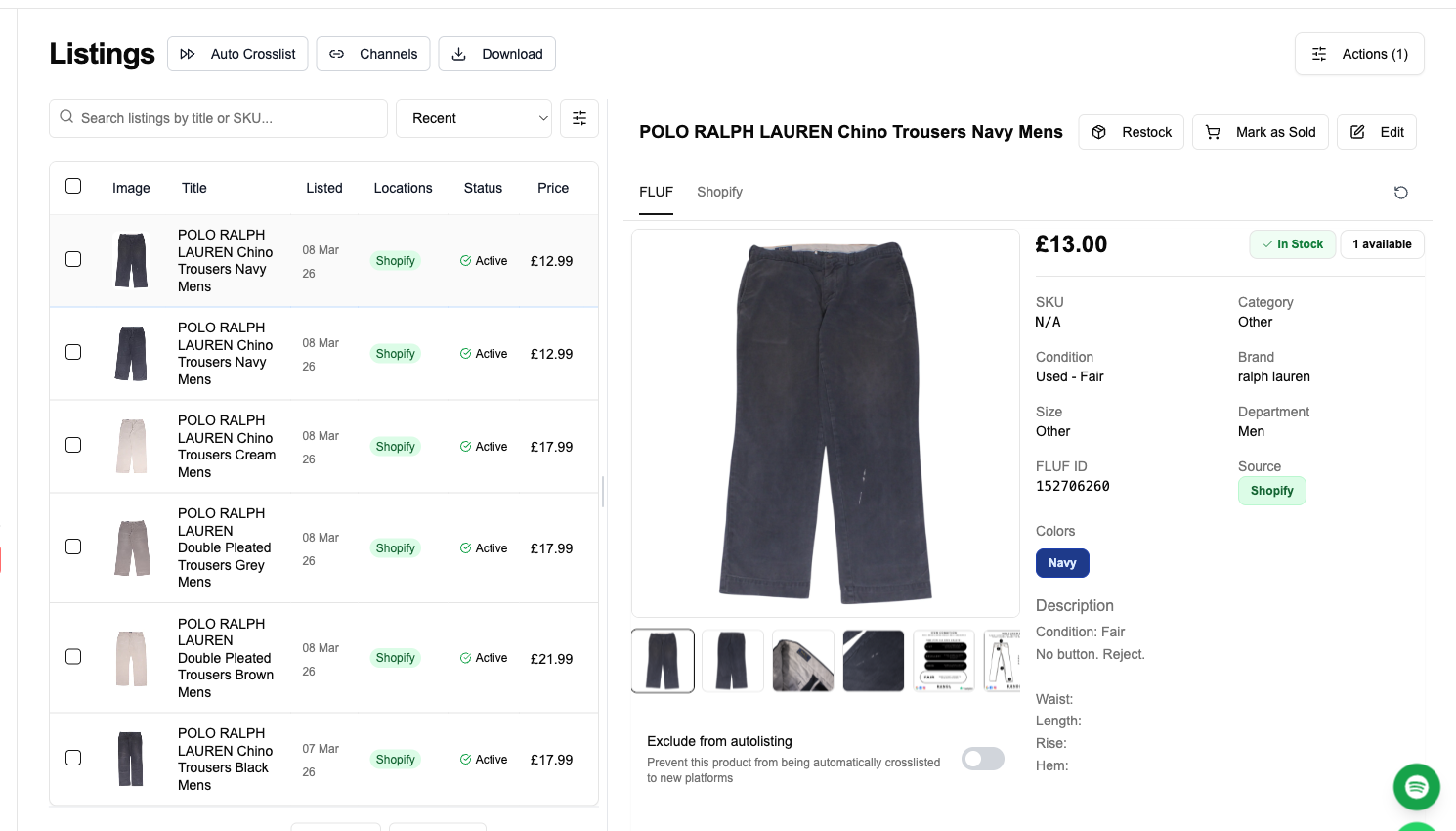
FLUF Connect maintains one master catalogue and pushes it out to every channel you enable, so you describe and photograph an item once and it appears everywhere. Because WooCommerce lives inside WordPress, the connection is a genuine WordPress plugin rather than a browser hack. Here is the full path:
- Install the FLUF Connect plugin from your WordPress admin. Log into your WordPress dashboard (wp-admin), go to Plugins, and install the FLUF Connect plugin for WooCommerce the same way you would any other WordPress plugin. Activate it. Nothing about your theme or existing content changes.
- Connect your WooCommerce store. Install the FLUF Connect plugin and follow the setup prompts in WordPress. Import and review your existing products before crosslisting.
- Connect Designer Wardrobe. Link your Designer Wardrobe seller account so FLUF can read your live listings and their photos, prices and details, and keep order status flowing back.
- Choose your channels. In the FLUF dashboard, pick which channels each item should go to. Enable WooCommerce as a destination and, if you like, keep Designer Wardrobe plus any of the dozen-plus other channels FLUF supports — eBay, Vinted, Depop, Etsy, Shopify, Vestiaire Collective, Facebook Marketplace and more.
- Import and review your catalogue. Import Designer Wardrobe listings into FLUF Connect, check the title, description, images, price, quantity and SKU, then publish to WooCommerce.
- Publish. FLUF creates the matching WooCommerce products in your store — as simple products, or as variable products where an item has size or colour variations. They appear in your WordPress admin under WooCommerce → Products exactly as if you had typed them in by hand, ready to sell.
From that point on you work from one screen. New item? Add it once in FLUF, tick Designer Wardrobe and WooCommerce, publish. Price change? Edit once, it propagates. You are no longer copy-pasting the same description into two different systems and hoping you did not fat-finger a price.
Use your existing Designer Wardrobe catalogue to build out your WooCommerce store. Products published by FLUF Connect are standard WooCommerce products that you can edit in WordPress and use with your store’s theme and selling tools.
What transfers — fields and categories
FLUF Connect maps the fields that matter for a fashion listing from your Designer Wardrobe catalogue onto the equivalent WooCommerce product fields. The core set transfers cleanly:
| Field | Designer Wardrobe (source) | WooCommerce (destination) |
|---|---|---|
| Title | Listing title | Product name |
| Description | Item description | Product description / short description |
| Images | Listing photos | Product gallery (featured + gallery images) |
| Price | Asking price | Regular price |
| Quantity | Stock (usually 1 for one-off pieces) | Stock quantity (inventory managed) |
| SKU | Your item code | Product SKU (per product, or per variation) |
| Brand / size / category / condition | Designer Wardrobe attributes | Attributes / categories / tags where supported |
The detail worth understanding is WooCommerce variable products. Most Designer Wardrobe listings are true one-of-a-kind pieces — a single dress, a single bag, quantity one. Those map naturally to WooCommerce simple products. But if you sell anything that comes in multiple sizes or colours (say, a run of the same shirt, or a size-graded accessory), WooCommerce models that as a variable product: one parent product with child variations, each carrying its own SKU, price and stock level. FLUF supports this structure, so per-variation SKU and per-variation stock come across rather than being flattened into one lump. That matters because it is precisely how WooCommerce tracks inventory correctly — when the medium sells out, only the medium goes out of stock.
Categories and attributes are mapped to your WooCommerce store’s taxonomy where the destination supports them, so your designer, size and condition data lands as browsable, filterable product attributes rather than being buried in the description. Because it is your own WordPress site, you have complete freedom over how those categories are named and structured — something no marketplace lets you do.
What syncs and what doesn’t
This is the section where honesty matters most, because getting sync wrong is how resellers oversell an item they only own one of. Here is exactly what FLUF Connect does between these two channels, using their real capabilities.
WooCommerce (your store): FLUF Connect supports order and inventory sync. A store sale updates availability on supported connected channels. Allow time for changes to complete and check pending sales for one-of-a-kind items.
Designer Wardrobe: Designer Wardrobe supports both order-sync and mark-as-sold. So when a piece sells on Designer Wardrobe, FLUF sees the order and can update its status, and when you sell an item elsewhere FLUF can end it on Designer Wardrobe automatically.
Put together, the practical behaviour is: because you only own one of each designer piece, you want a sale in one place to close the item everywhere. FLUF’s inventory sync ties the two together — a sale that lands as a WooCommerce order pulls the stock down, and FLUF then acts on the channels that support automatic removal (Designer Wardrobe among them, via mark-as-sold). The reverse also holds: a Designer Wardrobe sale flows back and FLUF decrements your WooCommerce stock so the item stops being buyable on your own site.
What we will not pretend: no crosslister can guarantee a zero-millisecond race between two independent platforms. Sync runs continuously but is not instantaneous, so for genuinely one-off pieces the safest habit is still to let FLUF do the heavy lifting and glance at your dashboard rather than assuming two buyers can never click “buy” in the same sixty seconds. That caveat aside, the day-to-day reality is that FLUF keeps your Designer Wardrobe listings and your WooCommerce store telling the same story about what is in stock — which by hand is nearly impossible to sustain.
Before and after: your new workflow
Before. You photograph a vintage Zimmermann dress, write a lovely description, and list it on Designer Wardrobe. Two months later you decide you want your own store, so you spin up WooCommerce — and now you are re-uploading every photo, re-typing every description, and re-keying every price into WordPress by hand. When the dress sells on Designer Wardrobe you have to remember to go into wp-admin and set it to zero stock, or you risk selling a dress you no longer own. Multiply that across 200 pieces and the maintenance alone eats your evenings. Most resellers give up and just let the two stores drift apart, which defeats the point.
After. You add the dress once to FLUF Connect. It lands on Designer Wardrobe and in your WooCommerce store simultaneously, with the same photos, description, price and SKU. When it sells on either side, inventory sync closes it on the other so you never oversell your single dress. When you drop the price for a weekend sale, you change it once and both update. When a repeat customer who first found you on Designer Wardrobe wants to buy directly and save you the marketplace commission, your WooCommerce store is right there — same inventory, your brand, your checkout, zero per-sale fee. You spend your time sourcing and photographing, not copy-pasting.
Automation and bulk tools
Automation is included in every FLUF plan, not a paid add-on. The pieces that matter for a Designer Wardrobe-to-WooCommerce reseller:
- Bulk crosslisting. Import your whole Designer Wardrobe catalogue and push it into WooCommerce in batches rather than one product at a time — the difference between an afternoon and a fortnight when you are migrating a large closet.
- Inventory and order sync. Included on every plan. FLUF watches for sales and stock changes and keeps your channels aligned automatically, using each channel’s real capabilities as described above.
- Bulk editing. Change prices, descriptions or attributes across many listings at once instead of editing each WooCommerce product by hand in wp-admin.
- One catalogue, many channels. The same source item that feeds Designer Wardrobe and WooCommerce can also feed eBay, Vinted, Depop, Etsy, Shopify, Vestiaire Collective, Facebook Marketplace and more — so once you are set up, adding another sales channel is a checkbox, not a project.
Manage crosslisting from FLUF Connect after connecting your WooCommerce store. Your customers continue shopping through your existing storefront.
The reason automation earns its keep is compounding. The first migration from Designer Wardrobe to WooCommerce is a one-off cost — a day, maybe, for a large closet. But the ongoing tax of running two stores by hand never stops: every new item, every price cut, every sold-out piece is duplicated work forever. Automating it is not a nice-to-have; it is the only thing that makes running an owned WooCommerce store alongside a marketplace sustainable rather than a second job. That is the whole point of routing both through one catalogue: you set up the plumbing once, and after that adding WooCommerce sales to your Designer Wardrobe business costs you almost no extra time at all.
Pricing
Plans start at £9/month (Starter). There is no free plan, but every new account gets a 7-day trial for £1. Inventory sync, order sync and bulk tools are included on every plan rather than sold as extras.
Worth separating two different “free”s here, because they are easy to confuse. WooCommerce the plugin is genuinely free and open-source — you install it into WordPress at no licence cost and you pay for your own hosting and any premium extensions you choose. That is a true fact about WooCommerce, and it is a big part of why an owned WooCommerce store carries no per-sale marketplace commission. It is not a FLUF plan. FLUF Connect — the tool that keeps your Designer Wardrobe and WooCommerce inventory in lockstep and saves you the manual re-listing — starts at £9/month.
The economics tend to favour the move quickly. Designer Wardrobe takes 12.95% of anything you sell above A$40 (plus payment fees); a sale you route through your own WooCommerce store instead pays no marketplace commission at all. A handful of direct sales a month through the store you own can cover both your hosting and your FLUF subscription, and everything beyond that is margin you keep.
Sources and verification
Every non-trivial statistic above is drawn from a primary source. Fees, member counts and platform-share figures change over time — verify against the originals before quoting them.
- WordPress share of the web (~41.5%; ~59.2% of known-CMS sites): W3Techs
- WooCommerce ~33.4% of tracked e-commerce platforms; 4.5–6M+ stores: WPFactory WooCommerce statistics
- WooCommerce free/open-source, self-hosted, no marketplace commission: Red Stag Fulfillment
- WooCommerce variable products (per-variation SKU/price/stock): WooCommerce documentation
- Designer Wardrobe fees (free to list; 12.95% above A$40, A$4.95 flat under A$40, max A$249): Designer Wardrobe Help
- Designer Wardrobe ~350,000 members and ~A$1.6m monthly transactions: Ocean Road Magazine, NZ Entrepreneur
Frequently Asked Questions
Yes. Install and activate the FLUF Connect plugin from your WordPress admin, then follow the prompts to connect your store.
Yes. Where a Designer Wardrobe item has size or colour variations, FLUF creates a WooCommerce variable product with per-variation SKU, price and stock, rather than flattening everything into one simple product. Most one-of-a-kind designer pieces map to WooCommerce simple products with quantity one.
Manage crosslisting from FLUF Connect after connecting your WooCommerce store. Your customers continue shopping through your existing storefront.
Title, description, images, price, quantity and SKU transfer across, plus brand, size, category and condition mapped to your WooCommerce attributes and taxonomy where the destination supports them.
WooCommerce supports order and inventory sync, and Designer Wardrobe supports order sync and mark-as-sold. Sales update availability on supported connected channels. Sync is not instantaneous; check your dashboard for pending sales and one-off stock.
WooCommerce the plugin is genuinely free and open-source — you install it into WordPress at no licence cost and pay only for hosting and any premium extensions. That is a fact about WooCommerce, not a FLUF plan. FLUF Connect, which keeps your Designer Wardrobe and WooCommerce inventory in lockstep and saves manual re-listing, starts at £9/month.
Designer Wardrobe finds you buyers but owns the customer relationship and takes 12.95% above A$40. A self-hosted WooCommerce store on WordPress charges no per-sale marketplace commission (you pay hosting instead), and gives you your own domain, brand, customer email list and analytics — an asset nobody can suspend or reprice.
No. Plans start at £9/month (Starter). There is no free plan, but every new account gets a 7-day trial for £1. Inventory sync, order sync and bulk tools are included on every plan.