Crosslist from Designer Wardrobe to Grailed — Reach a Global Menswear & Designer Audience
Take your Australasian designer and archive pieces global — crosslist from Designer Wardrobe to Grailed's 10M+ US-led buyer pool with FLUF Connect.



Key Takeaways — Designer Wardrobe to Grailed
- Designer Wardrobe is Australasia’s largest pre-loved fashion community — 350,000+ members across New Zealand and Australia, women’s designer and contemporary labels, priced in NZD/AUD with a 12.95% success fee on sales over $40 and payouts via the DW Wallet (source).
- Grailed is a US-led global marketplace that surpassed 10 million users in 2025 and sits inside GOAT Group’s 50M+ member network across 170 countries — the home of menswear, streetwear, designer, archive and rare “grail” pieces, priced in USD (source).
- Crosslisting takes your listing’s title, description, photos, price, condition, brand and category from Designer Wardrobe and rebuilds it as a native Grailed listing — with the price converted into USD for a global buyer pool.
- Inventory sync is honest and one-directional on Grailed: when an item sells on Designer Wardrobe (order-sync and mark-as-sold are supported there) the Grailed listing is taken down automatically; when it sells on Grailed, FLUF lets you mark it sold across every other channel in one action.
- On Grailed, FLUF Connect does crosslisting plus cross-channel mark-as-sold only — there is no relisting, no offer management and no order-sync on Grailed itself. We tell you that up front so you can plan around it.
- Plans start at £19/month (Growth — 500 products). There is no free plan. Automation is included in every plan, not a paid add-on.
If you sell women’s designer and contemporary pre-loved fashion on Designer Wardrobe, you already have a strong, trust-heavy home market. But that market has a boundary drawn around it: your buyers sit almost entirely in New Zealand and Australia, and your prices are quoted in NZD or AUD. The moment you list a unisex designer coat, an archive knit or a menswear-adjacent piece, you are showing it to a pool that may never contain the right buyer. That buyer often lives on the other side of the world — and on Grailed.
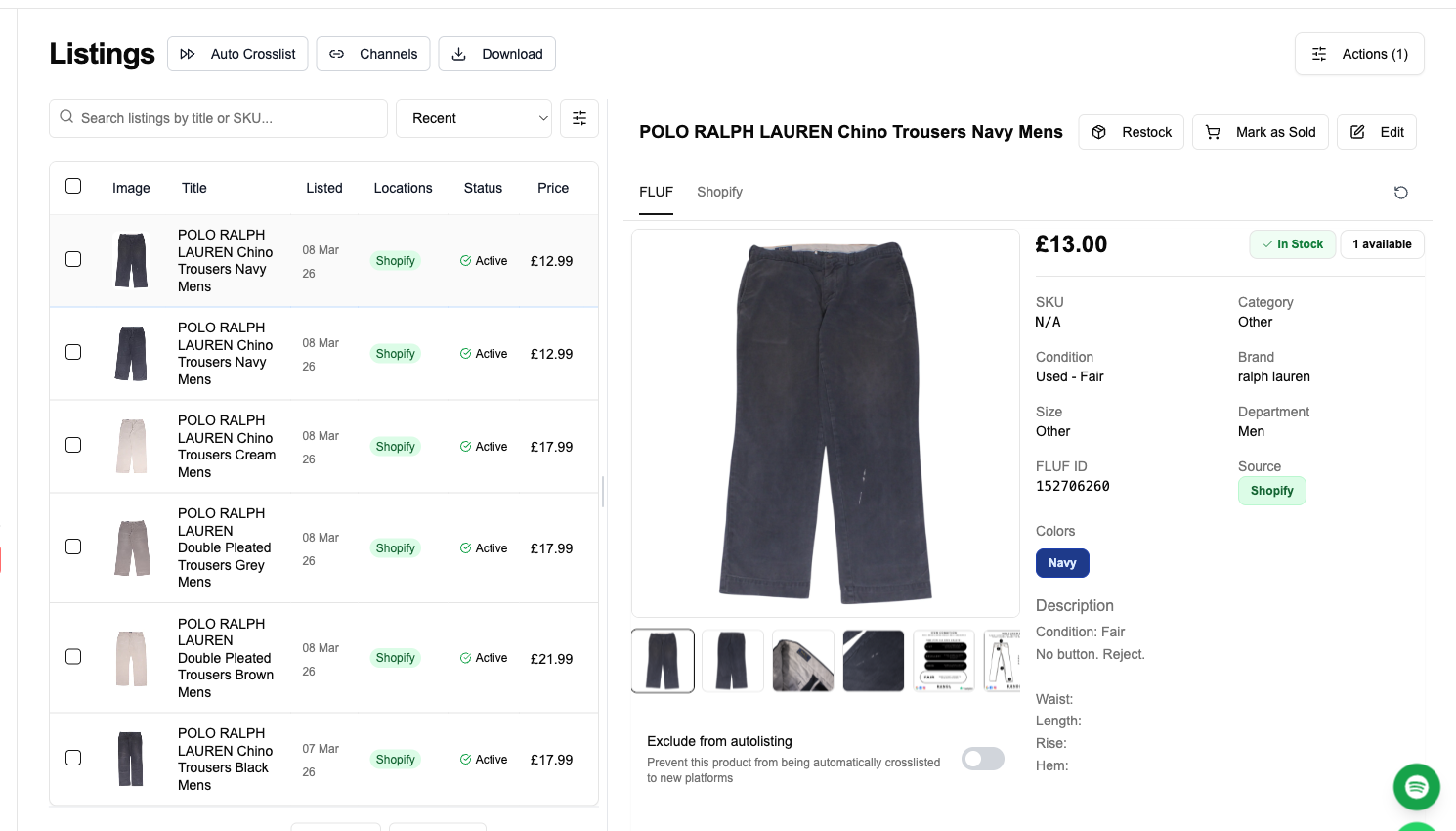
Designer Wardrobe and Grailed do not talk to each other. There is no button on one that pushes a listing to the other, no shared inventory, no automatic takedown when something sells. FLUF Connect is the bridge: it imports your Designer Wardrobe catalogue, rebuilds each item as a native Grailed listing in USD, and keeps your stock consistent so a piece that sells on your home platform comes down from the global one without you touching it. This page explains exactly how that works — and, just as importantly, where the honest limits are.
Why Sell on Both Designer Wardrobe and Grailed?
The case for running both platforms is not “more places equals more sales” in the abstract. It is that these two marketplaces have almost no overlap — in geography, in currency, in buyer intent or in the pieces they reward — so each one reaches demand the other structurally cannot.
Designer Wardrobe is a New Zealand-born community that expanded across the Tasman into Australia in October 2024, and now counts more than 350,000 members with over a million items sold and roughly $1.6M in transactions each month (source). Its identity is women’s designer and contemporary resale — a female-skewed, label-literate buyer base that knows NZ and Australian designers as well as the big global houses (source). That is a superb place to sell a Zambesi dress or a Scanlan Theodore blazer. It is a much narrower place to sell an archive Raf Simons bomber.
Grailed is the mirror image. It surpassed 10 million users in 2025 and is part of GOAT Group, a network of more than 50 million members spanning 170 countries (source). Founded in 2013, it built its reputation on men’s streetwear, designer, vintage and archive — Supreme, Raf Simons, Gucci, Saint Laurent and the rare “grail” pieces its name is built on (source). Its audience skews male — roughly 57% male to 43% female — with the largest age band being 25–34 (source). Crucially, it is priced in USD and its buyers actively search for specific designers, seasons and silhouettes with a level of archive knowledge that turns a “nice coat” into a “grail.”
Put the two together and the logic is obvious. Your Designer Wardrobe listings sell your women’s contemporary pieces to a loyal Australasian community. Your Grailed crosslistings expose your designer, unisex and archive pieces — the ones that under-perform in a women’s-only, AUD/NZD market — to a global, US-led buyer pool that will pay grail money for the right label. The same rail of stock earns from two completely different kinds of demand.
There is a timing dimension to this, too. Designer Wardrobe only expanded into Australia in October 2024, so it is still a young cross-Tasman platform in absolute terms compared with a marketplace Grailed’s size (source). For a seller, that means Designer Wardrobe is where you build reputation and move volume in a defined region, while Grailed is where a single rare piece can find a specialist buyer you would never have reached locally. Neither replaces the other — and because their buyers rarely overlap, listing on both dilutes nothing.
The currency and audience shift, concretely
The single biggest change when you crosslist to Grailed is currency. A piece you priced at NZD $220 on Designer Wardrobe is not automatically worth a fixed number of US dollars — it is worth what a global grail buyer will pay. Moving from an NZD/AUD price to a USD price is not a mechanical conversion so much as a repositioning: you are placing the item in front of buyers who benchmark against international resale comps, not local ones. For unisex and designer menswear especially, that often means a stronger price than your home market would bear, because Grailed concentrates the world’s most motivated buyers for exactly that material.
How to Crosslist from Designer Wardrobe to Grailed with FLUF Connect
FLUF Connect manages one inventory across 20+ resale marketplaces from a single dashboard, so crosslisting from your Australasian home platform to a global one is a short, repeatable flow rather than a manual re-listing chore.
- Connect Designer Wardrobe as your source. Link your Designer Wardrobe account so FLUF can read your live catalogue — titles, descriptions, photos, prices, conditions and categories — and treat it as the master copy of your stock.
- Connect Grailed as a destination channel. Authorise Grailed inside FLUF Connect. Grailed is where your designer, unisex and archive pieces will reach the global buyer pool.
- Import your catalogue. FLUF pulls your existing Designer Wardrobe listings into the central dashboard so you are never re-typing an item you have already described once.
- Choose what to crosslist. Select the pieces that suit a menswear/designer/archive audience — the unisex coats, the archive knits, the collectible designer items — and crosslist them to Grailed. You do not have to send everything; the women’s-contemporary pieces that thrive at home can stay home.
- Review the USD price and Grailed details. FLUF maps your category and condition to Grailed’s structure and converts your price into USD. This is the moment to reposition for a global grail buyer rather than a local one.
- Publish and let sync run. Your item goes live as a native Grailed listing. From then on, when it sells on Designer Wardrobe the Grailed copy is taken down automatically, and when it sells on Grailed you mark it sold everywhere in one click.
Because everything is edited centrally, a change you make once — a better hero photo, a sharper title, a price adjustment — can be pushed out rather than repeated platform by platform. And because your Designer Wardrobe account remains the master copy, you never risk your two catalogues drifting apart: the home platform stays the source of truth for what you actually have in stock, and Grailed simply reflects the subset of it you have chosen to take global.
What Transfers When You Crosslist from Designer Wardrobe to Grailed?
Crosslisting rebuilds your Designer Wardrobe item as a native Grailed listing. Here is what carries across and what to watch for:
| Field | Transfers? | Notes for Designer Wardrobe → Grailed |
|---|---|---|
| Title | Yes | Rebuilt for Grailed. Grailed buyers search by designer, item type and era, so lead with brand and silhouette rather than a generic description. |
| Description | Yes | Your full description carries over. Add measurements and archive/season detail — Grailed’s audience expects it. |
| Photos | Yes | All images transfer. Grailed rewards clean, well-lit, detail-heavy photography; your existing shots go across as-is. |
| Price | Yes — converted to USD | Your NZD/AUD price is converted to USD. Treat this as a repositioning opportunity for a global buyer pool, not just a currency swap. |
| Category | Yes — smart-mapped | FLUF maps your Designer Wardrobe category to Grailed’s menswear/designer/streetwear structure. Review unisex pieces so they land in the right department. |
| Condition | Yes | Your condition grade is carried into Grailed’s condition options. Pre-loved detail matters to grail buyers judging wear. |
| Brand / Designer | Yes | Brand carries across and is one of Grailed’s most important search fields — accurate designer tagging is what surfaces your item. |
| Variants / sizing | Yes | Size transfers; note that Grailed’s menswear-led sizing conventions may differ from a women’s-contemporary listing, so confirm the mapping. |
The recurring theme: crosslisting saves you the re-typing, but the fields that matter most to a global grail audience — accurate designer, honest condition, thorough measurements and a USD price that reflects international comps — are worth a quick manual review before you publish.
Inventory Sync Between Designer Wardrobe and Grailed — What Stays in Sync?
This is where honesty matters most, because Grailed’s integration is deliberately limited and we would rather you plan around the real behaviour than be surprised by it.
When an item sells on Designer Wardrobe. Designer Wardrobe supports both order-sync and cross-channel mark-as-sold in FLUF Connect. So when a piece sells on your home platform, FLUF knows, and it automatically takes the matching Grailed listing down. That is the protection that stops a piece selling twice — sold in Auckland, pulled from Grailed, no double-sale.
When an item sells on Grailed. Grailed does not support automatic order-sync inside FLUF, so FLUF cannot detect a Grailed sale on its own. What it does give you is one-click cross-channel mark-as-sold: the moment you know a Grailed sale has happened, you mark it sold in FLUF and every other channel — Designer Wardrobe included — is delisted in a single action. It is a manual trigger with an automatic cascade, rather than a fully hands-off loop, and knowing that lets you build a simple habit around it.
What FLUF does not do on Grailed. To be completely clear: on Grailed, FLUF Connect provides crosslisting plus cross-channel mark-as-sold only. There is no automated relisting, no offer management and no automatic order-sync on Grailed. Those features exist for other channels in your account, but not for this one, and we will never pretend otherwise.
Crosslisting from Designer Wardrobe to Grailed: Before and After FLUF Connect
| Task | Before FLUF Connect | After FLUF Connect |
|---|---|---|
| Reaching a global audience | Stuck with NZ/AU buyers only; unisex and archive pieces under-sell | Designer and grail pieces exposed to Grailed’s 10M+ global, US-led buyer pool |
| Listing an item on Grailed | Re-type the title, re-write the description, re-upload every photo by hand | Imported from Designer Wardrobe and rebuilt as a native Grailed listing |
| Currency | Manually work out a USD price and re-key it | Price converted to USD automatically, ready for you to reposition |
| Avoiding double-sales | Remember to pull the Grailed listing whenever a DW sale lands | DW sale auto-takes-down the Grailed listing via order-sync |
| Handling a Grailed sale | Manually delist the item from every other marketplace | One-click mark-as-sold delists it everywhere at once |
| Editing a listing | Repeat every edit separately on each platform | Edit centrally and push changes out |
Automation Features for Designer Wardrobe and Grailed Sellers
FLUF Connect includes a range of automations across your account, but on this specific pairing only the matrix-permitted ones apply — and we hold to that strictly.
- Crosslisting. Push your Designer Wardrobe pieces live as native Grailed listings, with fields mapped and price converted to USD.
- Cross-channel mark-as-sold. When a Grailed sale happens, mark it sold once in FLUF and every other channel is delisted automatically.
- Order-sync from Designer Wardrobe. A sale on your home platform automatically takes the Grailed listing down, protecting you from double-selling.
- Central editing and bulk operations. Manage, edit and organise one inventory across all your channels from a single dashboard.
What is intentionally not on this list for Grailed: automated relisting, offer/counter-offer management and automatic Grailed order-sync. Those simply are not available on Grailed through FLUF, so we do not claim them. If you rely heavily on those workflows, you will find them on other channels in your FLUF account — Designer Wardrobe itself supports order-sync and mark-as-sold, and marketplaces like Depop and Vinted support the full set.
How Much Does It Cost to Crosslist from Designer Wardrobe to Grailed?
There are two separate cost layers: what each marketplace charges when you sell, and what FLUF charges to run the crosslisting.
Designer Wardrobe fees
Designer Wardrobe is free to sign up and list, with a success fee charged only when an item sells. Sales under NZD $40 carry a flat $4.95 fee; sales above $40 are charged a 12.95% commission (capped at a maximum fee of $249), plus a small payment-processing fee, and the fee applies to the final value including shipping (source). There are no listing fees, and your earnings sit in the DW Wallet — released after the buyer confirms receipt and withdrawable at no cost (source).
Grailed fees
Grailed also has no listing fees — you pay only when you sell. Its commission moved to a tiered structure in mid-2026: 9% on sales of $120 and above, and a reduced 6% (minimum $1.99) on sales under $120 (source). Payment processing is charged separately — for a domestic, onboarded US seller that is 3.49% + $0.49, and higher if you are not onboarded or the sale is international (source). Payouts run via Stripe, and buyers are covered by Grailed Purchase Protection (source). The tiered model deliberately lowers Grailed’s take on cheaper sub-$120 items, which is worth remembering when you decide which pieces are worth the international shipping effort.
Shipping from Australasia to a global buyer
One practical consideration unique to this direction: on Designer Wardrobe you ship domestically within NZ/Australia on a tracked courier, but a Grailed sale may go anywhere in Grailed’s 170-country footprint. International shipping from Australasia costs more and takes longer than a local NZ/AU delivery, so build that into your USD pricing — a grail buyer expects to pay for tracked international postage on a rare piece, but you want the maths to work before you list.
FLUF Connect pricing
Plans start at £19/month (Growth — 500 products). There is no free plan. Automation is included in every plan, not a paid add-on — you are not charged extra for order-sync, mark-as-sold or central editing. See our pricing for the full breakdown. The point of the tool is straightforward: if crosslisting your designer and archive pieces to a 10-million-user global marketplace lands even a couple of extra sales a month at USD grail prices, it pays for itself many times over.
Who This Pairing Is For
This route suits a specific seller: an established Australasian Designer Wardrobe seller whose catalogue includes more than just women’s contemporary staples. If you regularly take in unisex designer outerwear, archive knitwear, collectible menswear or “grail” labels that under-perform in an NZD/AUD women’s market, Grailed is where those pieces meet their buyer. You keep the home advantage of Designer Wardrobe’s trusted community for the pieces it sells best, and you extend the long tail of your designer and archive stock to a global, US-led audience that will pay in USD for exactly that material. FLUF Connect makes running both a matter of minutes rather than double the work — with the sync and mark-as-sold behaviour spelled out honestly so you always know what is automatic and what needs your click.
Sources & Verification
Designer Wardrobe fees: source.
Designer Wardrobe how-it-works & DW Wallet: source.
Designer Wardrobe category/audience: source.
Designer Wardrobe community size & Australia launch: source.
Designer Wardrobe Australia launch (Oct 2024): source.
Grailed fees & payments: source.
Grailed 10M users: source.
Grailed / GOAT Group network & category: source.
Grailed demographics: source.
Last verified: July 2026.
Frequently Asked Questions
Yes. FLUF Connect imports your Designer Wardrobe catalogue and rebuilds each item as a native Grailed listing — title, description, photos, condition, brand and category all carry across, and your NZD or AUD price is converted into USD ready for a global buyer pool. You choose which pieces to send, so your women's-contemporary staples can stay on your home platform while your designer, unisex and archive pieces go global.
Yes. Your Designer Wardrobe price is converted into USD when the listing is rebuilt on Grailed. Treat this as a repositioning opportunity rather than a straight currency swap: Grailed buyers benchmark against international resale comps, so designer and archive pieces often command a stronger price there than in a local NZD/AUD women's market.
Designer Wardrobe supports order-sync in FLUF Connect, so when a piece sells on your home platform FLUF detects it and automatically takes the matching Grailed listing down. That protects you from selling the same item twice across the two marketplaces.
Grailed does not support automatic order-sync through FLUF, so FLUF cannot detect a Grailed sale on its own. Instead, you get one-click cross-channel mark-as-sold: as soon as you know a Grailed sale has happened, you mark it sold in FLUF and every other channel, Designer Wardrobe included, is delisted automatically in a single action.
No. On Grailed, FLUF Connect provides crosslisting plus cross-channel mark-as-sold only. There is no automated relisting, no offer or counter-offer management, and no automatic Grailed order-sync. We are upfront about this so you can plan around it. Those workflows are available on other channels in your FLUF account, such as Designer Wardrobe's order-sync or the full feature set on Depop and Vinted.
Both are free to list and charge only on a sale. Designer Wardrobe charges a flat NZD $4.95 on sales under $40 and 12.95% commission (capped at $249) on sales above $40, plus a small processing fee. Grailed charges tiered commission — 9% on sales of $120 and above, 6% (minimum $1.99) under $120 — plus separate payment processing of 3.49% + $0.49 for onboarded US sellers, higher for international. Remember to factor international shipping from Australasia into your USD price.
Because the two barely overlap. Designer Wardrobe is Australasia's largest pre-loved fashion community — 350,000+ members, women's designer and contemporary, priced in NZD/AUD. Grailed is a US-led global marketplace of 10M+ users inside GOAT Group's 50M+ network across 170 countries, built for menswear, streetwear, designer and archive grails in USD. Listing on both lets the same stock earn from two completely different kinds of demand.
Plans start at £19/month (Growth — 500 products). There is no free plan. Automation, including order-sync, mark-as-sold and central editing, is included in every plan and not a paid add-on.